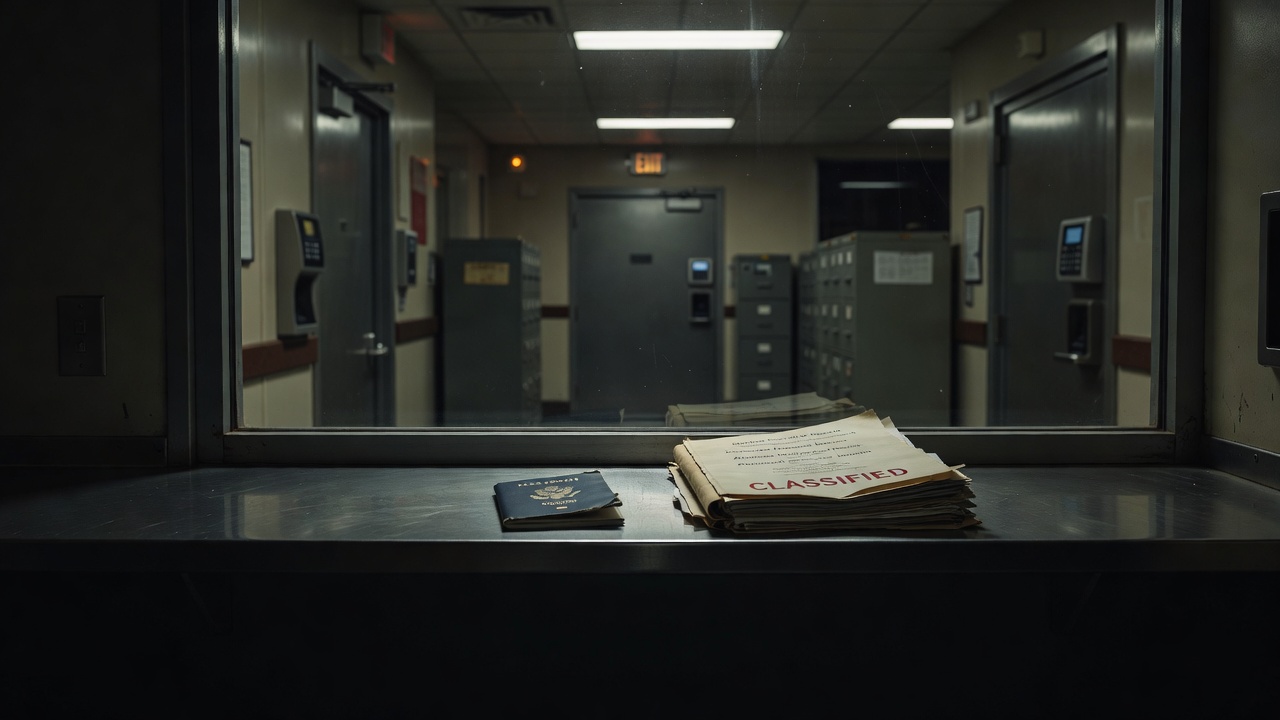
At the embassy window, the conversation can end before the real interrogation begins. A passport slides forward. A research plan follows. Aerospace. Advanced materials. Encryption. Maybe the applicant is just a graduate student chasing a future. Maybe, in the eyes of Washington, the applicant is a walking export risk. The officer says the case needs more review, and the file disappears into a system most people never hear about: a list of sensitive fields, a security advisory opinion, and a refusal that is not quite a denial.
The Case For
A quiet list with a very large shadow
The Technology Alert List is not folklore. It is documented policy. In the August 2002 State Department cable updating the TAL, the government said the list was being revised with “particular attention” to post-9/11 concerns and used to guide cases involving applicants suspected of seeking access to controlled technology or sensitive information. The same cable laid out critical fields that stretched across conventional munitions, nuclear technology, rockets, advanced materials, information security, robotics, sensors, and other dual-use domains. In plain English: if your work touched the wrong knowledge, your visa interview stopped being just an immigration matter.
That is where the darker reading begins. The list did not target contraband in a crate. It targeted proximity to knowledge. Public guidance reproducing State’s framework says officers should be alert when applicants plan graduate study, research, teaching, training, employment, or commercial activity in one of the listed technical fields.
How the list becomes a gate
According to the Government Accountability Office’s 2005 report on Visa Mantis, the most common security advisory opinion for science applicants was Visa Mantis. The trigger was explicit: a consular officer decided whether the applicant’s background or proposed activity could expose them to technologies on the Technology Alert List. If yes, the case generally moved into a temporary refusal under section 221(g) of the Immigration and Nationality Act while interagency review ran in Washington.
That mechanism matters because a 221(g) refusal sounds bureaucratic and temporary, but in practice it can function like an invisible wall. The same GAO report found that Mantis checks initiated in spring 2003 took an average of 67 days to process, and State had reported average processing times of 75 days in October 2003 before reforms brought them down. A semester can vanish in 67 days. A lab position can disappear. A project can move on without you. When the government says it is only pausing a visa, the applicant may experience something much closer to exclusion.
Critics saw more than delay. They saw a hidden perimeter around American science. If a government can quietly flag sensitive subjects, send applicants into a classified review channel, and hold them there with little explanation beyond “administrative processing,” it does not need to announce a blacklist. It can shape access through friction. That suspicion links naturally with our earlier reporting on Visa Mantis and the quiet tech-transfer gate and with the broader Government Secrets investigations.
The Realist’s Eye
The record supports a net — but not a hidden purge
Now the brakes. The strongest realist objection is that the public record shows a blunt, overburdened security screen more than a covert plot to lock the world out of American research. The GAO report that documented long delays also undercut the idea of a vast silent denial regime. It says only 2 to 3 percent of all nonimmigrant visa applications required any security advisory opinion in the first place. It also says less than 2 percent of Mantis requests ultimately resulted in visa denial. Most people caught in the machinery were eventually cleared.
That matters because bureaucratic drag and strategic exclusion are not the same thing. A student delayed for weeks may reasonably feel targeted. But the paper trail points to interagency backlog, inconsistent guidance, and consular confusion as much as deliberate suppression. GAO found that officers at major posts still needed more clarity on how to use the TAL because many did not have technical backgrounds and were unsure what the listed categories actually meant.
What 221(g) really means — and why it still feels sinister
The State Department’s administrative-processing guidance makes the ambiguity worse. A refusal under 221(g), it says, means the applicant did not establish eligibility to the satisfaction of the consular officer at that moment. The case may require more documents or more administrative processing, and if documents are requested the applicant has up to one year to respond. Officially, that is not a final denial. Functionally, it can still become a life-altering limbo.
The realist reading is that the TAL became frightening because it fused two legitimate state interests — export control and visa screening — into one opaque checkpoint. The government was not imagining dual-use risk out of thin air. The 2002 TAL update followed 9/11. The listed fields really do overlap with missile systems, encryption, biotechnology, and other areas with military relevance. At the same time, once a screening system starts treating advanced study itself as a possible pathway for diversion, the line between security policy and knowledge control gets thin fast.
And the story did not entirely end at the consular window. A 2016 ICE expenditure plan described a “Domestic Mantis Initiative” meant to identify students who entered the United States for nonsensitive study and later shifted into TAL-related sensitive fields. The document said SEVIS lacked an automated way to track those moves and estimated about 600 leads per semester for vetting. That does not prove a grand conspiracy. It does show institutional continuity.
What We Know For Certain
- The State Department updated the Technology Alert List in August 2002 with revisions tied to post-9/11 concerns.
- The TAL covers multiple scientific and technical fields that the U.S. government considers sensitive for export-control and national-security reasons.
- GAO reported in 2005 that consular officers use the TAL to decide when a Visa Mantis security advisory opinion is needed.
- GAO also reported that a Mantis review generally led to a temporary refusal under INA section 221(g) pending further administrative processing.
- DHS later proposed a Domestic Mantis Initiative to track students who changed from nonsensitive to TAL-related sensitive fields after entering the United States.
The Unanswered Questions
- How consistently did consular officers interpret broad TAL categories when many lacked technical expertise?
- How many applicants abandoned study, work, or research opportunities because of delays even when their visas were later approved?
- What criteria separated a routine TAL-related review from a case that escalated toward denial or deeper intelligence scrutiny?
- How much of the post-entry monitoring logic behind programs like Domestic Mantis ever became durable practice beyond pilot status?
The Closer — You Decide
Some systems do not need to hide in a black vault to feel clandestine. They only need enough acronyms, enough discretion, and enough delay to make the consequences visible while the mechanism stays blurred. The Technology Alert List is real. Visa Mantis is real. Section 221(g) limbo is real. So is the government’s argument that sensitive knowledge can move as dangerously as hardware. The documents are on the table. The tension is still there. Was this prudent screening, or a quiet way to build a border around science itself? You decide.