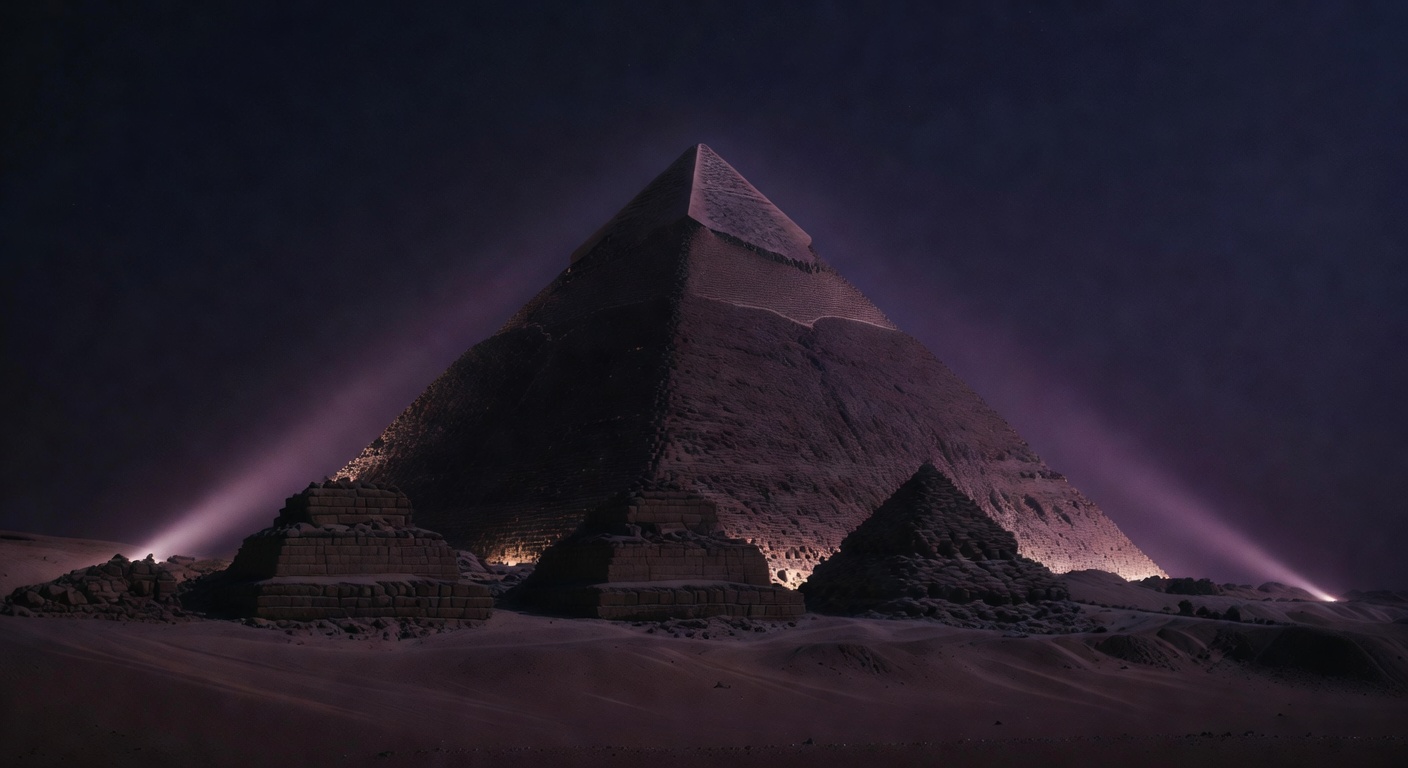
Imagine standing at the base of the Great Pyramid of Giza, that colossal triangle of stone piercing the desert sky. It’s not just a pile of rocks—it’s a geometric perfection that defies the sand-blasted passage of 4,500 years. You’ve heard the textbook story: tombs for god-kings, built by sweat and ramps. But what if that’s the cover story? What if these behemoths were humming power plants, tapping into Earth’s hidden energies to light up an ancient world we can barely comprehend? Buckle up, truth-seekers. We’re diving deep into the Pyramids of Giza, where history meets heresy, and the stones themselves might whisper forgotten secrets.
The Official Story: Tombs or Something More?
Let’s start with what they teach in school. The Pyramids of Giza—Khufu’s monster in the center, flanked by Khafre and Menkaure—rose during Egypt’s Fourth Dynasty, around 2580–2560 BCE. Khufu, the pharaoh credited with the Great one, supposedly marshaled 2.3 million limestone and granite blocks, each averaging 2.5 tons, into a 481-foot-tall marvel. It held the title of tallest man-made structure for 3,800 years. The narrative? These were eternal homes for pharaohs, stocked with treasures for the afterlife, aligned with stars to guide their souls.
But poke around, and cracks appear. No mummies were ever found inside the Great Pyramid. Zahi Hawass, Egypt’s former antiquities minister, admits the chambers are empty. Sarcophagi? Sure, but battered and lidless, like they were looted—or never used. And the precision? Base sides differ by mere inches over 13 acres. Corners align to true north within 3/60th of a degree. Ancient Egyptians with copper chisels? Pull the other one.
This is where the rabbit hole yawns open. What if the tomb tale is a smokescreen for something far more electric?
Architectural Enigmas: Built for Power, Not Pharaohs
Step inside the Great Pyramid, and the air thickens with mystery. Forget Indiana Jones tropes—the interior is a labyrinth of granite and limestone, engineered with surgical precision. The King’s Chamber, heart of the beast, sits 170 feet up, walled in massive Aswan granite blocks (sourced 500 miles away, some weighing 70 tons). Why granite? It’s piezoelectric—squeezed right, it generates electricity. Coincidence?
The Grand Gallery: Acoustic Amplifier or Energy Highway?
Ascend the Grand Gallery, a 28-foot-high corridor corbelled to support insane pressures. Its slots? Official line says chevron beams for roof support. Theorists like Christopher Dunn, in his book The Giza Power Plant, argue they held ceramic resonators or crystals, tuning the space like a giant organ pipe. Clap your hands here, and the echo resonates at specific frequencies—perfect for amplifying vibrations. Dunn, a 50-year manufacturing engineer, measured it: the gallery’s dimensions match harmonic series for sound waves. Not random tomb bling.
Below, the Queen’s Chamber with its corroded copper “handles” and star shafts piercing to the sky. Above, five “construction chambers” with interlocking beams—no mortar, no gaps. Pressure plates? Energy storage?
Celestial Lock-On: Stars as the Ultimate Grid
Now, the alignments. The pyramids mirror Orion’s Belt from 10,500 BCE, per Robert Bauval‘s Orion Correlation Theory. Shafts in the King’s Chamber point to Sirius and Orion—dog star and hunter god. Cardinal alignment? Dead-on, better than modern observatories. Why? Proponents say it synced with cosmic energies, like Telluric currents (Earth’s natural electric flows) peaking at solstices.
Engineer evidence: The pyramid’s slope angle encodes pi and phi ratios. Height times 43,200 (Earth’s precession cycle) equals polar radius. Base perimeter divided by twice the height? Pi to four decimals. Math whizzes without computers? Or encoded knowledge from… elsewhere?
The Power Plant Theory: Juice from the Earth
Enter the star of our show: the Giza Power Plant Theory, popularized by Dunn’s 1998 tome (check it out here). Picture this: subterranean aquifers under Giza churn hydrogen gas via chemical reactions. Pump it up shafts, mix with air in the Queen’s Chamber (those copper fittings as electrodes?). Ignite or resonate in the King’s Chamber, where granite sarcophagus acts as a maser—microwave amplification by stimulated emission of radiation. Output? Wireless power, beaming to obelisks or Dendera “light bulbs” (those reliefs looking suspiciously like filament lamps).
Chemical Brew: Hydrogen from the Depths
Giza sits on a massive aquifer. Dunn posits: limestone (calcium carbonate) + sulfuric acid from underground springs = hydrogen gas + water. Pipes in the subterranean chamber? Primed for flow. Evidence? Petrie found “scour marks” like hydrochloric acid etching—straight from 19th-century surveys by William Flinders Petrie.
Resonance and Microwave Magic
The pyramid’s shape focuses energy. Experiments show models concentrate electromagnetic waves at the apex. Granite’s quartz crystals? Piezoelectric powerhouses. Vibrate ’em with Earth’s Schumann resonance (7.83 Hz), and you get current. Russian pyramid research (ignored by mainstream) claims replicas boost plant growth and heal water—scalar energy?
Nikola Tesla obsessed over pyramids, modeling his Wardenclyffe Tower on them. Coincidence? He said: “The pyramids were the first power plants.”
Crushing the Skeptics: Evidence vs. Egyptology Dogma
Mainstream Egyptologists scoff: “No wires, no proof!” Fair, but absence of evidence isn’t evidence of absence. Mark Lehner‘s ramps? Can’t explain granite transport or precision. Carbon dating? Inconsistent—some blocks predate Khufu by centuries.
Internal clues: No hieroglyphs or treasures inside the Great Pyramid. Why build the world’s wonder as a dusty tomb? And the Inventory Stela (Cairo Museum) claims Khufu restored the pyramid of older god Khnum—admitting it’s pre-dynastic?
Geopolymer theory from Joseph Davidovits: Blocks weren’t cut, but cast like concrete from Nile sludge. Traces of natron and ash confirm it. Pourable power plant, anyone?
External power evidence: Baghdad Battery (200 BCE) proves ancients knew electricity. Dendera “bulbs”? Snake-like filaments in lotus “flowers,” supported by metal clamps. Underground tunnels at Giza? Sealed shafts with mercury traces—alchemical conductors?
Ancient Aliens or Lost Civilians? The Bigger Picture
Atlantis? Edgar Cayce foresaw records under the Sphinx from 10,000 BCE. Scans show voids there—Hawass dismisses, but won’t excavate. Graham Hancock links Giza to a 12,800-year-old cataclysm, pyramids as survivors’ tech.
Cosmic angle: Pyramid power aligns with ley lines, global energy grid. Stonehenge, Teotihuacan—same playbook?
Echoes in Modern Tech: Pyramids Today
Pyramid-shaped antennas focus signals. Russians built 450-foot replicas—claims of earthquake deflection, crop boosts. FBI docs from the 1970s tested pyramid energy on razors (they didn’t rust). Fringe? Or suppressed?
Down the Rabbit Hole
- Sphinx Water Erosion: Did Robert Schoch prove it’s 12,000 years old, predating Egypt?
- Dendera Light Bulbs: Ancient Egyptian fluorescents or religious art?
- Orion Correlation: Bauval’s star map linking Giza to 10,500 BCE skies.
- Atlantis in Antarctica: Hancock’s frozen tech under ice—Giza as outpost?
- Baghdad Battery: Proof of ancient electricity worldwide?
We’ve journeyed from sun-baked stones to humming generators, challenging the dustiest dogmas. The Pyramids of Giza aren’t just relics—they’re riddles screaming for reappraisal. Were they power plants fueling a golden age? The evidence piles higher than the stones themselves. Keep questioning, keep digging. The truth hides in plain sight.
Disclaimer: This article explores alternative theories for entertainment and discussion. It’s not endorsed as historical fact—consult primary sources and experts for balanced views.