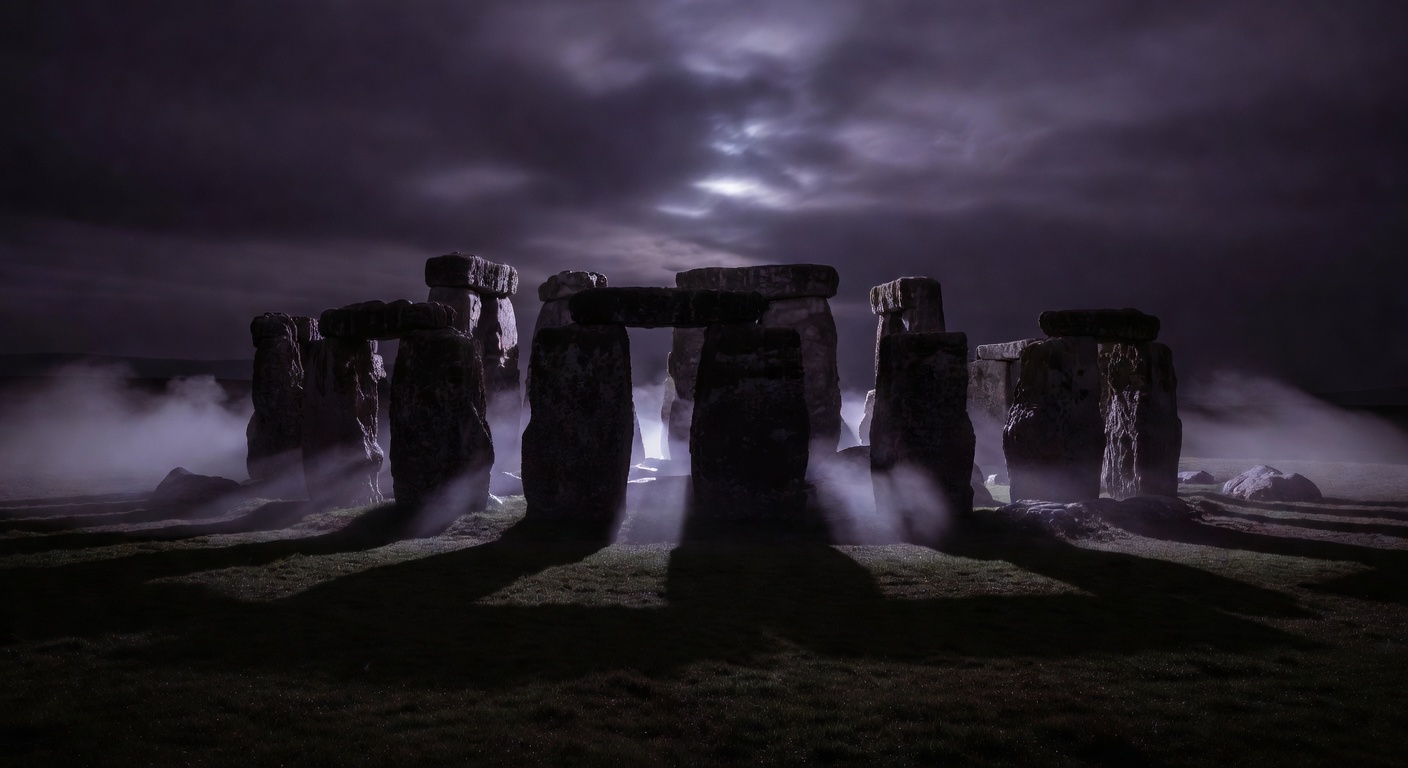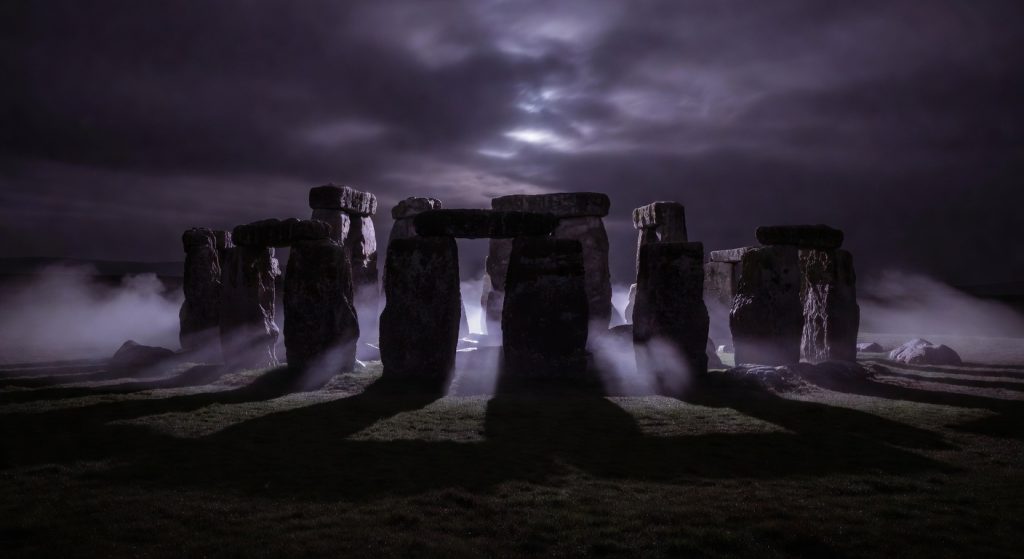
Imagine standing on the misty Salisbury Plain at dawn, the summer solstice sun cresting the horizon like a fiery eye, perfectly framed by Stonehenge‘s colossal upright stones. Your heart races as shadows shift, revealing alignments that no primitive tribe could possibly master. This isn’t just a pile of rocks—it’s a 5,000-year-old enigma staring back at you, whispering questions that have haunted humanity for millennia. Who built it? Why? And how, with Stone Age tools, did they haul 50-ton behemoths across impossible distances? Buckle up, truth-seekers, because we’re about to peel back the layers of official history and plunge into the rabbit hole of Stonehenge‘s forbidden truths.
The Dawn of a Megalithic Enigma
Let’s set the scene properly. Stonehenge, that iconic ring of weathered giants on England’s windswept Wiltshire plains, wasn’t slapped together overnight. Construction unfolded in phases over 1,500 years, from around 3000 BCE to 1500 BCE, bridging the Neolithic and Bronze Ages. This was a time when Europe was awakening from hunter-gatherer nomadism, embracing farming, and forging the first glimmerings of civilization. But here’s where it gets juicy: the builders weren’t cavemen grunting over sticks. They were part of a megalithic culture that spanned continents, erecting monuments from Ireland’s Newgrange to Malta’s temples, all synced to the stars.
Archaeologists, those gatekeepers of the narrative, tell us it started with a circular ditch and bank—think henge, from the Old English for “hanging stones.” By 2500 BCE, the real showstoppers arrived: the sarsen stones, massive sandstone slabs averaging 13 feet high and up to 50 tons each. Sourced from Marlborough Downs 20 miles north, they were dragged, shaped, and erected into a 100-foot-diameter horseshoe and circle. Then came the bluestones, smaller but no less mind-boggling—4-ton pillars quarried in Wales‘s Preseli Hills, 140-200 miles away. How? Roll them on logs? Float them on rafts? The official story strains credulity, especially when you factor in the precision: lintels dovetailed like Lego bricks, mortise-and-tenon joints predating Iron Age tech by centuries.
Eyewitness accounts from the era? None, obviously. But carbon dating and stratigraphy paint a picture of ritual feasts, with pig bones from as far as Scotland suggesting massive gatherings. Pig DNA analysis, published in a 2019 Antiquity journal study, confirms animals were herded hundreds of miles—evidence of a pilgrimage superhighway. Yet, for all this “evidence,” the how and why remain shadows in the fog.
Architectural Marvels That Defy Explanation
Walk the monument today, and the scale hits like a freight train. The outer sarsen circle boasts 30 stones (17 surviving upright), topped by 30 lintels forming a continuous ring. Inside, the horseshoe of five trilithons—two uprights capped by a lintel—peaks at the 50-ton “Great Trilithon.” At the heart lies the Altar Stone, a 6-ton greenstone slab from Scotland or Wales, fallen but central. And those bluestones? Arranged in twin arcs, some weighing 2 tons, others mere 1-ton “rhyolites.”
Precision is the kicker. Stones are dressed to within half an inch accuracy, axes and stone hammers leaving microscopic tool marks verified by electron microscopy. The Heel Stone, outside the circle, aligns with the midsummer sunrise—as does the avenue leading to the river Avon. Winter solstice sunset? Framed by the Great Trilithon. Lunar standstills? Check. Eclipses? Some alignments suggest predictive power.
But dig deeper: excavations reveal antler picks for the ditch, yet no wheels, no metals until late phases. A 2020 geophysical survey by English Heritage uncovered buried stones forming a crescent around the site—part of a larger complex? And underground? Ground-penetrating radar hints at shafts and enclosures, echoing Woodhenge nearby. This isn’t amateur hour; it’s engineering that rivals the pyramids.
Mainstream Theories: The Sanitized Story
Historians love tidy boxes. Gerald Hawkins, in his 1965 book Stonehenge Decoded, crunched the numbers: over 200 astronomical alignments, dubbing it a Neolithic computer for eclipses. Farmers tracking solstices for planting? Makes sense for an agrarian shift. Mike Parker Pearson‘s “domain of the dead” theory posits cremation cemetery—56 Aubrey Holes held human ashes from across Britain. Ceremonial hub for elites? Feasts fed thousands, per bone isotope analysis.
Religious site? Druids get romanticized (thanks, 18th-century romantics), but they arrived 2,000 years post-construction. Healing center? Bluestones’ “magnetic” properties (debunked) or folklore of miraculous cures fuel this. Yet, no artifacts scream “temple”—no idols, altars beyond the stone, just abstract power.
These tales soothe academia, backed by digs like Timothy Darvill‘s 2008 bluestone quarry work. But they dodge the elephants: How did 4,000-year-BCE Brits master logistics equaling Egypt’s Giza project? Why abandon it by 1500 BCE?
Down the Rabbit Hole: Forbidden Theories
Now, the fun stuff. What if the textbook version is a cover-up? Let’s crank the dial to 11.
Ancient High Tech or Lost Civilization?
Graham Hancock, in Fingerprints of the Gods (1995), argues Stonehenge echoes a pre-Ice Age civilization, survivors of a cataclysm 12,000 years ago. Bluestones? Transported when sea levels were lower, via land bridges. Alignments match Gobekli Tepe in Turkey—13,000 BCE, proving advanced antediluvians. Evidence? Erosion patterns on sarsens suggest water weathering predating official dates, per geologist Robert Schoch‘s similar Sphinx claims.
Atlantis link? Plato’s tales describe circular temples; Ignatius Donnelly (1882) pegged Stonehenge as Atlantean outpost. Welsh bluestones vibrate at ultrasonic frequencies—lab tests show resonance at 110 Hz, inducing altered states. Coincidence for shamans, or acoustic tech for levitation? John Keely‘s 19th-century experiments echoed this; modern acoustic levitation lifts small objects—scale it up?
Alien Architects and Energy Grids
UFOlogists salivate. Erich von Däniken (Chariots of the Gods, 1968) calls it extraterrestrial runway or beacon. Precision tolerances beat Roman aqueducts; MIT experiments show replica stones need cranes moderns struggle with. Ley lines? Alfred Watkins mapped energy grids; Stonehenge sits on the St. Michael line, intersecting Glastonbury and Avebury. Dowsers detect anomalies; geomagnetic surveys confirm flux.
ET power plant? Bluestones as piezoelectric generators—quartz crystals under pressure produce electricity. Russian pyramid research shows similar effects; Stonehenge‘s layout mimics a capacitor? Nazi occultists like Himmler‘s Ahnenerbe obsessed over it, believing Aryan star gates.
Elite Blood Rituals and Suppression
Darkest twist: sacrificial hub for ancient elites. Aubrey Holes held skulls with blunt trauma; child burials nearby scream ritual. Modern parallel? Bohemian Grove pagentry. Theories tie it to Freemasons—Sir Christopher Wren surveyed it; symbols match lodge rituals. Hidden knowledge? Churchill classified WWII radar tests there, fearing “ancient forces.”
Carbon dating fraud? Colin Wilson alleged manipulated samples to fit Darwinian timelines, suppressing older dates (12,000 BCE possibles from early tests). Global elite cover-up to deny human potential?
The Mounting Evidence Stack
Let’s get evidence-forward. Radiocarbon from cremains dates phases precisely: ditch 3100 BCE, sarsens 2500 BCE. Strontium isotopes in bluestone tools trace Welsh origins—read the 2019 Science Advances paper here. Pig fat residues confirm long-distance trade. But anomalies abound: bluestones predating sarsens by centuries—rearranged? Z holes (unfinished) suggest failed expansions.
Recent digs: Durrington Walls, 2 miles away, housed 4,000 builders—feast debris galore. Yet no quarries nearby for practice; they nailed it first try. Math whiz Alexander Thom surveyed 300 UK sites: megalithic yard unit, eclipse predictors. Stats don’t lie—random chance? 1 in a million.
Comparative: Easter Island moai (50 tons) walked with ropes; but Stonehenge‘s 200-mile trek? Polynesian rafts capsized at 10 tons. Egyptian obelisks used lubricated sleds—but no evidence here.
Why It Matters Today
Stonehenge isn’t dusty trivia; it’s a mirror to our hubris. If ancients did this sans cranes, what else did we miss? It challenges evolution’s slow grind, hints at forgotten golden ages. Modern replicas fail—History Channel‘s 2014 attempt used 200 people and machinery. Solstice crowds (30,000 yearly) feel the pull—energy spikes on EEGs?
Governments restrict access; English Heritage charges £20 entry, drones banned. Why hide? Perhaps the alignments predict cycles we ignore—pole shifts, solar micronovas per Suspicious0bservers.
Conclusion: The Stones Still Speak
As the sun dips behind the Heel Stone, Stonehenge endures, mocking our certainties. Was it observatory, temple, or star portal? The evidence tilts toward something profound—lost tech, cosmic attunement, or elite rite—that officialdom sanitizes. But you decide. Visit, feel the hum, question everything. The builders left no manual; they trusted we’d decode it. Time to listen.
Down the Rabbit Hole
1. Pyramids of Giza: Precision Beyond Pharaohs – Mirror Stonehenge‘s math to Egypt’s apex—same lost civilization?
2. Gobekli Tepe: Rewriting Human History – 12,000 BCE temple trumps Stonehenge; Ice Age engineers unite?
3. Ley Lines and Earth’s Energy Grid – Stonehenge as node in global network—UFO hotspots mapped.
4. Atlantis Unearthed: Plato’s Proofs – Bluestone voyages trace sunken empire highways.
5. Modern Megaliths: HAARP and Elite Rituals – Today’s power plants echo ancient ones?
Disclaimer: This article explores historical theories and alternative perspectives for entertainment and discussion. It is not endorsed as factual by ConspiracyRealist.com; always cross-reference with primary sources.