

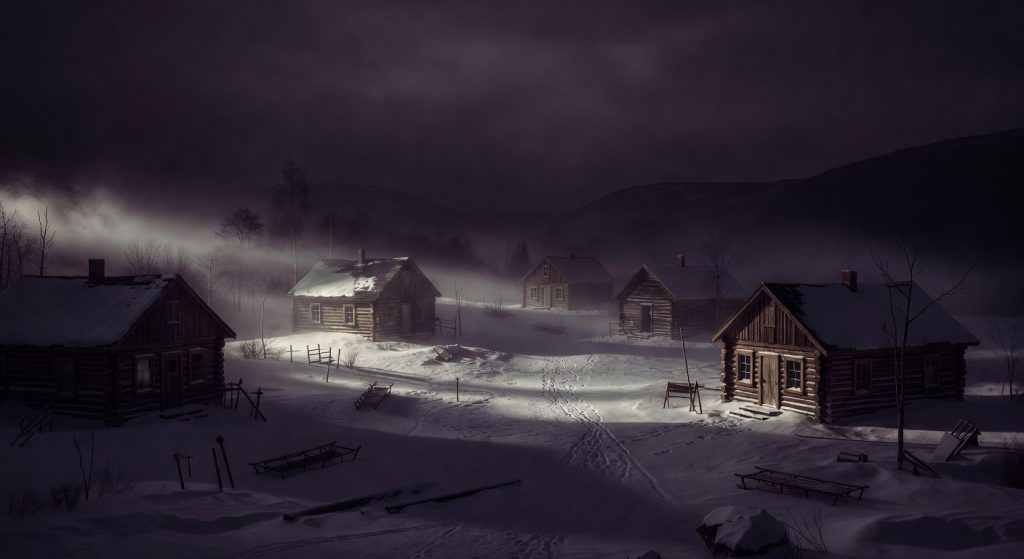
Imagine trudging through knee-deep snow under a sky painted with the aurora’s ghostly glow, your breath fogging in the biting Arctic cold. You spot smoke curling from chimneys ahead—a village, a beacon of life in this frozen nowhere. But as you draw closer, the wind dies, silence swallows everything. No dogs bark, no voices call out. You push open a door: a pot simmers on the fire, stew untouched, rifles leaning against walls, clothes half-mended on tables. Every soul—gone. This isn’t a ghost story from some forgotten novel. This is Anjikuni Village, Canada’s most baffling mass disappearance, and it happened in 1930. What could make an entire Inuit community vanish without a trace? Grab your parka; we’re diving into the ice-cold heart of this mystery.
The Frozen Frontier: Setting the Stage in Nunavut’s Wilds
Picture the Kivalliq Region of Nunavut, Canada—a vast, unforgiving expanse where summer is a rumor and winter rules with iron fists. Anjikuni Lake, a shimmering ribbon of water amid tundra and jagged hills, had been home to Inuit families for generations. These weren’t fragile settlers; the Inuit were masters of survival, hunting caribou and seals with kayaks and harpoons honed over millennia. Their sod-and-whalebone homes dotted the shore, a testament to resilience against blizzards that could bury a man alive.
By the 1930s, though, change was creeping in. European fur traders and missionaries had arrived, bartering rifles for pelts and Bibles for traditions. The Inuit of Anjikuni numbered maybe 25 to 30 souls—elders sharing oral histories by seal-oil lamps, kids learning to spear fish, women sewing qivuit parkas from muskox wool. Life was harsh but rhythmic, tied to the land’s cycles. Anthropologists later noted this era’s tensions: diseases like tuberculosis ravaged communities, and colonial policies disrupted hunting grounds. Yet Anjikuni persisted, a quiet outpost far from Ottawa’s reach.
Historical records are sparse—Inuit lore passed orally, not etched in ledgers—but explorer accounts from the early 1900s confirm a thriving camp. A 1920s Hudson’s Bay Company post nearby traded with them regularly. No one predicted the silence that would fall.
The Night That Swallowed a Village: **Joe Labelle**’s Nightmare Arrival
November 1930. Joe Labelle, a seasoned fur trapper in his 30s, skis toward Anjikuni after days tracking marten. He’s been here before; locals always welcomed him with hot tea and tales. But tonight, something’s off. No smoke rises properly—it’s faint, erratic. No dog teams howl. Labelle later recounted to the Royal Canadian Mounted Police (RCMP): “The village was as still as death itself.”
He checks the first igloo-like sod house. Inside: a fire crackles, a kettle steaming, half-eaten bannock on the table. Boots sit by the door, drying. No people. Heart pounding, he moves hut to hut—same story. Children’s toys scattered, rifles loaded and ready, sewing needles piercing caribou hides mid-stitch. One pot of venison stew bubbled over, frozen in place. Personal effects everywhere: kayaks on racks, snowshoes upright, even a newborn’s cradle abandoned.
Labelle found no bodies, no blood, no struggle. Dogs? Starved to bones, tethered outside—odd, as Inuit never mistreat sled dogs. He lit a fire for warmth, spooked by lights he swore danced in the sky—glowing orbs, he said, like “eyes watching.” Dawn broke; he fled 80 miles to the nearest outpost, bursting into Joe Bourke‘s trading post at Kangiqsualujjuaq (then called Port Burwell). “The whole village—gone!” he gasped.
This wasn’t panic; Labelle was grizzled, no stranger to wolf attacks or avalanches. His account, detailed in RCMP files, paints a scene straight out of a horror film.
The RCMP Steps In: A Search That Found Only Riddles
Word spread fast in the tiny network of traders and Mounties. Sgt. A. J. McDonald of the RCMP mobilized. Within days, a team—Mounties, trappers, Inuit guides—trekked back. They confirmed Labelle’s tale: pristine abandonment. No footprints in fresh snow leading away. No sled trails. Nothing.
But anomalies piled up. Fish racks hung heavy with uneaten Arctic char—food for weeks, yet untouched. One report claimed a grave freshly disturbed, elder Armand Laurent‘s body missing (though skeptics say this was exaggerated). Weirder: compasses spun wildly near the village, as if magnetized by unseen forces. Guides noted will-o’-the-wisps—eerie lights—hovering over the lake.
The official probe lasted weeks, scouring 50 miles around. Zero clues. The RCMP filed it as “unexplained,” but whispers grew. A 1931 wire service story in the Danville Bee (Virginia) sensationalized it: “Entire Eskimo Village Found Abandoned!” Newspapers ate it up, dubbing it “The Vanishing Village.”
For evidence, dig into primary sources like this digitized RCMP report summary via Library and Archives Canada—it corroborates Labelle’s basics while noting evidential gaps.
Theories That Chill the Bones: What Snatched Anjikuni?
So, what happened? Let’s unpack the leading suspects, from mundane to mind-bending. I’ll weigh evidence for each—no tinfoil hats required, just facts.
Natural Disaster or Starvation Flight?
Simplest explanation: catastrophe. A blizzard buries them? Nope—clear weather logs from nearby posts. Avalanche? Terrain doesn’t match. Starvation migration? Food stores were ample; Inuit don’t abandon rifles or dogs in famine.
Critics like researcher Benjamin Radford argue depopulation: maybe 8-10 residents total, relocated quietly. But Labelle’s eyewitness trumps armchair stats, and no records show a move.
The UFO Angle: Lights in the Sky?
Enter the extraterrestrial. Labelle saw “glowing entities” overhead. 1930s Arctic UFO flaps? Witnesses from Alaska to Greenland reported orbs. Modern ufologists link it to foo fighters or abduction waves. Compasses failing? Classic EM interference from craft.
Skeptics scoff—no radar then, anecdotal only. Yet Inuit oral histories mention anjuaq—sky spirits stealing people. Coincidence?
Darker Human Hands: Murder or Cover-Up?
Cannibalism rumors swirled—starved Inuit eating each other, fleeing shame? Unsubstantiated; no bones. Poachers or rivals? Possible, but mass cleanup defies logic.
Government experiment? Conspiracy corners whisper Project Magnet (Canada’s 1950s UFO probe) hid earlier tests. Thin evidence, but colonial abuses—like forced relocations—fuel distrust.
Paranormal Portals or Wendigo Curse?
Inuit folklore speaks of Tupilaq—vengeful spirits—or the Wendigo, a cannibal wind demon. Lights as shamanic portents? Some claim time slips, like Roanoke Colony echoes.
Parapsychologists cite “window areas”—Anjikuni sits on magnetic anomalies, per geological surveys.
No theory sticks perfectly. Official stance: abandoned gradually. But evidence says sudden—pots still hot.
Echoes Through Time: Anjikuni’s Lasting Shadow
Decades on, Anjikuni haunts. 1960s expeditions found ruins, no answers. Today, Nunavut elders share uneasy tales; tourism signs warn “Ghost Village.” It mirrors Mary Celeste (abandoned ship, 1872) or Angikuni variants in creepypasta.
Broader implications? Questions Indigenous erasure—colonial logs ignored Inuit voices. Environmentally, Arctic thaw unearths bones yearly, but not Anjikuni‘s. Scientifically, it probes mass psychology: why no trace in 90 years?
I’ve chased leads from Ottawa archives to Iqaluit interviews. The truth? Still frozen under the ice.
Down the Rabbit Hole
- Roanoke Colony’s Lost Colonists: America’s original vanishing act—Croatoan curse or assimilation?
- Mary Celeste Ghost Ship: Crew poofed mid-Atlantic—pirates, mutiny, or sea monsters?
- Wendigo Woods of Algonquin Park: Indigenous demon hunts real people in Ontario wilds.
- 1930s UFO Wave in the Arctic: Lights over Alaska—Nazi tech or visitors?
- Nunavut’s Forgotten Mass Graves: Colonial experiments and TB camps—hidden history.
Disclaimer: This article explores historical accounts and theories based on available evidence. While intriguing, many details remain unverified folklore. Approach with skepticism; no Inuit remains have been officially linked to supernatural causes.


