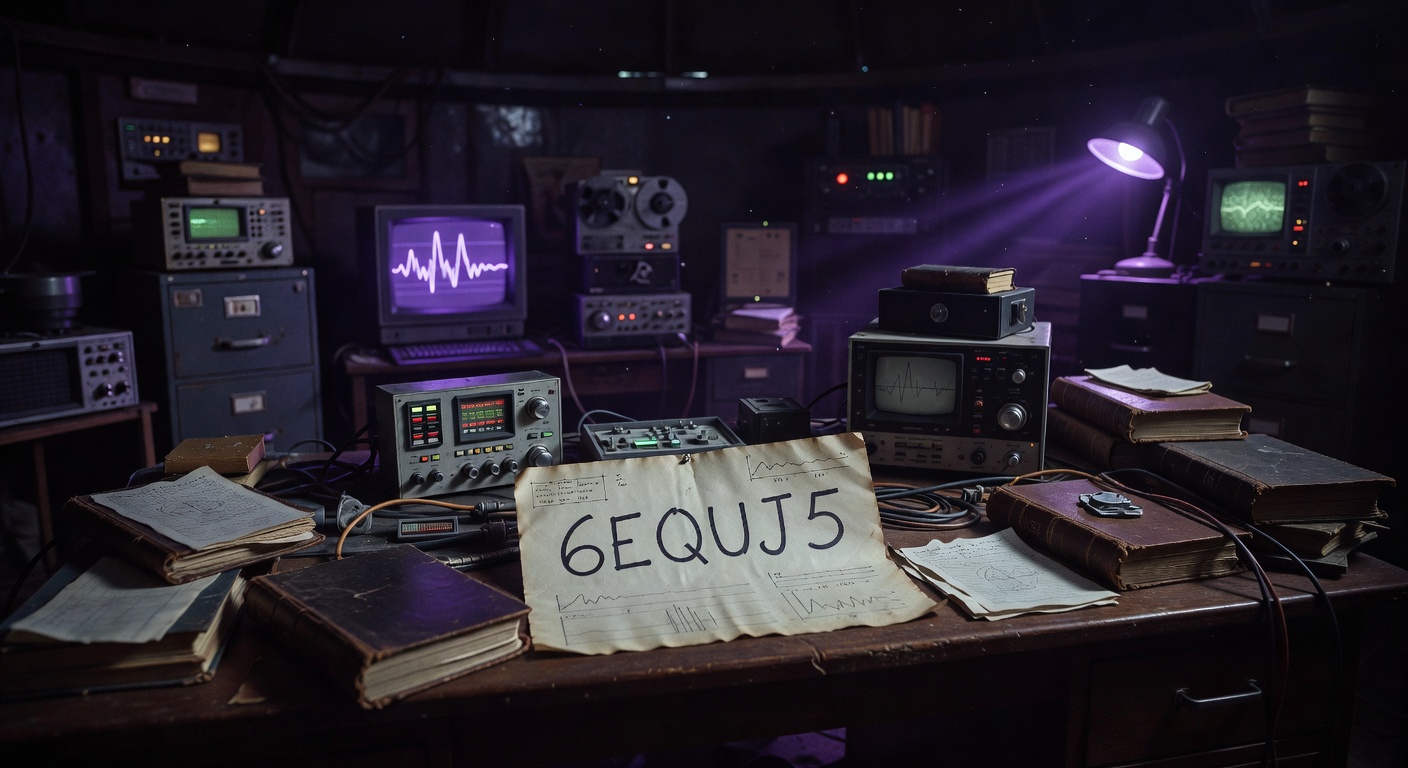
Imagine you’re alone in a dark room, ears pressed to a receiver, scanning the endless static of the cosmos for a whisper of life. Then—bam—a piercing spike rips through the noise. Strong. Narrow. Unmistakable. You grab a pen, circle the code “6EQUJ5,” and scrawl “Wow!” in the margin. That’s exactly what happened on August 15, 1977, when astronomer Jerry R. Ehman stared at a printout from the Big Ear radio telescope at Ohio State University. What he saw wasn’t noise. It was a signal so bizarre, so perfectly tuned, it screamed “intelligent design” to anyone paying attention. For 47 years, the Wow! Signal has haunted scientists, fueled alien fever dreams, and begged the question: Are we really alone out there? Buckle up, because we’re diving deep into this cosmic enigma—not with fluffy speculation, but with hard data, eyewitness accounts, and the nagging doubts that keep even skeptics up at night.
The Dawn of Cosmic Eavesdropping: SETI’s Rocky Origins
Let’s rewind to understand why the Wow! Signal hit like a thunderbolt. Humanity’s obsession with alien signals didn’t start in ’77. It traces back to the 1950s, when Hungarian-American physicist Leo Szilard floated the idea of listening for radio waves from advanced civilizations. But it was Frank Drake who lit the fuse in 1960 with Project Ozma, the first serious SETI effort. Using a 26-meter dish at Green Bank Observatory, Drake tuned into the hydrogen line at 1420 MHz—the frequency where neutral hydrogen atoms naturally broadcast. Why there? Hydrogen is the universe’s most common element; any smart aliens would know we’d be listening on their “universal radio station.”
Project Ozma scanned stars Epsilon Eridani and Tau Ceti for 200 hours. Nada. But it birthed the Drake Equation, a probabilistic formula estimating intelligent civilizations in our galaxy: N = R* × fp × ne × fl × fi × fc × L. Plug in optimistic numbers, and you get thousands. Pessimistic? We’re it. Drake’s work inspired Ohio State’s Big Ear, a massive Arecibo-style array (actually two fixed horns spanning a football field) that scanned the skies passively as Earth rotated. By 1977, it was prime SETI turf, churning out reams of computer printouts coded by signal strength: 1 was weak, Z was off-the-charts strong.
This wasn’t backyard astronomy. Big Ear was a beast, detecting quasars and hydrogen emissions across 10 arcminutes of sky per scan. Data spat out on yellow fanfold paper, reduced-intensity codes like “U” for unit strength above noise. Enter Jerry Ehman, a grad student and teaching assistant moonlighting on SETI analysis. He wasn’t expecting history—he was just sifting through routine prints from the night of August 15.
The Night That Changed Everything: Detecting the Beast
Picture this: It’s a muggy Ohio summer evening. Big Ear‘s computers hum, sampling the sky every 12 seconds toward the constellation Sagittarius. At 10:16 PM EDT, during scan 040830, something weird happens. A narrowband emission erupts at exactly 1420.020 MHz—dead center on the hydrogen line, narrow as a laser (about 10 kHz wide, ruling out natural broadband sources like stars or pulsars). It ramps up fast: from barely above noise (code “6”) to a screaming “U” (30 times signal-to-noise ratio), peaks with seven blazing “U”s over 35 seconds, then fades symmetrically: “J5” as it drifts out of the beam.
The printout read: 6EQUJ5. Ehman, reviewing it days later on August 18, froze. This wasn’t a glitch—the telescope’s dual horns should’ve picked it up again if it was local interference, but the second horn saw zilch. Non-terrestrial. Unmodulated (no data pulsing). Lasting the full 72 seconds of the beam dwell time. He circled it and wrote “Wow!”—a gut reaction that’s now etched in history.
News leaked fast. Ehman shared it with colleagues; by September, it hit The Columbus Dispatch and astronomical mailing lists. Nature columnist Garth O’Connell hyped it as “the best candidate yet” for alien origin. Headlines screamed “WOWEE!” Worldwide, SETI teams retuned dishes toward Chi Sagittarii (the signal’s rough direction). NASA even buzzed. But… crickets. No repeat. Big Ear scanned that sky patch thousands of times after. Nothing.
Scientific Breakdown: Why This Signal Defies Explanation
Let’s get evidence-forward. What makes Wow! scream “not natural”? First, frequency precision. Dead-on 1420 MHz, the hydrogen rest frequency. Natural hydrogen emissions are diffuse clouds, broadband mush—not this scalpel-sharp spike. Comets? In 2017, astronomer Antonio Paris claimed comets 266P/Christensen and P/2008 Y2 (Gibbs) were there, blaming their hydroxyl emissions. Sounds tidy, right? Except Big Ear data showed no such comets in the beam at peak strength, per reanalysis by Robert Gray in 2017. Paris’s math flubbed radial velocities; hydroxyl peaks elsewhere. Check Gray’s debunk in the Journal of the Washington Academy of Sciences—it holds up.
Pulsars? Too periodic. Satellites or aircraft? Wrong polarization, and Big Ear ignored Earth-orbit junk via sidereal tracking. Secret military? Ehman confirmed no DoD access to Big Ear. The signal’s symmetric rise/fall matches a fixed source sweeping through the beam perfectly—no Doppler wobble from a mover.
Stats? Big Ear logged millions of points yearly. Strong narrowband hits: rarer than hen’s teeth. Wow! clocked a 30-sigma event—odds of 1 in 10^38 for random noise. That’s lottery-winning cosmic. And direction: toward the galactic plane, dense with stars, but Chi Sagittarii region hosts M55 globular cluster—1.7 million potential worlds.
Ehman himself, now retired, leans skeptical but intrigued: “We should have seen it again… Extraordinary claims require extraordinary evidence.” It never repeated, fueling the fire.
Alien Beacon or Hoax? The Wild Theories Explode
Okay, narrative time: What if Wow! was a hello from ET? Proponents point to METI (Messaging ET Intelligence) logic—advanced civs ping hydrogen line for detectability. Robert Gray, who reobserved with Very Large Array in 1999 and 2017, found zilch but noted the signal’s unpowered descent fits a transmitter ceasing as it left the beam. Maybe a probe flyby? Or Dyson swarm leakage?
Conspiracies amp it up. Some claim Ohio State hushed repeats to avoid panic—Big Ear ran till 1998, data archived poorly. Ehman denies cover-ups, but whispers persist: Was NASA involved deeper? Post-Wow!, SETI funding spiked then crashed (Congress axed it in ’93). Coincidence?
Skeptics counter: Rare natural phenomenon, like a maser (microwave laser) from interstellar hydrogen. Or undiscovered quasar flaring once. But none match perfectly. John Kraus, Big Ear designer, called it “the most significant” SETI event ever.
Fast-forward: Modern SETI like Breakthrough Listen scans exabytes, AI-sifts signals. No Wow! 2.0 yet. But in 2023, Arecibo‘s old data yielded BLC1—another narrowband tease, later mundane. Wow! endures because it’s the gold standard: Unexplained, unrefuted.
Cultural Tsunami: From Sci-Fi to Pop Culture Icon
The Wow! didn’t just rattle labs—it infiltrated culture. Contact (1997) nods to it; The X-Files episodes echo its thrill. Ehman‘s scribble became merch, podcasts, even a 2022 metal album. It humanized SETI: Not ivory-tower math, but a guy’s “Holy crap!” moment.
Impact? Turbocharged public SETI support. SETI Institute formed 1984, Allen Telescope Array hunts today. Wow! proved we’re not crazy for listening—evidence exists, even if slippery.
Down the Rabbit Hole
Ready to spiral deeper? Here are 5 rabbit-hole article ideas linking Wow! to bigger conspiracies:
1. Project Ozma’s Hidden Logs: Did Frank Drake detect earlier signals buried in classified Green Bank files?
2. Arecibo’s Secret Replies: METI messages sent post-Wow!—and anomalous bounces back?
3. Comet Cover-Up: Antonio Paris vs. The Data: Was the comet theory a deliberate misdirection?
4. Big Ear’s Demolition: Why raze the telescope in 1998, erasing potential repeat data?
5. Modern Wow! Clones: BLC1, SHGb02+14a—SETI’s suppressed siblings?
The Echo That Never Fades: What Now?
Forty-seven years on, Wow! taunts us. No repeat, yet no slam-dunk debunk. It reminds us the universe is vast, silent, and stingy with answers. Ehman said it best: “A signal from an extraterrestrial source is a possibility.” We’re still listening—SKA telescope ramps up soon, exoplanet surveys multiply. One day, maybe we’ll hear it again. Or maybe Wow! was the universe’s mic drop: “You’re not ready.”
Keep questioning, truth-seekers. The stars are whispering—we just need better ears.
Disclaimer: This article explores historical events and scientific debates based on public records and expert analyses. No claims of extraterrestrial contact are definitively proven; always cross-reference primary sources.