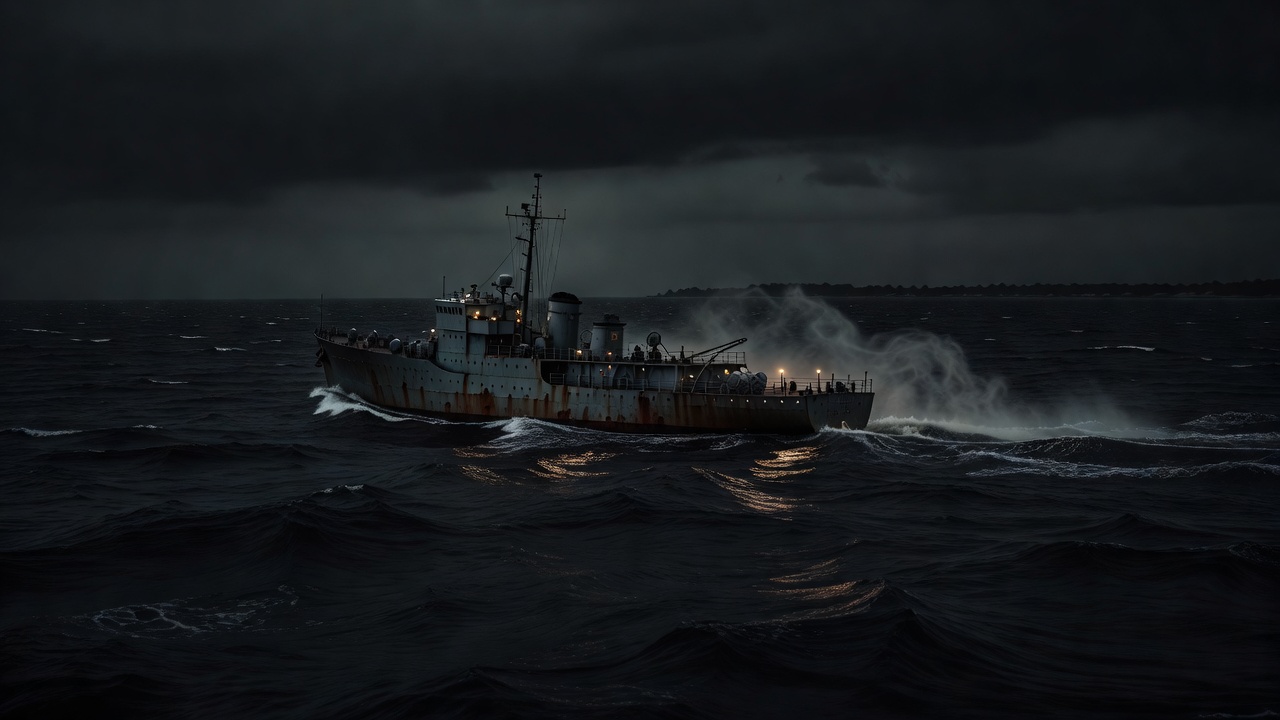
Just before dawn, a Navy minesweeper moved along the Atlantic edge of the American South, not hunting enemy metal in the water but helping map an invisible threat in the air. The ship was USS Tercel. Offshore, it became a release platform in a Cold War experiment called Operation Dew. On paper, the mission was technical: study how an aerosol cloud traveled from sea to land. In practice, it raised a darker possibility. If one small warship could help spread a tracer across populated coastline, what exactly had the military learned about how a biological attack might move over American cities before the public even knew the test existed?
The Case For
Tercel was more than background scenery
The documentary backbone of this story is sturdier than many Cold War rumors. The Naval History and Heritage Command’s official ship history places USS Tercel back on East Coast duty on February 6, 1952, after a Mediterranean deployment, which matches the timing of Operation Dew I’s spring 1952 test window. The same historical record shows the ship remained in routine Atlantic operations until another Mediterranean deployment began on April 21, 1953. That matters because the public record of the operation places Dew I between March 26 and April 21, 1952—exactly the slice of time when Tercel was available and active along the coast.
The National Research Council’s 1997 assessment of the Army’s zinc cadmium sulfide dispersion tests ties Operation Dew to a much larger military effort to understand aerosol spread. In summaries drawn from Army documents, Dew I involved five separate trials intended to see whether a large offshore cloud could be maintained long enough to drift inland and achieve broad area coverage. The figures attached to the program are not small. Public summaries of the record describe release lines roughly 100 to 150 nautical miles long, about 5 to 10 nautical miles off the coasts of Georgia and the Carolinas, with some runs affecting more than 60,000 square miles of populated coastal region.
That is where Tercel becomes central. The same body of reporting identifies the minesweeper as the Dew I release platform. In plain English, a U.S. Navy vessel helped disperse tracer material in tests designed to model how an aerosolized biological agent might move from offshore toward civilian landfall. It is difficult to call that incidental. A ship is not just transportation in that scenario. It is the hinge between military theory and field execution.
The pattern deepens when Dew II enters the frame. A FOIA-released 1957 Army Biological Labs memorandum, Relationship Between Times of Arrival of Cloud, Peak Recovery and Cessation for Operation Dew II, analyzed how the aerosol cloud behaved over time. The memo argued that Dew II timing relationships resembled radiological fallout patterns and recommended applying similar analysis to Operation LAC. That connects Dew to a broader Cold War lineage of dispersion modeling, not an isolated curiosity. Read beside our Operation Dew deep dive and the Government Secrets investigations archive, the Tercel chapter looks like operational proof that planners were moving from theory to deployment rehearsal.
The Realist’s Eye
The ship’s role is documented, but the intent still needs careful handling
This is where realism has to slow the adrenaline down. Operation Dew does not prove that the Navy was deliberately poisoning civilians or that Tercel was a covert strike ship loaded with live pathogens. The public record shows a release platform used in tracer tests. That distinction matters.
It also matters that many operational details survive through later summaries and a FOIA-released technical memo rather than a full run of contemporaneous field records. The Dew II memorandum is real and valuable, but it is analytical rather than narrative. It shows how Army scientists thought about cloud arrival, peak recovery, and cessation. It does not give us a scene-by-scene shipboard log of every release decision aboard Tercel.
There is also a command-structure problem. Operation Dew is usually discussed as an Army Chemical Corps effort. Tercel was a Navy vessel. That makes interservice cooperation obvious, but not necessarily sinister by itself. In the early Cold War, military branches routinely shared platforms and test support for programs aimed at vulnerability assessment. To argue that Tercel proves a Navy conspiracy against the public, you would need stronger evidence about who knew what, what local officials were told, and whether health risks were privately understood in ways that differed from public claims.
Then there is the toxicity question. The National Research Council’s later review did not say there was zero reason for concern, but it also did not validate the broadest claims sometimes made after the tests became public. Zinc cadmium sulfide remains controversial because cadmium is not a trivial substance, yet the evidence base for specific long-term harms from Dew itself is far thinner than the evidence that the test happened. That leaves an uncomfortable middle ground: secrecy is documented, exposure occurred, military modeling was real, but the leap from that record to a settled case of intentional mass harm is not supported by the public evidence now available.
Still, the optics are hard to ignore. An official Navy ship with a traceable service history sits inside a secretive aerosol program aimed at understanding how a cloud could move over inhabited coastline. Even if the narrow claim is “field testing” rather than “attack,” the logic behind the field test remains the same. Someone wanted to know what a hostile aerosol release would actually do.
What We Know For Certain
- USS Tercel was an active U.S. Navy minesweeper on the East Coast in early 1952, according to the Naval History and Heritage Command.
- Operation Dew I took place in spring 1952 and was designed to study offshore-to-onshore aerosol dispersion using zinc cadmium sulfide tracer material.
- Public summaries of Army records identify Tercel as the release vessel for Dew I.
- A 1957 Army Biological Labs memo on Dew II was released under FOIA and analyzed cloud arrival, peak recovery, and cessation mathematically.
- Operation Dew fed into a broader Cold War effort to model large-area aerosol behavior later seen in related programs such as Operation LAC.
The Unanswered Questions
- How much did Navy officers and crew aboard Tercel know about the full strategic purpose of the Dew tests?
- What surviving Army or Navy logs could clarify the exact release procedures used during Dew I?
- What risk assessments, if any, existed at the time regarding public exposure along the affected coastline?
- How candid were official cover stories with local and state authorities during the operation?
- Are there still unreleased or poorly indexed records that would show how Dew I data directly shaped later large-area aerosol planning?
The Closer — You Decide
Sometimes the most revealing part of a Cold War story is not the secret memo. It is the hardware that carried the memo into the real world. USS Tercel was a real ship. Operation Dew was a real test. The question is not whether those facts belong together. They do. The question is what they say about the line America was willing to cross to understand its own vulnerability. The documents are on the table, the wake is still visible, and the rest is where judgment begins. You decide.