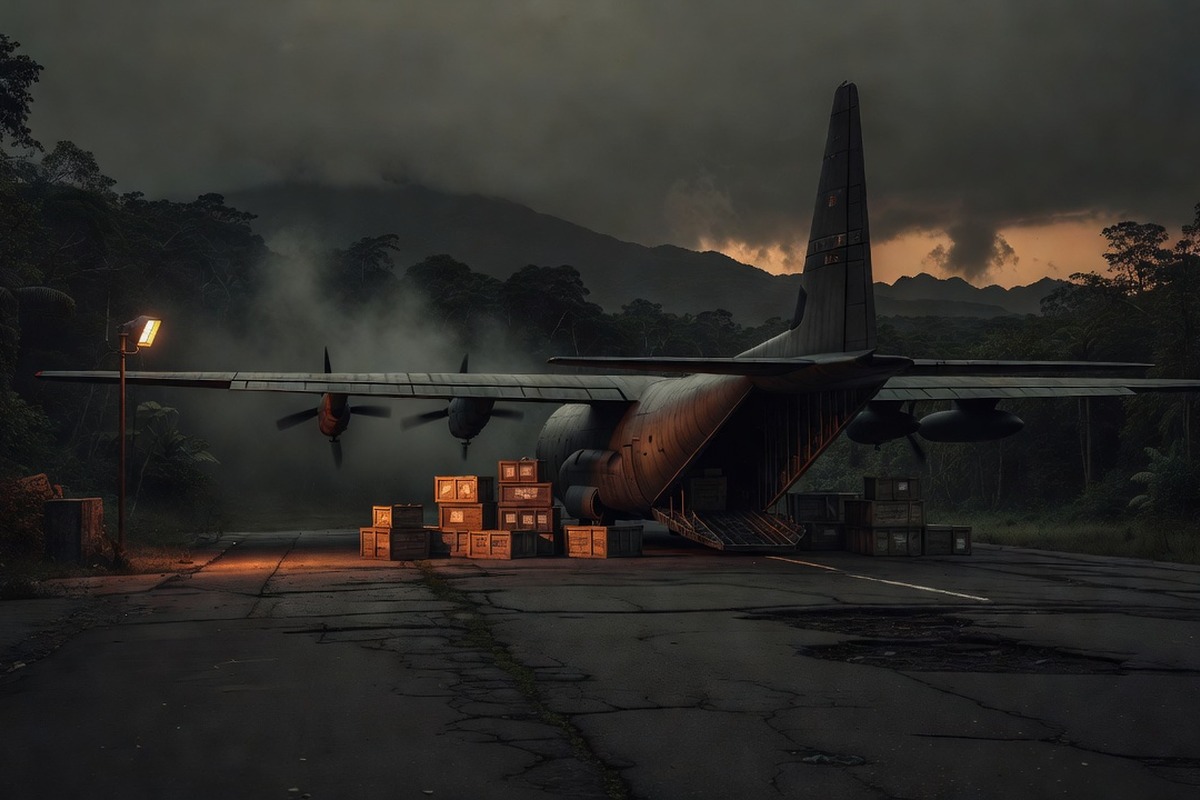
Washington was fighting two wars at once in the 1980s. One was public: a White House crusade against narcotics. The other moved in the shadows: the covert campaign to support the Nicaraguan Contras after Congress tried to tighten the leash. Somewhere between those two missions, planes kept flying, money kept moving, and the wrong people kept showing up around the right operations. By the time Senator John Kerry’s subcommittee started pulling on the thread, the question was no longer whether criminals had drifted near the Contra war. It was whether U.S. policy had learned to live with them.
The Case For
A Senate report that refused to look away
In 1988, the Senate Subcommittee on Terrorism, Narcotics and International Operations released Drugs, Law Enforcement and Foreign Policy, a 169-page investigation built from open hearings, executive sessions, depositions, and subpoenas. The Office of Justice Programs summary says the inquiry examined the links between U.S. foreign policy, narcotics, and law enforcement across the Caribbean and Central and South America. In his 1989 floor statement introducing the report, Kerry said the subcommittee found that the secret Contra war created “numerous opportunities for drug traffickers to link up with the Contras, and they did.” That line still hangs in the air because it did not come from a pamphlet, a rumor mill, or a late-night radio host. It came from Congress.
The report’s most enduring claim was not that every Contra leader was a trafficker. It was narrower, and in some ways more disturbing: there was “substantial evidence of drug smuggling” by individual Contras, suppliers, pilots, mercenaries, and supporters. The same Congressional Record statement said the State Department chose four companies controlled by drug traffickers to provide assistance to the Contras. That matters because it suggests contamination inside the supply chain, not just at its edges.
The documentary trail around Oliver North
Researchers later added more paper to the pile. The National Security Archive’s briefing book on the Contras and cocaine assembled declassified notebooks, memos, FBI and DEA records, and hearing transcripts showing that senior U.S. officials received repeated warnings about Contra-linked trafficking. Among the most cited entries are Oliver North notebook references to aircraft “probably being used for drug runs into U.S.” and a note that money for arms had “came from drugs.” Another memo described “questionable” Southern Front figures with suspected involvement in drug running.
Stack those records beside the already documented legal maze around Contra funding, and the pattern gets harder to dismiss. The Justice Department inspector general’s background chronology shows how the second Boland amendment restricted military support in 1984, while the National Security Council continued to back Contra operations and Congress later approved humanitarian aid administered through the Nicaraguan Humanitarian Assistance Office. In a system built around deniability, traffickers did not need formal invitations. They only needed doors left open. That is exactly why the Gary Webb story still echoes inside the wider landscape of government secrets investigations.
The Realist’s Eye
What the Kerry Report did not prove
The strongest caution is also the most important one: the Kerry Report did not prove that the CIA orchestrated a deliberate plot to flood American neighborhoods with crack. Even Kerry’s own formulation was more restrained than the myth that grew around it. The subcommittee documented links, tolerated associations, and enforcement failures. It did not conclude that Contra leaders as a whole ran a centralized narcotics conspiracy, and it did not establish that U.S. intelligence officials ordered cocaine into Los Angeles.
Later official investigations pushed back even harder. The Justice Department inspector general’s 1997 review of the CIA-Contra-crack controversy found serious flaws in Gary Webb’s broadest claims, especially the argument that one Contra-connected network essentially created the crack epidemic. That report argued the market was larger, more diffuse, and already expanding through multiple trafficking channels. In other words, evidence of contact and knowledge did not automatically equal evidence of command and control.
Knowledge, tolerance, and conspiracy are not the same thing
That distinction is where many conspiracy cases either sharpen or collapse. A realist has to ask whether the record shows an integrated master plan or something more bureaucratically familiar: policy makers treating drug allegations as acceptable collateral damage while pursuing a geopolitical objective. The National Security Archive frames its documents as evidence of official knowledge and protection of known traffickers. That is serious. But “knowledge” is not identical to “management,” and “protection” in specific cases is not the same as proving a top-down CIA narcotics pipeline.
There is also the problem of retrospective gravity. Once the Iran-Contra scandal, the crack epidemic, and the “Dark Alliance” debate fused together in public memory, every documented overlap began to look like a single machine. History is often messier than that. The documentary record suggests a permissive environment in which anti-Sandinista priorities repeatedly bent law enforcement. What it does not deliver, at least not cleanly, is a signed order proving that U.S. officials chose crack devastation as a conscious domestic strategy.
What We Know For Certain
- The Senate subcommittee chaired by John Kerry issued Drugs, Law Enforcement and Foreign Policy after hearings, executive sessions, depositions, and subpoenas.
- The report found substantial evidence of drug smuggling by individuals connected to Contra networks, including suppliers, pilots, mercenaries, and supporters.
- The Justice Department inspector general documented the complicated funding structure around the Contras, including restrictions imposed by the Boland amendments and later humanitarian aid channels.
- Declassified notes and memos collected by the National Security Archive show senior U.S. officials received warnings about suspected trafficking tied to Contra operations.
- Later official investigations did not find proof that the CIA directed a conspiracy to cause the crack epidemic in the United States.
The Unanswered Questions
- How often did U.S. officials receive credible trafficking warnings and choose not to escalate them?
- What vetting standards, if any, were actually applied to contractors and transport networks aiding the Contras?
- Were specific investigations slowed, redirected, or quietly abandoned to protect the broader anti-Sandinista mission?
- How much of the remaining record still sits fragmented across intelligence, law enforcement, and congressional archives?
The Closer — You Decide
The Kerry Report never gave the world a neat movie ending. It gave us something less comforting: a documented glimpse of how national security priorities can warp the rules without ever fully admitting it. The files show overlap. The hearings show warning signs. The later reviews show real limits on what can honestly be claimed. That tension is the story. The paper trail is real. The blind spots were real. Whether that adds up to conspiracy, tolerance, or something in between is still sitting in the record. The evidence is on the table. You decide.