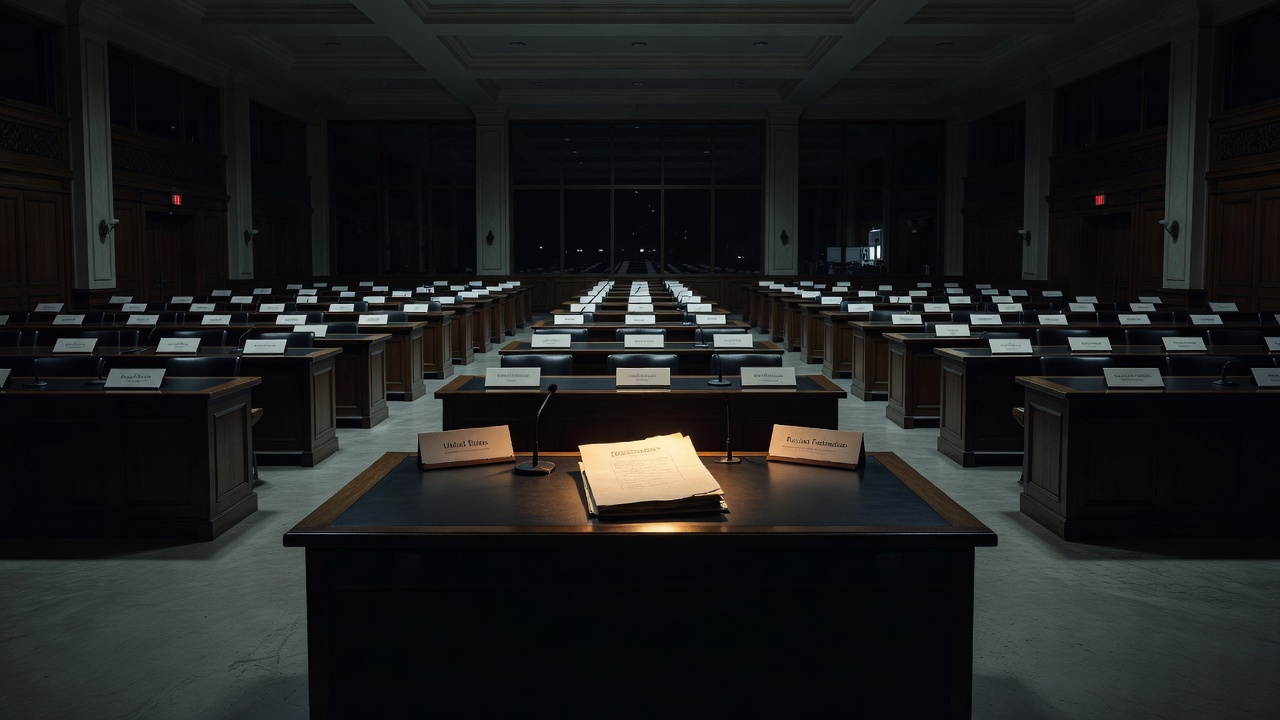
By the summer of 2001, Geneva had the look of a room where everyone knew the answer before anyone said it out loud. For six years, diplomats had tried to build the missing lock on one of the Cold War’s most important promises: the ban on biological weapons. What was missing was the mechanism that could walk into a suspicious lab, open the doors, and ask the question nobody likes to hear. Then the talks broke. After that, the silence around bioweapons got louder.
The Case For
A treaty with a hole in the middle
The Biological Weapons Convention was historic from the start. It opened for signature in 1972 and entered into force in 1975 as the first multilateral treaty to ban an entire category of weapons of mass destruction. But even strong language can hide a structural weakness. The treaty prohibited the development, production, stockpiling, and transfer of biological weapons, yet it never created the kind of standing verification body that later became normal in harder-edged arms control regimes.
That gap is what the 1990s negotiations were supposed to fix. As the Arms Control Association’s BWC overview notes, states-parties created an Ad Hoc Group in 1994 to negotiate a legally binding protocol. The idea was simple on paper: require declarations of relevant facilities, allow routine visits to declared sites, and preserve challenge investigations when compliance looked doubtful. The world was trying to add teeth to a treaty that had relied on trust.
Then Washington pulled the brake
The conspiratorial reading begins with how abruptly the effort died. On July 25, 2001, U.S. negotiator Donald Mahley told the Ad Hoc Group in Geneva that Washington could not support the draft protocol, known as the Composite Text or CRP.8. In the State Department archive of that statement, Mahley said the proposed protocol would “not improve our ability to verify BWC compliance,” would “do little to deter” violators, and would put “national security and confidential business information at risk.”
To critics, that was the tell. If a verification regime was imperfect, why kill it instead of tightening it? The suspicion deepened later that year, when the Fifth Review Conference unraveled over the future of the Ad Hoc Group. To conspiracy-minded observers, the message was clear: the world had gotten close to building a system that might have looked behind laboratory doors, and the most powerful state in the room decided the doors should stay mostly closed.
That reading gains force from the record beneath the treaty. The Soviet Union maintained an offensive biological weapons program after signing the BWC, a fact later exposed through defections and post-Cold War admissions. A state could sign the convention, praise the convention, and still cheat. That is why the collapse of the protocol still echoes through this site’s larger biowarfare cluster, from The Biological Weapons Convention: Ban or Blindfold? to When Nixon Ended America’s Biowarfare Program and the broader archive of government secrets and black-site history. If cheating was possible, critics ask, who benefited from keeping verification weak?
The Realist’s Eye
Biology really is harder to police than missiles
The strongest counterargument is not that the collapse was harmless. It is that the negotiators had run into a technical wall. Biological research is notoriously dual-use. The same fermenters, containment gear, and pathogen samples that can support vaccine work or defensive research can also support offensive capability. Jonathan Tucker, writing for the Nuclear Threat Initiative in 2001, argued that the draft protocol was never expected to deliver the kind of certainty seen in nuclear or chemical arms control because modern biology is easier to conceal, easier to sanitize, and harder to distinguish by intent alone.
That matters. A missile silo is visible. A suspicious fermentation line can look like ordinary industry. A vaccine plant and a weapons-capable facility may share equipment, staff, and methods. When Mahley argued that routine visits could expose sensitive biodefense or proprietary commercial information while still missing bad actors, he was not inventing a fake problem. He was pressing on one of the hardest truths in arms control: some weapons are simply easier to verify than others.
Opposition to this protocol was not proof of a secret arsenal
There is also a temptation to flatten the story into a simple morality play. But the available record does not prove that the United States rejected the protocol because it was hiding an offensive biological weapons program. It proves that U.S. officials believed—or at least argued publicly—that the protocol was weak, risky, and potentially counterproductive. John Bolton said much the same in a 2002 statement to the Conference on Disarmament, calling the draft protocol “counterproductive” and pushing alternative measures such as stricter export controls and improved biodefense preparedness.
Reasonable critics can say those alternatives were too soft. They can argue that “unverifiable” is a convenient label for any regime a state does not want to accept. But the realist has to admit something else too: a flawed verification regime can create false confidence.
So the unresolved tension is sharper than the easy version of the theory. Maybe Washington killed an imperfect but useful mechanism. Or maybe the draft really was a bad instrument for a uniquely slippery class of weapons. The collapse is suspicious. Suspicion alone is not a document.
What We Know For Certain
- The BWC bans the development, production, stockpiling, acquisition, and transfer of biological weapons, but it does not have a standing verification organization comparable to the Chemical Weapons Convention.
- In 1994, BWC states-parties created an Ad Hoc Group to negotiate a legally binding compliance protocol.
- On July 25, 2001, U.S. negotiator Donald Mahley publicly rejected the draft protocol known as the Composite Text or CRP.8.
- The Fifth Review Conference later deadlocked over the future of the Ad Hoc Group, and the protocol effort did not recover.
- The Soviet Union secretly maintained an offensive biological weapons program despite being a BWC state-party.
The Unanswered Questions
- Would the 2001 protocol have meaningfully raised the political and operational cost of cheating, even if it could not guarantee perfect detection?
- How much of the U.S. objection was driven by genuine technical limits, and how much by protecting biodefense and commercial secrecy from outside scrutiny?
- Did the collapse of the protocol permanently normalize a weaker verification standard for biological weapons than the world would accept for other mass-casualty threats?
- What stronger verification model, if any, could work today in an era of faster, smaller, and more distributed biotechnology?
- How many states quietly concluded from 2001 onward that biology was the least inspectable corner of the WMD world?
The Closer — You Decide
Sometimes the most revealing moment in a conspiracy story is not the secret program. It is the meeting where oversight nearly becomes real, and then doesn’t. The BWC survived. The norm against biological weapons survived. What never arrived was the inspection architecture many people assumed must already exist. That could mean the protocol was unworkable. It could also mean the world blinked when the questions got too close to the lab door. The record is real. The collapse is real. The space it left behind is real too. The evidence is on the table. You decide.