Menu

GAO’s 2002 Deemed Export Warning

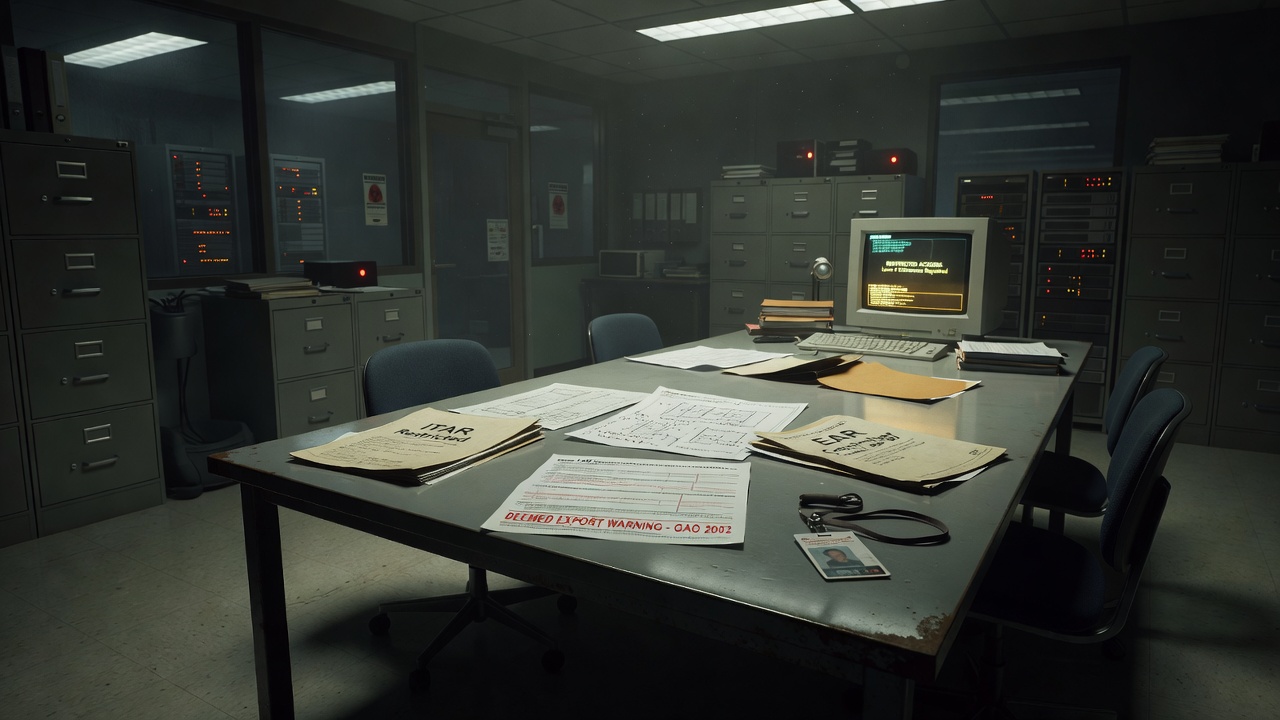
Empty federal conference room symbolizing the GAO deemed export warning — ConspiracyRealist.com

GAO’s 2002 deemed export warning helped turn Form I-129 into a quiet national-security checkpoint for high-tech hiring. It arrived as a checkbox. Somewhere between immigration law and export control, a routine hiring form picked up a quiet new power: before a company could bring in certain foreign professionals, it had to ask whether the work itself might count as a national-security transfer. Not a shipment. Not a suitcase full of blueprints. A conversation, a server login, a lab bench, a line of source code. By the time most people noticed, the logic was already inside the paperwork. A visa petition had become a gate.

The Case For

A warning buried in a GAO report

The conspiracy-minded version of this story writes itself: Washington discovered a leak in the technology pipeline and quietly deputized immigration paperwork to help plug it. The documented starting point is real enough. In GAO-02-972, published in September 2002, the Government Accountability Office warned that weaknesses in the deemed-export system could help “countries of concern” gain access to sensitive U.S. dual-use technology. GAO found that Commerce screened many visa applications filed overseas, but did not screen thousands of domestic H-1B change-of-status cases already moving through the immigration system.

That gap matters because a deemed export is not a traditional export at all. As the Bureau of Industry and Security explains, it can be the release of controlled technology or source code to a foreign person inside the United States. In practical terms, access itself becomes the transfer. A controlled design reviewed on a monitor, a protected research process explained in a lab, a sensitive software repository opened to the wrong person — all of it can trigger export-control consequences.

GAO’s numbers made the vulnerability look less theoretical. In fiscal year 2001, Commerce approved 822 deemed-export license applications and rejected only three. The same report said deemed-export licenses made up almost 10 percent of all export licenses approved by Commerce. Yet GAO also found that Commerce lacked an effective program to monitor whether companies were actually following the security conditions attached to those licenses. In other words: the government was approving access, but it was not especially good at checking the locks afterward.

How a national-security concern migrated into immigration

Fast-forward to the visa form itself. On its FAQ page for Part 6 of Form I-129, USCIS says directly that the agency added the export-control certification after two government reports: GAO-02-972 and an April 2004 Inspectors General report, OIG-04-23. USCIS says Part 6 was “a solution” to those findings. That is not fringe interpretation. That is the agency’s own explanation.

The certification, added to the revised I-129 in November 2010 and required for covered petitions postmarked on or after February 20, 2011, forces petitioners in H-1B, H-1B1, L-1, and O-1A cases to review export rules and certify one of two things: either no license is required, or a license is required and the worker will not get access until that authorization is in hand. A hiring petition became a compliance declaration.

As this site’s recent reporting on deemed exports in university labs and the H-1B deemed export trap suggests, national-security controls do not always arrive as raids and indictments. Sometimes they arrive as administrative obligations that quietly reorder who can see what, when, and under what supervision. The public-facing visa process becomes a soft surveillance layer for sensitive work.

The Realist’s Eye

Not a hidden plot — an overt compliance move

There is a limit to how far the darker reading can go. First, none of this was secret. The GAO report was public. USCIS publicly explained why it changed Form I-129. BIS publicly defines deemed exports and publishes guidance for license applicants. If this was a covert program, it was an unusually well-documented one.

Second, Part 6 did not itself create the underlying export-control regime. USCIS is explicit on that point. The export-control rules were already in place under the Export Administration Regulations and the International Traffic in Arms Regulations. The form change did not suddenly criminalize ordinary hiring. It inserted an attestation into an existing legal structure, mostly for fields that could plausibly intersect with controlled technology.

There is also a narrower explanation for the government’s move: bureaucratic patchwork. GAO found that Commerce and immigration authorities were not coordinating effectively. USCIS responded by building one checkpoint into a form employers were already filing. It may look ominous, but it also looks like a classic federal workaround.

Even the scope complicates the hardest conspiracy reading. Part 6 applies only to certain visa categories, and USCIS does not require employers to submit the actual export license with the petition. The agency also says a petition will not be denied simply because a license has not yet been obtained, so long as the petitioner certifies that access will be blocked until approval comes through. That sounds less like a dragnet and more like a compliance attestation with teeth if ignored later.

The unanswered enforcement problem

But the realist counterpoint does not make the underlying concern disappear. If the government believed enough in the risk to place export-control attestations inside immigration forms, why did oversight remain so dependent on employer honesty? GAO’s 2002 report criticized weak monitoring. That tension keeps the topic alive: the state treats the risk as serious, yet often enforces it through paperwork and delayed follow-up rather than constant direct verification.

That leaves a narrower claim. The issue is not that a secret cabal smuggled a hidden loyalty test into immigration law. The issue is that documented national-security concerns transformed an employment petition into an export-control checkpoint, with consequences workers and employers may not grasp. For a process that can shape careers, research access, and hiring timelines, that is more than administrative trivia.

What We Know For Certain

  • GAO-02-972, published in 2002, found weaknesses in Commerce’s deemed-export controls, including gaps involving domestic H-1B change-of-status cases.
  • BIS defines a deemed export as the release of controlled technology or source code to a foreign person in the United States.
  • USCIS revised Form I-129 on November 23, 2010, to add Part 6, the export-control certification.
  • USCIS says Part 6 was added in response to GAO-02-972 and the 2004 OIG report OIG-04-23.
  • Part 6 applies to H-1B, H-1B1, L-1, and O-1A petitions filed on or after February 20, 2011.

The Unanswered Questions

  • How often do employers certify that no license is required in cases where the technology question is genuinely close?
  • How frequently do USCIS, BIS, and other agencies verify that post-filing access controls are actually being enforced?
  • Did Part 6 materially reduce unauthorized deemed exports, or did it mainly shift liability onto employers?
  • How many workers lose project access or face delayed starts because export review happens after the visa strategy is already in motion?

The Closer — You Decide

The form is real. The warning that helped shape it is real. In modern America, the border is not always at the airport. Sometimes it sits inside a hiring packet, waiting between a signature block and a compliance checkbox. Maybe that is prudent. Maybe it is overdue. Maybe it is one more example of the security state disappearing into procedure. The evidence is on the table. You decide.

dive down the rabbit hole

GAO’s 2002 Deemed Export Warning

S-FX.com
Empty federal conference room symbolizing the GAO deemed export warning — ConspiracyRealist.com

GAO’s 2002 deemed export warning helped turn Form I-129 into a quiet national-security checkpoint for high-tech hiring. It arrived as a checkbox. Somewhere between immigration law and export control, a routine hiring form picked up a quiet new power: before a company could bring in certain foreign professionals, it had to ask whether the work itself might count as a national-security transfer. Not a shipment. Not a suitcase full of blueprints. A conversation, a server login, a lab bench, a line of source code. By the time most people noticed, the logic was already inside the paperwork. A visa petition had become a gate.

The Case For

A warning buried in a GAO report

The conspiracy-minded version of this story writes itself: Washington discovered a leak in the technology pipeline and quietly deputized immigration paperwork to help plug it. The documented starting point is real enough. In GAO-02-972, published in September 2002, the Government Accountability Office warned that weaknesses in the deemed-export system could help “countries of concern” gain access to sensitive U.S. dual-use technology. GAO found that Commerce screened many visa applications filed overseas, but did not screen thousands of domestic H-1B change-of-status cases already moving through the immigration system.

That gap matters because a deemed export is not a traditional export at all. As the Bureau of Industry and Security explains, it can be the release of controlled technology or source code to a foreign person inside the United States. In practical terms, access itself becomes the transfer. A controlled design reviewed on a monitor, a protected research process explained in a lab, a sensitive software repository opened to the wrong person — all of it can trigger export-control consequences.

GAO’s numbers made the vulnerability look less theoretical. In fiscal year 2001, Commerce approved 822 deemed-export license applications and rejected only three. The same report said deemed-export licenses made up almost 10 percent of all export licenses approved by Commerce. Yet GAO also found that Commerce lacked an effective program to monitor whether companies were actually following the security conditions attached to those licenses. In other words: the government was approving access, but it was not especially good at checking the locks afterward.

How a national-security concern migrated into immigration

Fast-forward to the visa form itself. On its FAQ page for Part 6 of Form I-129, USCIS says directly that the agency added the export-control certification after two government reports: GAO-02-972 and an April 2004 Inspectors General report, OIG-04-23. USCIS says Part 6 was “a solution” to those findings. That is not fringe interpretation. That is the agency’s own explanation.

The certification, added to the revised I-129 in November 2010 and required for covered petitions postmarked on or after February 20, 2011, forces petitioners in H-1B, H-1B1, L-1, and O-1A cases to review export rules and certify one of two things: either no license is required, or a license is required and the worker will not get access until that authorization is in hand. A hiring petition became a compliance declaration.

As this site’s recent reporting on deemed exports in university labs and the H-1B deemed export trap suggests, national-security controls do not always arrive as raids and indictments. Sometimes they arrive as administrative obligations that quietly reorder who can see what, when, and under what supervision. The public-facing visa process becomes a soft surveillance layer for sensitive work.

The Realist’s Eye

Not a hidden plot — an overt compliance move

There is a limit to how far the darker reading can go. First, none of this was secret. The GAO report was public. USCIS publicly explained why it changed Form I-129. BIS publicly defines deemed exports and publishes guidance for license applicants. If this was a covert program, it was an unusually well-documented one.

Second, Part 6 did not itself create the underlying export-control regime. USCIS is explicit on that point. The export-control rules were already in place under the Export Administration Regulations and the International Traffic in Arms Regulations. The form change did not suddenly criminalize ordinary hiring. It inserted an attestation into an existing legal structure, mostly for fields that could plausibly intersect with controlled technology.

There is also a narrower explanation for the government’s move: bureaucratic patchwork. GAO found that Commerce and immigration authorities were not coordinating effectively. USCIS responded by building one checkpoint into a form employers were already filing. It may look ominous, but it also looks like a classic federal workaround.

Even the scope complicates the hardest conspiracy reading. Part 6 applies only to certain visa categories, and USCIS does not require employers to submit the actual export license with the petition. The agency also says a petition will not be denied simply because a license has not yet been obtained, so long as the petitioner certifies that access will be blocked until approval comes through. That sounds less like a dragnet and more like a compliance attestation with teeth if ignored later.

The unanswered enforcement problem

But the realist counterpoint does not make the underlying concern disappear. If the government believed enough in the risk to place export-control attestations inside immigration forms, why did oversight remain so dependent on employer honesty? GAO’s 2002 report criticized weak monitoring. That tension keeps the topic alive: the state treats the risk as serious, yet often enforces it through paperwork and delayed follow-up rather than constant direct verification.

That leaves a narrower claim. The issue is not that a secret cabal smuggled a hidden loyalty test into immigration law. The issue is that documented national-security concerns transformed an employment petition into an export-control checkpoint, with consequences workers and employers may not grasp. For a process that can shape careers, research access, and hiring timelines, that is more than administrative trivia.

What We Know For Certain

  • GAO-02-972, published in 2002, found weaknesses in Commerce’s deemed-export controls, including gaps involving domestic H-1B change-of-status cases.
  • BIS defines a deemed export as the release of controlled technology or source code to a foreign person in the United States.
  • USCIS revised Form I-129 on November 23, 2010, to add Part 6, the export-control certification.
  • USCIS says Part 6 was added in response to GAO-02-972 and the 2004 OIG report OIG-04-23.
  • Part 6 applies to H-1B, H-1B1, L-1, and O-1A petitions filed on or after February 20, 2011.

The Unanswered Questions

  • How often do employers certify that no license is required in cases where the technology question is genuinely close?
  • How frequently do USCIS, BIS, and other agencies verify that post-filing access controls are actually being enforced?
  • Did Part 6 materially reduce unauthorized deemed exports, or did it mainly shift liability onto employers?
  • How many workers lose project access or face delayed starts because export review happens after the visa strategy is already in motion?

The Closer — You Decide

The form is real. The warning that helped shape it is real. In modern America, the border is not always at the airport. Sometimes it sits inside a hiring packet, waiting between a signature block and a compliance checkbox. Maybe that is prudent. Maybe it is overdue. Maybe it is one more example of the security state disappearing into procedure. The evidence is on the table. You decide.

GAO’s 2002 Deemed Export Warning

Empty federal conference room symbolizing the GAO deemed export warning — ConspiracyRealist.com

GAO’s 2002 deemed export warning helped turn Form I-129 into a quiet national-security checkpoint for high-tech hiring. It arrived as a checkbox. Somewhere between immigration law and export control, a routine hiring form picked up a quiet new power: before a company could bring in certain foreign professionals, it had to ask whether the work itself might count as a national-security transfer. Not a shipment. Not a suitcase full of blueprints. A conversation, a server login, a lab bench, a line of source code. By the time most people noticed, the logic was already inside the paperwork. A visa petition had become a gate.

The Case For

A warning buried in a GAO report

The conspiracy-minded version of this story writes itself: Washington discovered a leak in the technology pipeline and quietly deputized immigration paperwork to help plug it. The documented starting point is real enough. In GAO-02-972, published in September 2002, the Government Accountability Office warned that weaknesses in the deemed-export system could help “countries of concern” gain access to sensitive U.S. dual-use technology. GAO found that Commerce screened many visa applications filed overseas, but did not screen thousands of domestic H-1B change-of-status cases already moving through the immigration system.

That gap matters because a deemed export is not a traditional export at all. As the Bureau of Industry and Security explains, it can be the release of controlled technology or source code to a foreign person inside the United States. In practical terms, access itself becomes the transfer. A controlled design reviewed on a monitor, a protected research process explained in a lab, a sensitive software repository opened to the wrong person — all of it can trigger export-control consequences.

GAO’s numbers made the vulnerability look less theoretical. In fiscal year 2001, Commerce approved 822 deemed-export license applications and rejected only three. The same report said deemed-export licenses made up almost 10 percent of all export licenses approved by Commerce. Yet GAO also found that Commerce lacked an effective program to monitor whether companies were actually following the security conditions attached to those licenses. In other words: the government was approving access, but it was not especially good at checking the locks afterward.

How a national-security concern migrated into immigration

Fast-forward to the visa form itself. On its FAQ page for Part 6 of Form I-129, USCIS says directly that the agency added the export-control certification after two government reports: GAO-02-972 and an April 2004 Inspectors General report, OIG-04-23. USCIS says Part 6 was “a solution” to those findings. That is not fringe interpretation. That is the agency’s own explanation.

The certification, added to the revised I-129 in November 2010 and required for covered petitions postmarked on or after February 20, 2011, forces petitioners in H-1B, H-1B1, L-1, and O-1A cases to review export rules and certify one of two things: either no license is required, or a license is required and the worker will not get access until that authorization is in hand. A hiring petition became a compliance declaration.

As this site’s recent reporting on deemed exports in university labs and the H-1B deemed export trap suggests, national-security controls do not always arrive as raids and indictments. Sometimes they arrive as administrative obligations that quietly reorder who can see what, when, and under what supervision. The public-facing visa process becomes a soft surveillance layer for sensitive work.

The Realist’s Eye

Not a hidden plot — an overt compliance move

There is a limit to how far the darker reading can go. First, none of this was secret. The GAO report was public. USCIS publicly explained why it changed Form I-129. BIS publicly defines deemed exports and publishes guidance for license applicants. If this was a covert program, it was an unusually well-documented one.

Second, Part 6 did not itself create the underlying export-control regime. USCIS is explicit on that point. The export-control rules were already in place under the Export Administration Regulations and the International Traffic in Arms Regulations. The form change did not suddenly criminalize ordinary hiring. It inserted an attestation into an existing legal structure, mostly for fields that could plausibly intersect with controlled technology.

There is also a narrower explanation for the government’s move: bureaucratic patchwork. GAO found that Commerce and immigration authorities were not coordinating effectively. USCIS responded by building one checkpoint into a form employers were already filing. It may look ominous, but it also looks like a classic federal workaround.

Even the scope complicates the hardest conspiracy reading. Part 6 applies only to certain visa categories, and USCIS does not require employers to submit the actual export license with the petition. The agency also says a petition will not be denied simply because a license has not yet been obtained, so long as the petitioner certifies that access will be blocked until approval comes through. That sounds less like a dragnet and more like a compliance attestation with teeth if ignored later.

The unanswered enforcement problem

But the realist counterpoint does not make the underlying concern disappear. If the government believed enough in the risk to place export-control attestations inside immigration forms, why did oversight remain so dependent on employer honesty? GAO’s 2002 report criticized weak monitoring. That tension keeps the topic alive: the state treats the risk as serious, yet often enforces it through paperwork and delayed follow-up rather than constant direct verification.

That leaves a narrower claim. The issue is not that a secret cabal smuggled a hidden loyalty test into immigration law. The issue is that documented national-security concerns transformed an employment petition into an export-control checkpoint, with consequences workers and employers may not grasp. For a process that can shape careers, research access, and hiring timelines, that is more than administrative trivia.

What We Know For Certain

  • GAO-02-972, published in 2002, found weaknesses in Commerce’s deemed-export controls, including gaps involving domestic H-1B change-of-status cases.
  • BIS defines a deemed export as the release of controlled technology or source code to a foreign person in the United States.
  • USCIS revised Form I-129 on November 23, 2010, to add Part 6, the export-control certification.
  • USCIS says Part 6 was added in response to GAO-02-972 and the 2004 OIG report OIG-04-23.
  • Part 6 applies to H-1B, H-1B1, L-1, and O-1A petitions filed on or after February 20, 2011.

The Unanswered Questions

  • How often do employers certify that no license is required in cases where the technology question is genuinely close?
  • How frequently do USCIS, BIS, and other agencies verify that post-filing access controls are actually being enforced?
  • Did Part 6 materially reduce unauthorized deemed exports, or did it mainly shift liability onto employers?
  • How many workers lose project access or face delayed starts because export review happens after the visa strategy is already in motion?

The Closer — You Decide

The form is real. The warning that helped shape it is real. In modern America, the border is not always at the airport. Sometimes it sits inside a hiring packet, waiting between a signature block and a compliance checkbox. Maybe that is prudent. Maybe it is overdue. Maybe it is one more example of the security state disappearing into procedure. The evidence is on the table. You decide.

Table of contents