The Archive Laundering Conspiracy: How Redactions, Metadata, and Staggered Releases Make Secrecy Look Like Transparency
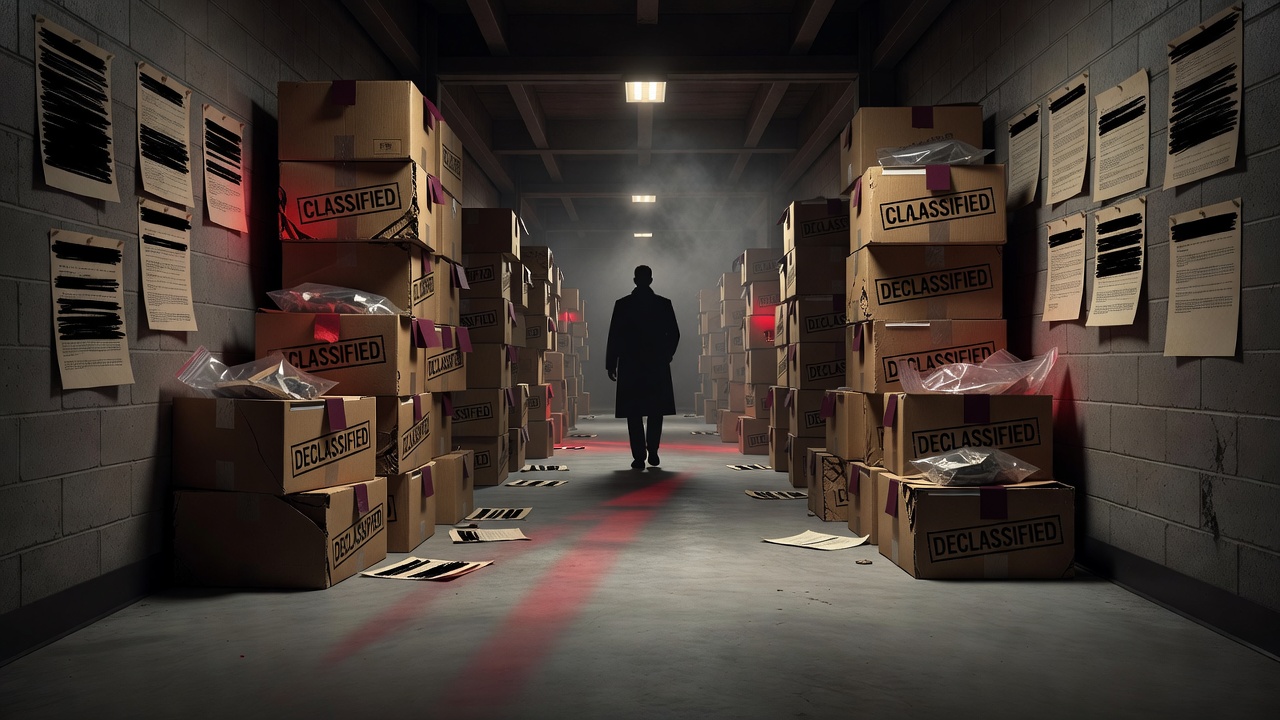
A fluorescent hallway glows at midnight. Banker boxes breathe dust. A file finally appears online—heavily blacked out, buried under bland metadata, released just late enough to blunt its political blast. The public is told the vault has opened. But what if the real trick is subtler: not hiding the archive forever, but laundering it until secrecy arrives dressed as transparency?
The Case For
The modern state does not always suppress the record — it can flood, fragment, and sanitize it until disclosure becomes a maze
The archive laundering conspiracy starts with a simple suspicion: the most durable information control system is no longer the locked filing cabinet. It is the controlled release. In this model, governments do disclose real records, but they do so through structures that shape what the public can actually find, connect, and understand. A document appears, but only after time has drained its urgency. A page is released, but with key names or passages removed. A dataset is published, but scattered across portals, libraries, and mismatched formats that make synthesis difficult. The result is a strange political theater in which transparency is technically happening while genuine clarity remains elusive.
The official machinery for this theater is real. The Justice Department’s FOIA Library says many documents are available without a request because they are posted as “proactive disclosures” by Department components. It also explains that FOIA-processed documents may be released in full or with redactions, and that agencies post records that are “frequently requested” or otherwise likely to interest the public. On paper, that sounds like a democratic triumph: information moves from the vault to the citizen. But it also means the state now curates vast libraries of partially disclosed material, choosing format, labeling, placement, and timing.
The metadata layer makes the system even more revealing. In the Justice Department’s guidance on using metadata in FOIA documents posted online, the Office of Information Policy says agencies can create a “virtual” government-wide FOIA Library simply by adding a uniform “FOIA” metadata tag to records. The same guidance stresses that agencies should make information “accessible and usable, not just available.” That sentence cuts two ways. If metadata determines discoverability, then metadata is not a minor technical detail. It is part of how official memory gets organized, surfaced, and sometimes buried in plain sight.
Once you see that, archive laundering no longer sounds like fantasy. It sounds like the bureaucratic evolution of secrecy. The old regime controlled whether a file existed in public. The new regime can also control whether that file is searchable, contextualized, grouped with similar records, or effectively lost in a digital swamp.
Redactions and staggered release schedules can preserve the appearance of openness while protecting the narrative center of a story
The National Archives’ page on Mandatory Declassification Review shows how narrow the release channel can be. It says any individual can request review of classified information, but the request must identify the material with “sufficient specificity” so the agency can locate it with a “reasonable” amount of effort. It also notes that broad types of information, entire file series, or similar non-specific requests may be denied for processing. That creates a structural paradox. Citizens often suspect a larger hidden pattern, but the system works best when the requester already knows exactly which page, memo, title, or date to ask for.
Then come the redactions. The same National Archives guidance states agencies are expected to release records in full or in redacted form unless withholding remains authorized, and it describes line-by-line review plus the duty to identify redacted portions. The public receives a visible remnant of the hidden whole. That can be useful, but it also normalizes a ritual of partial truth: the state demonstrates openness by displaying the shape of what it still will not share.
Even the appellate layer reflects this managed pace. The National Archives’ ISCAP Appeals Status Log says, “In the interest of transparency,” the government posts a log of open mandatory declassification review and classification challenge appeals, while also listing status categories such as “Materials Requested from Agency,” “Appeal Under Review by the ISCAP,” and “Decision Reached.” The same page explains that appeals may be administratively closed for reasons including insufficient specificity, no records located, litigation, or the CIA operations file exemption. Read cinematically, this is the perfect laundering machine: visible process, visible categories, visible movement — but often years of distance between public demand and meaningful release.
That is why staggered disclosure matters so much to conspiracy-minded observers. A piecemeal system can defuse impact without needing an outright lie. Release enough to claim transparency. Withhold enough to preserve ambiguity. Spread the archive across time, portals, and appeals, and the public spends its energy reconstructing fragments instead of confronting the entire architecture at once.
The Realist’s Eye
The record does not prove a master puppeteer — but it does show a system with built-in incentives to turn disclosure into administration
A sober analyst has to separate style from proof. The archive laundering conspiracy does not require a single smoke-filled room where officials coordinate every redaction and upload schedule. Bureaucracies do not need omniscience to produce opaque outcomes. They need procedure, incentives, and institutional self-protection. And those incentives are visible everywhere in the disclosure ecosystem.
The Public Interest Declassification Board’s 2025 Annual Report to Congress says its work centered on “structural reform in the management of classified national security information,” “AI-enabled declassification initiatives,” and persistent concern about “overclassification” and standardization. The report also says the Board’s mandate is to promote “the fullest possible public access to a thorough, accurate, and reliable documentary record” of national security decisions. That is not fringe rhetoric. It is an official acknowledgment that structural problems in classification and declassification still distort what the public can see.
The same report is especially telling because it frames reform as a systems problem rather than a one-off scandal. If overclassification, standardization failures, and bottlenecks require sustained institutional repair, then opacity is not just the result of extraordinary emergencies. It is part of routine governance. In that environment, archive laundering may emerge less as a secret plot than as a recurring administrative equilibrium: disclose what you must, delay what you can, compartmentalize what remains, and present the whole process as proof that oversight is functioning.
This is where our previous reporting on the classification conspiracy, the Glomar conspiracy, and the official acknowledgment conspiracy locks into place. Classification can delay. Glomar can deny. Official acknowledgment can define when a claim becomes socially real. Archive laundering sits one level downstream: it governs what the public receives after the system decides to release something at all.
The darker possibility is that transparency infrastructure can become camouflage — a way to make secrecy look civilized, searchable, and responsibly managed
The most unsettling part of this story is not the black bar over a name. It is the possibility that modern transparency tools themselves can soften public resistance. A portal looks cleaner than a locked room. A FOIA library looks kinder than a denial letter. A spreadsheet of appeals looks more accountable than silence. Yet all three can still leave the decisive picture out of reach.
The Justice Department’s metadata guidance openly celebrates the idea of a searchable, “virtual” government-wide FOIA Library. That goal is genuinely useful. But it also proves the principle that discoverability is engineered. If records become easier or harder to locate depending on tags, formats, and publishing conventions, then the architecture of access becomes part of the politics of access. A badly tagged record is not destroyed; it is simply made harder to summon into public consciousness.
Likewise, the National Archives’ MDR process gives the public a path into the classified record, but it also demands precision, patience, and procedural stamina. ISCAP offers another layer of review, yet its own status categories testify to how long a matter can remain inside official digestion. None of that is evidence that every hidden suspicion is true. It is evidence that the path from secret to public record is highly managed, and that management shapes what societies can absorb in real time.
So the realist conclusion is sharp. The archive laundering conspiracy is plausible not because it explains everything, but because it describes a recognizable pattern: disclosure without synthesis, release without context, access without ease, visibility without full intelligibility. In that world, the citizen is allowed into the archive — but only after the archive has been processed, staged, and cleaned for viewing.
What We Know For Certain
- The Justice Department’s FOIA Library says many records are posted online as “proactive disclosures,” including FOIA-processed documents that may appear in full or with redactions.
- The Justice Department’s guidance on metadata for FOIA documents says agencies can build a “virtual” government-wide FOIA Library with a uniform “FOIA” tag and should make information “accessible and usable, not just available.”
- The National Archives says Mandatory Declassification Review requests must identify records with “sufficient specificity,” and broad or non-specific requests may be denied for processing.
- The same MDR guidance says agencies are expected to release requested records in full or in redacted form unless withholding remains authorized under law.
- The National Archives’ ISCAP status log description says open MDR and classification challenge appeals are posted “in the interest of transparency,” while administrative closures can occur for insufficient specificity, no records located, litigation, and other limits.
- The PIDB’s 2025 annual report says the Board focused on structural reform, overclassification, standardization, AI-enabled declassification, and public access to historically significant national security records.
The Unanswered Questions
- How many politically explosive archives have been neutralized not by permanent suppression, but by staggered release after the window of maximum accountability passed?
- If metadata governs discoverability, who really controls whether a declassified record enters public consciousness or disappears into digital clutter?
- When citizens must already know the exact record to request, can they realistically uncover broad hidden systems through MDR and FOIA alone?
- Do redactions merely protect lawful secrets, or do they also train the public to accept partial truth as the final shape of transparency?
- Has the modern disclosure state solved secrecy — or simply upgraded it into a cleaner, calmer, more searchable form?
The Closer — You Decide
Maybe this is just the unavoidable cost of governing a secretive national security apparatus inside a constitutional democracy. Maybe records must move slowly. Maybe names must be protected. Maybe archives are messy because reality is messy. That explanation deserves respect.
But it is also exactly the explanation a mature secrecy system would offer while refining its grip. Not “you can never know,” but “you may know in installments.” Not “the file does not exist,” but “the file is online somewhere.” Not “the record is sealed,” but “the record is available, though redacted, delayed, scattered, and tagged in ways only specialists will ever fully navigate.”
That is why the archive laundering conspiracy feels so potent. It captures the suspicion that the deepest cover-up in the digital age may no longer be disappearance. It may be procedural domestication — the conversion of dangerous archives into manageable public artifacts. The file appears. The portal loads. The transparency box is checked. And somewhere behind the glow of the screen, the real story remains just out of frame.