The Sensor Gatekeeping Conspiracy: Why the Government Sees the Clearest UAP Data and the Public Gets the Blur
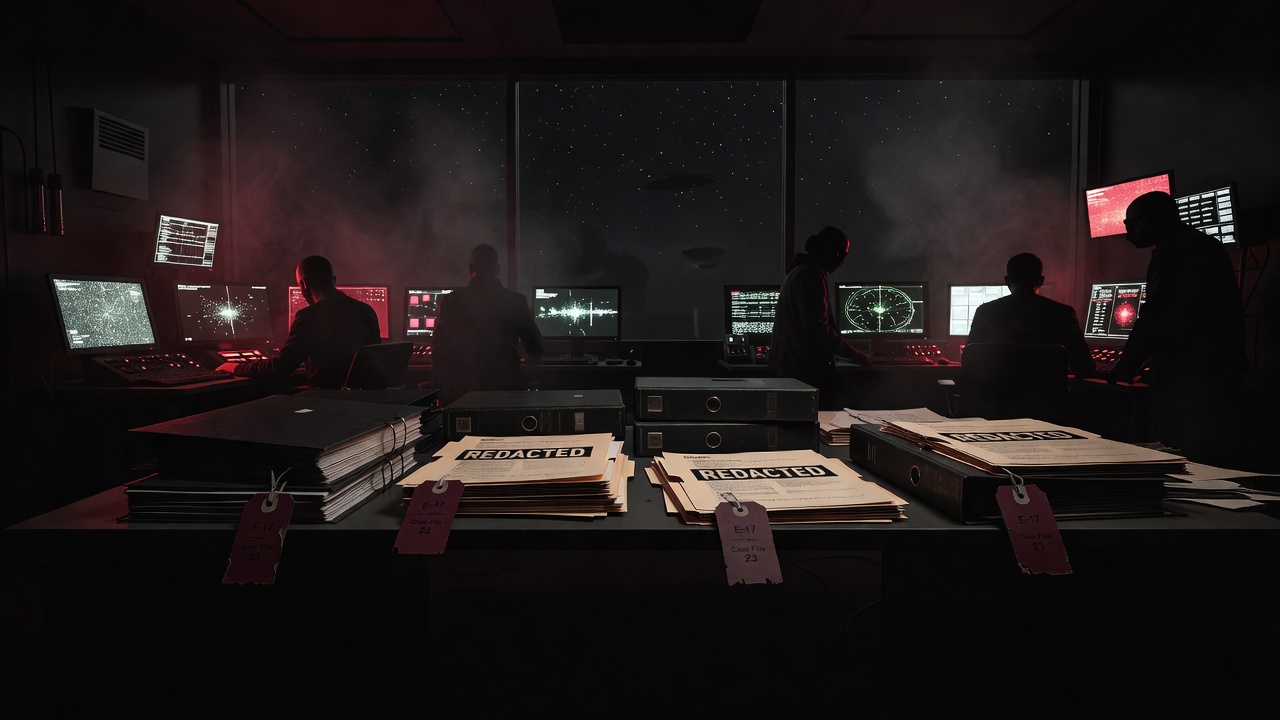
A cold screen glows in a sealed room. Somewhere over dark water, an object crosses a sensor’s field of view for a few impossible seconds—sharp enough to trigger alarms, classified enough to vanish behind the curtain. By the time the public sees the case, the edges are softer, the context is gone, and the mystery has been translated into a blur.
The Case For
The modern UFO conspiracy may not be a crashed craft in a bunker—it may be a sensor hierarchy that keeps the richest evidence inside the system
The most unnerving thing in the current UAP era is not that the U.S. government openly says it has all the answers. It does not. The unnerving thing is that it openly says the best answers depend on data the public almost never gets to see in full. That is the engine of the sensor gatekeeping conspiracy: the state’s most advanced platforms capture fragments of strange events, but the public encounter arrives later as edited footage, stripped metadata, or a cautious summary wrapped in caveats.
The ODNI’s 2021 preliminary UAP assessment said the “limited amount of high-quality reporting” hampers firm conclusions. It also said most reported UAP probably do represent physical objects and that a majority were registered across multiple sensors, including radar, infrared, electro-optical systems, weapon seekers, and visual observation. That is a remarkable admission. The public argument is often framed as believers versus skeptics, but the government’s own wording points to something stranger: many of the most serious cases are not single-witness stories at all. They are multi-sensor events that live inside technical systems most outsiders cannot audit.
The same report also says “sociocultural stigmas and sensor limitations remain obstacles to collecting data on UAP,” and notes that sensors on military platforms are designed for specific missions and are not generally suited for identifying UAP. On one level, that is a sober methodological warning. On another, it reinforces the conspiracy frame. If the best sensors are optimized for combat, surveillance, missile warning, or intelligence collection—not public explanation—then the state can possess a better picture of the anomaly than the public ever receives, even without staging a grand cover-up memo in a vault.
That is why the issue has outgrown the old Hollywood image of secrecy. Today the choke point is not merely whether a file exists. It is who controls the sensor stack, the metadata, the calibration context, the classified companion streams, and the final declassified slice. In a world ruled by sensor fusion, whoever curates the feed curates reality.
Official transparency efforts can deepen the mystery by proving the machinery exists while revealing how selective the public window really is
The modern disclosure architecture is paradoxical. Agencies now publish UAP videos, launch websites, and talk about transparency. But they do so in a way that reminds the public how much remains upstream. The AARO FY2024 consolidated annual report says AARO updates its public-facing website with “declassified UAP data and footage, case resolutions, UAP analytic trends, and other information about its mission.” That sounds open. Yet the same report also says 444 cases from the reporting period lacked sufficient data for analysis and were placed in an Active Archive, while 708 of 757 reports occurred in the air domain. In other words, the problem is being industrialized: more reports, more pipelines, more official outputs—and still a giant reservoir of unresolved material living behind institutional filters.
The FY2024 report gets even more revealing when it describes what AARO is building. It says MIT Lincoln Laboratory is developing prototype data-processing systems for FAA and National Weather Service radars to detect objects that are “currently filtered out of the data.” That single phrase should ring in the mind. Filtered out by whom? Filtered out for what purpose? Usually, the answer is mundane and technical: radar systems suppress clutter all the time. But conspiracy culture lives in the crack between the ordinary explanation and the larger implication. If important anomalies can disappear because the system is designed to smooth them away, then public ignorance may be as much a feature of architecture as a result of intent.
The same report says AARO has published educational material on artifacts such as parallax and related sensor effects, and that its GREMLIN prototype sensor suite uses multiple sensing modalities to detect, track, characterize, and identify UAP. Again, that can be read two ways. The charitable reading is that the government is finally building better tools. The darker reading is that the better the tools become, the clearer it is that public debate has long been downstream of partial, degraded, or strategically incomplete evidence.
The Realist’s Eye
The record does not prove a secret alien vault—but it does show that classified systems, selective release, and unresolved archives shape what the public is allowed to know
A realist should resist the lazy leap from “the evidence is controlled” to “therefore every extreme claim is true.” The current record does not prove extraterrestrial craft, an intact reverse-engineering empire, or a universal deception coordinated across every agency and decade. In fact, AARO and its director have repeatedly said they have found no verifiable evidence of extraterrestrial beings, activity, or technology in the cases they have resolved.
But realism cuts both ways. The official record also does not support the comforting idea that the public sees the same reality the government sees. In the Defense Department’s November 2024 AARO media roundtable transcript, Director Jon Kosloski said AARO had received more than 1,600 total reports, that over 900 remained in the active archive because they lacked sufficient scientific data, and that less than 3.5 percent of cases still retained anomalous characteristics after initial analysis. He also acknowledged a geographic bias near U.S. military assets and sensors. That matters. The places with the densest national-security sensors are also the places where the public is least likely to receive a clean, complete, declassified dataset.
NASA’s 2023 UAP independent study report reinforces the same pattern from a more scientific angle. It argues that the path forward requires new and robust data acquisition methods, advanced analysis, a systematic reporting framework, and reduced stigma. It also recommends leveraging satellites, radar systems, and even crowdsourced smartphone reporting—while stressing that artificial intelligence is only as good as the data feeding it. That is almost a blueprint for the entire controversy. Better instruments may reduce fantasy, but they may also expose how badly the public has been forced to reason from scraps.
The 2023 House hearing on UAP implications for national security, public safety, and government transparency made the political side explicit. Witnesses called for a “safe and transparent reporting process” and discussed stigma as a barrier to getting a full picture, especially on the civilian side. That hearing did not prove a hidden alien program. It proved something more institutionally important: Congress itself recognizes that reporting systems, classification boundaries, and public trust all affect what counts as reality in this field.
The bigger conspiracy arc is not just concealment—it is controlled ambiguity
Controlled ambiguity is what happens when the system neither fully closes the case nor fully opens the vault. It releases enough to keep the subject alive, enough to show oversight is happening, enough to acknowledge the phenomenon is worth tracking—but not enough to let outsiders independently reconstruct the strongest incidents from raw data upward. That middle zone is where the sensor gatekeeping conspiracy thrives.
The pattern is now visible across institutions. The National Archives UAP records program says federal agencies are transferring records into Record Group 615 on an ongoing, rolling basis, and its FAQ says publicly releasable records with redactions must be transferred in both redacted and unredacted form. That is a genuine transparency mechanism. But it also confirms the pace and shape of disclosure remain procedural, staged, and state-managed. The archive grows in waves. The public sees what is cleared for public release. The deeper context remains governed by the same institutions that created the secrecy problem in the first place.
This is why our recent deep dives on the UFO disclosure conspiracy, the UFO office conspiracy, official acknowledgment, and searchable transparency all rhyme. Different offices, different decades, different rhetoric—but the same recurring architecture. Reports are formalized. Data are filtered. archives are staged. footage is curated. debate is guided. The public gets a narrative window, not the whole machine.
Maybe that is inevitable in a national-security state. Maybe it is prudent. Maybe some information truly cannot be dumped raw without exposing methods, platforms, locations, or adversary vulnerabilities. All of that may be true. But it also means the public is rational to suspect that mystery is not only discovered in the sky. Sometimes it is manufactured on the ground by the way evidence is processed, clipped, classified, and released.
What We Know For Certain
- The ODNI 2021 preliminary assessment said limited high-quality reporting hampers firm conclusions, and that many reported UAP were observed across multiple sensors.
- The same ODNI report said 144 reports came from U.S. government sources, with 80 involving multiple sensors, and that sociocultural stigma and sensor limitations remain obstacles to data collection.
- The AARO FY2024 annual report said 708 of 757 reports in that period occurred in the air domain and that hundreds of cases remained unresolved due to insufficient data.
- The FY2024 report said prototype processing systems are being built to detect and track objects currently filtered out of FAA and National Weather Service radar data.
- The FY2024 report also said AARO publishes declassified UAP data, footage, case resolutions, and analytic trends on its public-facing website.
- NASA’s 2023 independent study report said better UAP understanding requires stronger data acquisition, advanced analysis, and reduced reporting stigma.
- The National Archives UAP FAQ says agencies are transferring UAP records on an ongoing, rolling basis and must provide both redacted and unredacted copies to NARA when publicly releasable records contain redactions.
- The 2023 House UAP hearing transcript includes calls for a safe and transparent reporting process and treats stigma as a real barrier to understanding the phenomenon.
The Unanswered Questions
- If the strongest UAP cases often begin inside classified military or intelligence sensor systems, how much of the real evidentiary picture can the public ever independently test?
- How many anomalies have been minimized not by a sinister memo, but by technical filters designed to discard clutter before outsiders even know something unusual was there?
- When agencies release declassified clips without full metadata, are they increasing transparency—or curating mystery?
- Will the growing UAP archive eventually clarify the phenomenon, or will rolling releases and partial disclosure simply create a permanent low-grade fog?
- If better sensors finally sharpen the picture, will the public receive the sharpened image—or only the next officially managed blur?
The Closer — You Decide
Maybe the sensor gatekeeping conspiracy is just the unavoidable geometry of secrecy in an age of classified platforms. Maybe the state is not hiding little green men at all. Maybe it is simply trapped between public curiosity and the operational need to protect how it sees. That is the generous interpretation.
But the darker interpretation is harder to dismiss than it used to be. The government now openly admits the best UAP cases are entangled with mission-specific sensors, stigmatized reporting pipelines, filtered data, active archives, and carefully staged public releases. That does not prove the final answer is extraterrestrial. It proves the public is standing outside the control room while being told to trust selected screenshots from inside.
And that may be the real conspiracy of the moment: not that every rumor is true, but that the truth, whatever it is, passes through a chain of sensor custody before ordinary people are allowed to see it. By then the raw event has become a product—trimmed, contextualized, de-risked, and maybe drained of the one detail that would have settled the matter. The sky may hold the anomaly. But the gate may be on the ground.