The UFO Office Conspiracy: From Blue Book to AARO, Why Every Disclosure Program Ends Up Managing the Narrative
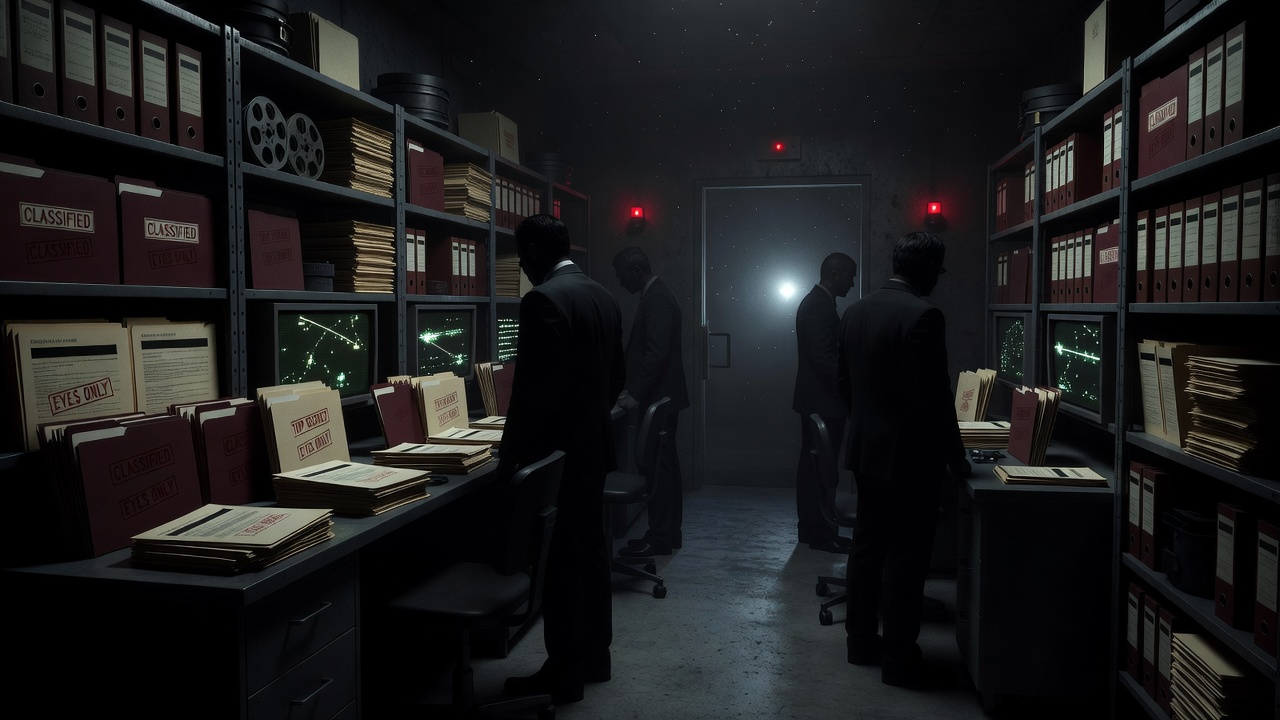
A file box opens. A memo slides under cold archive light. One office closes, another appears, and the public is told the mystery is finally being handled. But across decades of flying-saucer panic, Cold War secrecy, intelligence review panels, and modern UAP task forces, the same cinematic pattern keeps returning: transparency arrives just far enough to calm the crowd, never far enough to end the suspicion.
The Case For
Every generation gets a new UFO office — and every office promises answers while narrowing the story
The conspiracy is not simply that the government looked into UFOs. That part is no longer in dispute. The deeper suspicion is that the government repeatedly builds official channels for the phenomenon that perform two jobs at once: absorb public pressure and contain the narrative. The National Archives’ own Project Blue Book page makes the long arc impossible to ignore. The Air Force investigated UFOs through Project Blue Book, closed it in 1969, recorded 12,618 sightings, and still left 701 cases officially “unidentified.” Then the program was terminated and the public was told the matter was effectively settled.
That closure matters because it set a template. Blue Book did not erase the sightings. It converted a live mystery into an archived one. The records were declassified, boxed, microfilmed, and transferred to history. Public curiosity remained, but the active government posture receded. From a conspiracy-realist perspective, that is a master move: acknowledge just enough to prove you took the issue seriously, leave a residue of unresolved cases, then move the question into the slower machinery of records, experts, and gatekeepers.
The same pattern echoes in modern form. The ODNI’s 2021 Preliminary Assessment on UAP said limited high-quality reporting hampered firm conclusions, that most UAP probably were physical objects, and that more standardized collection was needed. In other words: the government publicly reopened the subject, but under a framework defined by data scarcity, reporting controls, and analytic filtering. The issue was not released into the wild; it was re-contained inside process.
Then came AARO. In its 2024 Historical Record Report, Volume I, the office said it reviewed official U.S. government efforts since 1945, consulted classified and unclassified archives, conducted about 30 interviews, and found no empirical evidence that any reviewed case confirmed extraterrestrial technology or a hidden reverse-engineering program. That is exactly why critics remain suspicious. The office inherits the deepest mystery in modern secrecy culture and then issues a report that is sweeping enough to shape headlines, but still dependent on what it was allowed to see, what witnesses would formally sign, and what classified compartments could be bridged.
The bureaucracy keeps changing names, but the architecture of controlled disclosure stays familiar
Look at the evolution of the public-facing structure. Blue Book gave way to official dormancy. Decades later, the UAP Task Force and then AARO revived the issue as a national-security and aviation-safety problem. NASA entered with an explicitly scientific brand. The NASA UAP page frames the matter around rigorous inquiry, openness, and transparency, while NASA’s September 2023 update announced a Director of UAP Research and said the agency would help build a data pipeline using AI, machine learning, and open-source information. Meanwhile, the National Archives has created Record Group 615, a formal UAP records collection established under the 2024 NDAA.
Put all of that together and the modern UFO office conspiracy comes into view. The state no longer says, “There is nothing to see.” It says something subtler: there is something to see, and we will decide the channels, standards, taxonomies, metadata, records flow, and public timing through which you see it. That is a more durable form of control. Flat denial creates backlash. Managed transparency builds legitimacy.
The Realist’s Eye
The evidence supports a narrative-management machine, even if it does not prove alien bodies in a bunker
A grounded reading has to resist two lazy extremes. One is reflexive dismissal: the claim that every new office proves the government is finally being honest. The other is maximal mythology: the claim that every office is merely a stage prop for a fully exposed alien-cover-up empire. The record does not support either shortcut. What it does support is a repeating pattern in which institutions publicly widen the conversation while retaining procedural control over what counts as evidence.
The 2023 House hearing on UAP, national security, public safety, and government transparency captured the tension perfectly. Members and witnesses repeatedly described over-classification, stigma, underreporting, and congressional frustration. Pilots said the reporting problem was real. Lawmakers said transparency and accountability were at stake. Yet the hearing itself also showed the limit of spectacle. Public concern can force a hearing, a task force, or a new office, but not necessarily unrestricted access to the deepest records or programs.
That is why the archive itself becomes part of the conspiracy frame. NARA’s UAP collection is significant, but it also reveals how disclosure becomes bureaucratized. Agencies identify records, decide what is publicly releasable, transfer digital copies, attach metadata, and release materials on a rolling basis. This may be better than silence, but it is still a curation system. It transforms the old image of the hidden file cabinet into a modern pipeline of staged release, procedural review, and institutional mediation.
We have traced this same structural move before in our coverage of Project Blue Book, AATIP, and Majestic 12. The names differ. The public mood shifts. But the larger arc remains hauntingly consistent: when UFO pressure becomes impossible to ignore, the system does not abandon secrecy. It modernizes it.
The most important question is not “Do officials know everything?” but “Who controls the boundary between mystery and legitimacy?”
That boundary is where the real power sits. Blue Book had the power to classify, investigate, and conclude. AARO has the power to define scope, prioritize cases, frame historical claims, and speak with the authority of interagency review. NASA has the power to dress the issue in the language of open science while still relying on data quality thresholds and institutional partnerships. The National Archives has the power to convert a live political controversy into a searchable records ecosystem that feels transparent even when it remains incomplete.
Seen that way, the UFO office conspiracy is bigger than any single whistleblower or single incident. It is a long-running administrative strategy for metabolizing the unexplained. Instead of one monolithic cover-up, the public gets a relay race of offices: investigate, summarize, archive, relabel, reopen, standardize, and reassure. The mystery survives, but always inside a government-managed frame.
What We Know For Certain
- The National Archives says Project Blue Book investigated UFO reports, closed in 1969, documented 12,618 sightings, and left 701 officially unidentified.
- ODNI’s 2021 preliminary UAP assessment said limited high-quality reporting prevented firm conclusions and called for more standardized collection and analysis.
- AARO’s 2024 historical report says it reviewed official U.S. government UAP efforts since 1945 and found no empirical evidence confirming extraterrestrial technology or a hidden reverse-engineering program.
- NASA publicly committed to a transparency-and-science framework, published an independent UAP study, and created a Director of UAP Research role.
- The National Archives established Record Group 615 so agencies can transfer publicly releasable UAP records to a dedicated federal collection on a rolling basis.
- Congressional hearings have repeatedly framed UAP not only as a mystery issue, but also as a problem of over-classification, underreporting, aviation safety, and public trust.
The Unanswered Questions
- If the government truly believes the phenomenon is mostly misidentification and data noise, why has it repeatedly needed new offices, new reporting systems, and new archival structures?
- How much of the modern disclosure story is being shaped by what agencies choose to classify, transfer, redact, or define as outside scope?
- Can Congress or the public independently verify that every relevant compartment, contractor channel, and legacy program has actually been searched?
- Does “transparency” now function as a trust-restoration brand while the decisive evidence remains filtered through the same institutions that managed secrecy before?
- When a case remains unresolved, who decides whether it is a genuine anomaly, a data failure, or a problem the public simply is not permitted to contextualize?
The Closer — You Decide
Maybe the pattern is innocent. Maybe the unexplained really does require a slow chain of analysts, archivists, scientists, and security officials. But maybe that is also how a durable disclosure-control system would look from the outside: not one black vault door, but a century-spanning procession of offices that inherit the mystery, rename it, standardize it, and hand the public another partial answer. Blue Book did not end the question. ODNI did not end it. NASA did not end it. AARO has not ended it. Instead, each office has helped move the phenomenon from panic to paperwork without dissolving the suspicion at the center of it all. The conspiracy, then, may not be a single hidden craft in a hangar. It may be the quieter and more resilient mechanism that decides when the unknown becomes official, how much becomes visible, and why the truth always seems to arrive already curated.