The Active Archive Conspiracy: Why Hundreds of Official UAP Cases Go Into Limbo Instead of Resolution
The red light on the console goes dark. A pilot files the report. A radar track flickers, a camera clip exists somewhere, a chain of custody begins—and then the case slips behind a phrase so bland it almost sounds harmless: active archive. In that instant, the mystery does not die. It is sealed alive.
The Case For
The new UFO conspiracy is not only about what gets denied. It is about what gets indefinitely warehoused inside an official system built to outlast public attention.
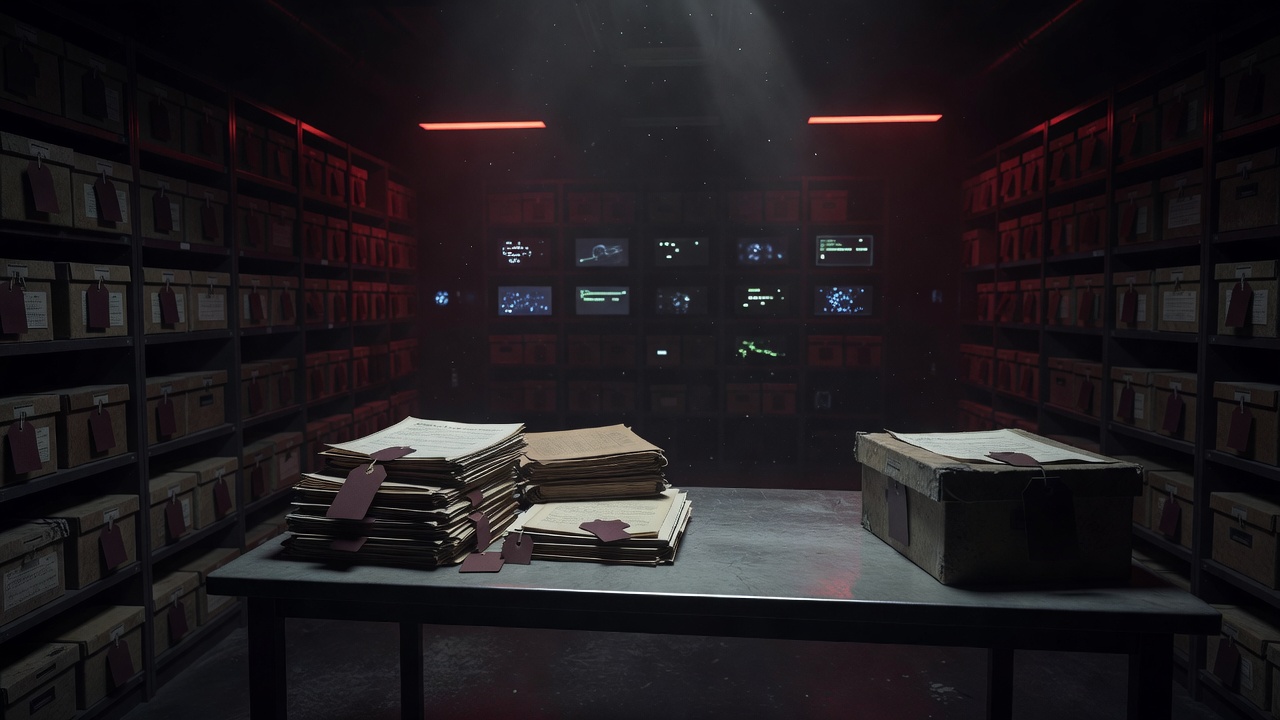
The most revealing phrase in the modern UAP story may not be “non-human intelligence,” “crash retrieval,” or even “classified.” It may be active archive. That bureaucratic label describes a zone where unresolved cases do not disappear, but they also do not fully emerge. They are neither solved nor released in a form the public can independently audit. They remain in a state-managed twilight. That is the heart of the active archive conspiracy: official systems can preserve the most intriguing incidents without ever truly resolving them in public.
The AARO Fiscal Year 2024 consolidated annual report gives the pattern a name and scale. It says the office received 757 reports during the covered period, identified 21 cases that merited further analysis, and placed the remaining 444 cases lacking sufficient data into the Active Archive, where they would be held for pattern-of-life and trend analysis or reexamined if additional data became available. That is already enough to trigger suspicion. Hundreds of cases are not being closed, disproven, or fully opened. They are being stored inside a permanent maybe.
The same report also says AARO’s ability to resolve cases remains constrained by a lack of timely and actionable sensor data. On one level that is a sober methodological statement. On another level it sharpens the conspiracy. If the government’s own anomaly office says its bottleneck is access to the right data, then the public is not imagining a system of selective visibility. It is reading one. The strongest events may not be lost because nothing happened. They may be lost because the sensor custody chain, classification environment, and reporting pipeline never deliver a publicly testable record.
That is what makes the archive feel active in a darker sense. It is not a graveyard of dead files. It is a holding mechanism for unresolved anomalies that can shape internal trend analysis while remaining externally opaque. The state keeps the puzzle pieces. The public gets the press release.
The more transparency expands, the more obvious the holding pen becomes
Paradoxically, the government’s new transparency posture can make the archive conspiracy feel stronger, not weaker. The November 2024 AARO media roundtable transcript features Director Jon Kosloski saying AARO had received more than 1,600 total reports and that over 900 remained in the active archive because they lacked sufficient scientific data for analysis. He added that cases can be reopened if more information emerges. That sounds reasonable. But it also means the archive is not a temporary side room. It is becoming one of the main architectures of the entire phenomenon.
And notice how the numbers move. The more the reporting net expands, the larger the official reservoir of unresolved cases becomes. The archive grows faster than public clarity. The institution can point to openness—reports, websites, briefings, dashboards—while the unresolved core becomes bigger, denser, and harder for outsiders to inspect. If secrecy in the Cold War was a locked drawer, secrecy now can look like a constantly updated database that outsiders are never allowed to meaningfully reconstruct.
The National Archives UAP FAQ adds another strange layer. Under the 2024 NDAA, agencies must identify, digitize, and prepare UAP records for transfer to Record Group 615 on an ongoing rolling basis. For publicly releasable records containing redactions, agencies must transfer both redacted and unredacted copies to NARA. This is real transparency infrastructure. But it also confirms that disclosure arrives through staggered transfer, metadata rules, redaction rules, and institutional custody. The archive is not simply where truth goes to die. It is where truth can be slowed, segmented, and proceduralized until public attention burns out.
The Realist’s Eye
The record does not prove a hidden alien warehouse. It does prove that unresolved official cases are being systematized inside structures the public cannot independently audit.
A realist should reject cartoon thinking. The available record does not prove that every archived UAP case hides extraterrestrial technology, a secret reverse-engineering program, or a coordinated lie stretching across every agency and decade. AARO explicitly says it has found no evidence of extraterrestrial beings, activity, or technology in the cases it has resolved. That matters. Reality is not served by pretending every unanswered question already has a cosmic answer.
But realism also means refusing the false comfort of bureaucratic vocabulary. “Active archive” is not the same thing as resolution. It is an admission of incompleteness on a large scale. The NASA UAP independent study report says UAP analysis is hampered by poor sensor calibration, lack of multiple measurements, missing metadata, and weak baseline data. It also says the importance of multiple well-calibrated sensors is paramount. That finding cuts both ways. It weakens sensationalism, because bad data produce bad conclusions. But it also strengthens suspicion, because if metadata and sensor context are everything, then the public debate is inevitably downstream of the systems that control metadata and sensor context.
The 2023 House hearing on UAP implications for national security, public safety, and government transparency made the institutional tension visible. Members and witnesses repeatedly described stigma, underreporting, and the need for a safe and transparent reporting process. That is not proof of aliens. It is proof that the reporting architecture itself has become part of the controversy. When careers, classification, and chain-of-command all shape what gets reported and how it is preserved, mystery becomes partly administrative.
In other words, the archive conspiracy may be less about one dramatic hidden vault and more about a dispersed machinery of deferral. A case lacks one data stream. A clip is releasable but not its metadata. An event is interesting but unresolved. A pattern is visible internally but not shareable externally. Each decision can be individually defensible. Together they create an ecosystem where the official record never quite becomes public knowledge in full resolution.
The bigger high-level arc is controlled limbo
Controlled limbo is what happens when institutions neither kill a mystery nor liberate it. They preserve it in place. They keep it available for internal pattern analysis, future correlation, and selective reopening, while the outside world is left with fragments, percentages, and carefully managed caveats. That architecture is tailor-made for a conspiracy culture that suspects the state never actually says “no” when it can say “not yet.”
Seen that way, the active archive is the natural companion to our recent deep dives on the UFO disclosure conspiracy, the UFO office conspiracy, official acknowledgment, and sensor gatekeeping. Different layer, same pattern. Reports are encouraged, data are centralized, public language sounds measured, and the most unresolved material remains lodged inside systems outsiders cannot fully test.
Maybe that is responsible governance. Maybe it reflects the real difficulty of sorting balloons, drones, satellites, sensor artifacts, and rare unknowns in a cluttered modern sky. But it also means ordinary people are justified in asking a very old question in a very new form: when a state says it is preserving the evidence for later, who decides when later finally arrives?
What We Know For Certain
- The AARO FY2024 annual report said 757 UAP reports were received during the covered period and that 444 cases lacking sufficient data were placed in the Active Archive.
- The same AARO report said archived cases are held for pattern-of-life and trend analysis and may be reopened if additional information becomes available.
- The report also said AARO’s ability to resolve cases remains constrained by a lack of timely and actionable sensor data.
- In the November 2024 media roundtable, Director Jon Kosloski said AARO had received more than 1,600 total reports and that over 900 remained in the active archive because they lacked sufficient scientific data.
- Kosloski also said fewer than 3.5 percent of cases still retained anomalous characteristics after initial analysis and that AARO had found no verifiable evidence of extraterrestrial beings, activity, or technology.
- The National Archives UAP FAQ says agencies are transferring UAP records to Record Group 615 on an ongoing rolling basis.
- The same NARA FAQ says publicly releasable UAP records with redactions must be transferred in both redacted and unredacted form, along with required metadata.
- NASA’s 2023 study report said UAP analysis is hampered by missing metadata, poor calibration, lack of multiple measurements, and weak baseline data.
- The 2023 House hearing transcript repeatedly framed stigma, underreporting, and transparent reporting pathways as real institutional issues.
The Unanswered Questions
- How many of the most provocative UAP cases are stuck in active archive not because they were trivial, but because the necessary sensor context never became shareable?
- If the archive is designed for future correlation, who outside the government will ever be able to independently test the patterns officials say they see?
- What percentage of archived cases involve high-interest military areas, advanced sensors, or classification barriers that the public will never be allowed to inspect directly?
- Does rolling transfer to the National Archives create genuine disclosure, or does it create a second slower archive that preserves uncertainty under the banner of openness?
- At what point does “pending more data” become a permanent bureaucratic answer rather than a temporary scientific one?
The Closer — You Decide
Maybe the active archive conspiracy is simply what honest uncertainty looks like inside a national-security bureaucracy. Maybe hundreds of UAP cases really do lack the sensor quality, calibration history, metadata, and corroboration needed for a clean answer. If so, the archive is not sinister. It is just the filing cabinet version of scientific restraint.
But the darker reading survives because the modern state has built a perfect machine for indefinite suspense. It can admit the cases are real reports, admit they were serious enough to preserve, admit they may matter for trend analysis, admit they may be reopened later—and still keep the decisive context out of reach. The result is not total secrecy. It is something more durable: managed incompletion.
That is why the active archive conspiracy has such staying power. It does not need a smoking gun in a hangar. It only needs a system that can hold unresolved anomalies in official custody longer than the public can hold its breath. And if that system keeps growing, the biggest secret may not be what is hidden in the files. It may be how long a government can keep history in a state of maybe.