Menu

Ghost Fleet of 1918

Ghost Fleet of 1918
Ghost Fleet of 1918

Imagine you’re standing on the deck of a creaky collier ship in 1918, the Atlantic wind whipping salt spray into your face. World War I is grinding to a bloody halt, U-boats lurk in the shadows, and your vessel is loaded to the gunwales with manganese ore—vital for steel production back home. The Bermuda Triangle looms ahead, that infamous stretch of ocean where compasses spin wild and ships slip into oblivion. You send your last radio message, routine as breathing: “All’s well.” Then… silence. No distress call. No debris. No trace. Just gone.

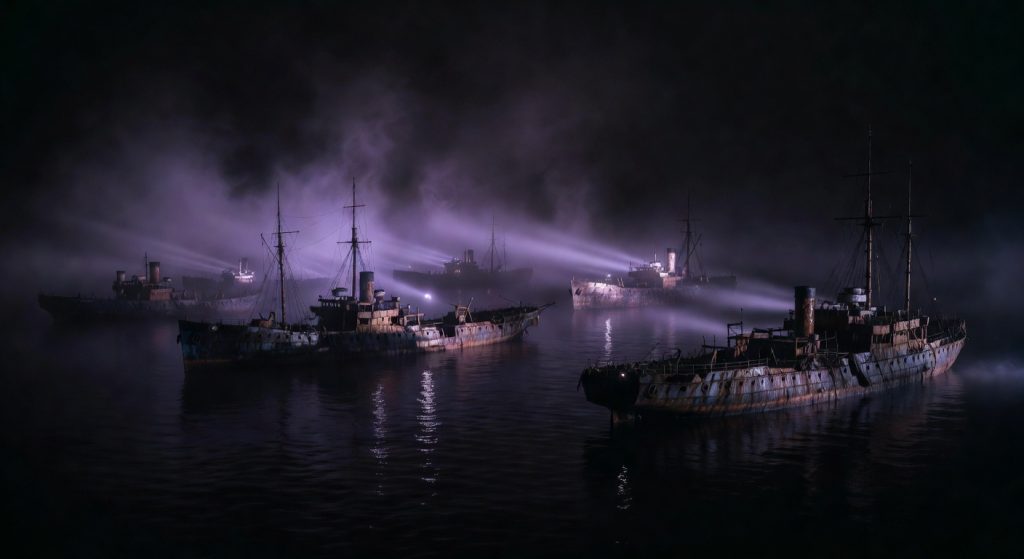
This isn’t some ghost story from a dime novel. This is the Ghost Fleet of 1918, a trio of U.S. Navy colliers—USS Cyclops, USS Proteus, and USS Nereus—that vanished without a whisper in the span of a few fateful months. Over 550 souls lost, no wreckage ever found. It’s the kind of maritime enigma that makes seasoned sailors cross themselves and conspiracy realists like us dig deeper. Was it freak weather? Structural flaws? Sabotage by German agents? Or something far stranger pulling strings from the deep? Buckle up, because we’re diving into this watery abyss, piecing together history, hard evidence, and the wild theories that keep it alive a century later.

The Chaotic Backdrop: World War I’s Maritime Mayhem

To grasp the Ghost Fleet saga, you have to zoom out to 1918. The Great War had turned the Atlantic into a floating graveyard. German U-boats prowled relentlessly, sinking over 5,000 Allied ships and claiming 15,000 lives. By Armistice in November, the U.S. Navy was saddled with a massive surplus of vessels—hastily built “hogs” like the colliers, designed not for elegance but for brute hauling.

These weren’t luxury liners; they were workhorses. The Cyclops-class colliersProteus, Nereus, and Cyclops herself—were massive at 542 feet long, each capable of lugging 12,500 tons. Built pre-war, they’d been repurposed for ferrying coal, bauxite, and that mysterious manganese ore. Post-war demobilization meant a frenzy of troop transports and supply runs from the Caribbean to Baltimore. Weather? Brutal. The “Triangle” zone—roughly Miami, Bermuda, Puerto Rico—saw vicious squalls, rogue waves, and magnetic anomalies that could scramble a compass.

Historical records from the U.S. Naval Historical Center paint a grim picture: shipping losses spiked in 1918, with 1917-1918 claiming more vessels than any other war year. But the Ghost Fleet? They didn’t go down fighting U-boats. No maydays. No oil slicks. Just poof.

The Vanishing Act Begins: USS Cyclops, March 1918

Let’s start with the headliner: USS Cyclops. Launched in 1910, she was a beast—19,360 tons displacement, crewed by 306 souls under Captain George W. Worley, a German-born naturalized American with a shadowy rep. Rumors swirled he’d served in the Kaiserliche Marine pre-war. Shady? Maybe.

On February 16, 1918, Cyclops loaded 10,600 tons of manganese ore in Brazil—super-dense stuff, half the ship’s capacity. By March 4, Barbados logs note her departure for Baltimore, last seen steaming north. A single radio ping on March 10: position report, all calm. Then nothing. Searches by the Navy and Coast Guard covered 240,000 square miles. Zilch.

Theories exploded. Official Navy Court of Inquiry (May 1918) blamed “structural failure” from uneven ore loading—Cyclops had a known hogged keel, sagging amidships like a tired camel. But no wreckage? Manganese ore should’ve left a telltale stain. The Navy’s own historical summary admits bafflement: “No sound of explosion, no wireless, no wreckage.”

Conspiracy angle: Worley’s pro-German leanings. FBI files (declassified later) probed sabotage—ore laced with explosives? A German agent aboard? Or worse, Worley plotting mutiny? No proof, but it fueled whispers.

Sisters in Silence: USS Proteus and USS Nereus Follow Suit

If Cyclops was eerie, her sisters cranked it to nightmare fuel. USS Proteus, launched 1913, sister ship identical in specs. December 23, 1918—post-Armistice—she sails from St. Thomas, Virgin Islands, with 58 crew, bauxite cargo, bound for Norfolk. Last contact: routine radio. Vanished. No trace.

Then USS Nereus, the baby sister, launched 1913. Christmas Eve 1918—irony noted—she departs the same port, same route, 56 aboard, more bauxite. Same fate: radio silence, eternal absence.

All three on identical runs. All colliers. All lost within 10 months. Navy logs confirm no U-boat claims—war was over. Searches? Futile. By 1919, the fleet was dubbed “ghosts” in naval dispatches.

Digging for Evidence: What the Records Really Say

Poring over primary sources flips the script from folklore to forensics. The Library of Congress holds Cyclops deck logs up to March 3—sunny skies, steady course. Weather reports from nearby ships? Clear-ish, but squalls possible.

A 2006 NOAA magnetic survey found no anomalies in the Triangle—debunking compass myths. Yet, Lloyd’s of London refused Cyclops insurance payout for decades, citing “suspicious circumstances.” Manganese ore? Tests show it absorbs water, potentially destabilizing overloaded hulls. A 1918 Navy report noted Cyclops rode unnaturally low—10 feet deeper than spec.

Eyewitness oddities: Barbados fishermen swore they saw Cyclops days later, listing badly. A 1918 New York Times article quoted a pilot spotting “smoke puffs” in her path—explosion?

External deep dive: Check out Larry Kusche’s The Bermuda Triangle Mystery Solved (1975), which crunches the data—available via Smithsonian scans—arguing mundane causes. But even Kusche admits the colliers’ triple whammy defies odds.

Conspiracy Theories: From Mundane to Mind-Bending

Now, the fun part—rabbit holes galore.

Theory 1: Killer Cargo. Manganese ore’s density + poor trim = snap. Sister ships overloaded similarly. Plausible, evidence-backed by naval engineers.

Theory 2: Rogue Waves & Freak Storms. Sargasso Sea calms mask micro-bursts. 1918 had La Niña extremes—waves topping 100 feet possible.

Theory 3: Sabotage. Worley’s German roots. Proteus captain William McNeil had crew gripes. Black Tom explosion (1916 German sabotage in NY) precedent.

Theory 4: Bermuda Triangle Weirdness. Methane hydrates erupting, sucking ships under. Or portals—Charles Berlitz‘s 1974 book The Bermuda Triangle popularized it, citing Cyclops as Exhibit A.

Wild Card: Nazi Tech or UFOs? Post-war docs hint at captured foo fighters tech mirroring 1918 anomalies. Tinfoil? Sure, but FOIA releases on Navy “ghost sightings” add spice.

Stats: Of 50+ Triangle losses, Ghost Fleet is the clusterfuck crown jewel—zero distress, sister ships, no bodies.

Echoes Through Time: Legacy and Modern Echoes

The Ghost Fleet didn’t fade; it shaped lore. Cyclops inspired The Bermuda Triangle craze of the ’70s, Spielberg’s Close Encounters vibes. Navy named no successor collier “Cyclops”—superstition?

Modern parallels: MV Derbyshire (1976, 44 lost, no trace—ore carrier). El Faro (2015, Bahamas Triangle, squall doom). Echoes?

Families? Haunting. Cyclops survivor kin still petition for answers. Navy memorial: “Lost at sea, forever.”

Down the Rabbit Hole

Ready to spiral deeper? Here are 5 related deep dives for ConspiracyRealist.com:

1. The Black Tom Explosion: German Sabotage Precursor to Ghost Fleet? WWI NYC blast—links to Worley?

2. Foo Fighters & WWI UFO Sightings Over the Atlantic Nazi wonder weapons or interdimensional scouts?

3. Methane Eruptions: Science Behind Triangle Ship-Swallowers NOAA data unpacked.

4. USS Cyclops Captain: Traitor or Victim? Declassified FBI dossier on Worley.

5. Modern Ghost Ships: From El Faro to Baltic Anomaly Today’s vanishings mirror 1918.

What do you think sank them? Mundane overload or Triangle tentacles? Drop theories in comments—we’re all ears.

Disclaimer: This article draws from declassified records, historical analyses, and eyewitness accounts. While evidence-based, maritime mysteries like the Ghost Fleet remain unsolved—approach theories with healthy skepticism. Not financial or safety advice; sea travel at your own risk.

dive down the rabbit hole

Ghost Fleet of 1918

S-FX.com
Ghost Fleet of 1918

Imagine you’re standing on the deck of a creaky collier ship in 1918, the Atlantic wind whipping salt spray into your face. World War I is grinding to a bloody halt, U-boats lurk in the shadows, and your vessel is loaded to the gunwales with manganese ore—vital for steel production back home. The Bermuda Triangle looms ahead, that infamous stretch of ocean where compasses spin wild and ships slip into oblivion. You send your last radio message, routine as breathing: “All’s well.” Then… silence. No distress call. No debris. No trace. Just gone.

This isn’t some ghost story from a dime novel. This is the Ghost Fleet of 1918, a trio of U.S. Navy colliers—USS Cyclops, USS Proteus, and USS Nereus—that vanished without a whisper in the span of a few fateful months. Over 550 souls lost, no wreckage ever found. It’s the kind of maritime enigma that makes seasoned sailors cross themselves and conspiracy realists like us dig deeper. Was it freak weather? Structural flaws? Sabotage by German agents? Or something far stranger pulling strings from the deep? Buckle up, because we’re diving into this watery abyss, piecing together history, hard evidence, and the wild theories that keep it alive a century later.

The Chaotic Backdrop: World War I’s Maritime Mayhem

To grasp the Ghost Fleet saga, you have to zoom out to 1918. The Great War had turned the Atlantic into a floating graveyard. German U-boats prowled relentlessly, sinking over 5,000 Allied ships and claiming 15,000 lives. By Armistice in November, the U.S. Navy was saddled with a massive surplus of vessels—hastily built “hogs” like the colliers, designed not for elegance but for brute hauling.

These weren’t luxury liners; they were workhorses. The Cyclops-class colliersProteus, Nereus, and Cyclops herself—were massive at 542 feet long, each capable of lugging 12,500 tons. Built pre-war, they’d been repurposed for ferrying coal, bauxite, and that mysterious manganese ore. Post-war demobilization meant a frenzy of troop transports and supply runs from the Caribbean to Baltimore. Weather? Brutal. The “Triangle” zone—roughly Miami, Bermuda, Puerto Rico—saw vicious squalls, rogue waves, and magnetic anomalies that could scramble a compass.

Historical records from the U.S. Naval Historical Center paint a grim picture: shipping losses spiked in 1918, with 1917-1918 claiming more vessels than any other war year. But the Ghost Fleet? They didn’t go down fighting U-boats. No maydays. No oil slicks. Just poof.

The Vanishing Act Begins: USS Cyclops, March 1918

Let’s start with the headliner: USS Cyclops. Launched in 1910, she was a beast—19,360 tons displacement, crewed by 306 souls under Captain George W. Worley, a German-born naturalized American with a shadowy rep. Rumors swirled he’d served in the Kaiserliche Marine pre-war. Shady? Maybe.

On February 16, 1918, Cyclops loaded 10,600 tons of manganese ore in Brazil—super-dense stuff, half the ship’s capacity. By March 4, Barbados logs note her departure for Baltimore, last seen steaming north. A single radio ping on March 10: position report, all calm. Then nothing. Searches by the Navy and Coast Guard covered 240,000 square miles. Zilch.

Theories exploded. Official Navy Court of Inquiry (May 1918) blamed “structural failure” from uneven ore loading—Cyclops had a known hogged keel, sagging amidships like a tired camel. But no wreckage? Manganese ore should’ve left a telltale stain. The Navy’s own historical summary admits bafflement: “No sound of explosion, no wireless, no wreckage.”

Conspiracy angle: Worley’s pro-German leanings. FBI files (declassified later) probed sabotage—ore laced with explosives? A German agent aboard? Or worse, Worley plotting mutiny? No proof, but it fueled whispers.

Sisters in Silence: USS Proteus and USS Nereus Follow Suit

If Cyclops was eerie, her sisters cranked it to nightmare fuel. USS Proteus, launched 1913, sister ship identical in specs. December 23, 1918—post-Armistice—she sails from St. Thomas, Virgin Islands, with 58 crew, bauxite cargo, bound for Norfolk. Last contact: routine radio. Vanished. No trace.

Then USS Nereus, the baby sister, launched 1913. Christmas Eve 1918—irony noted—she departs the same port, same route, 56 aboard, more bauxite. Same fate: radio silence, eternal absence.

All three on identical runs. All colliers. All lost within 10 months. Navy logs confirm no U-boat claims—war was over. Searches? Futile. By 1919, the fleet was dubbed “ghosts” in naval dispatches.

Digging for Evidence: What the Records Really Say

Poring over primary sources flips the script from folklore to forensics. The Library of Congress holds Cyclops deck logs up to March 3—sunny skies, steady course. Weather reports from nearby ships? Clear-ish, but squalls possible.

A 2006 NOAA magnetic survey found no anomalies in the Triangle—debunking compass myths. Yet, Lloyd’s of London refused Cyclops insurance payout for decades, citing “suspicious circumstances.” Manganese ore? Tests show it absorbs water, potentially destabilizing overloaded hulls. A 1918 Navy report noted Cyclops rode unnaturally low—10 feet deeper than spec.

Eyewitness oddities: Barbados fishermen swore they saw Cyclops days later, listing badly. A 1918 New York Times article quoted a pilot spotting “smoke puffs” in her path—explosion?

External deep dive: Check out Larry Kusche’s The Bermuda Triangle Mystery Solved (1975), which crunches the data—available via Smithsonian scans—arguing mundane causes. But even Kusche admits the colliers’ triple whammy defies odds.

Conspiracy Theories: From Mundane to Mind-Bending

Now, the fun part—rabbit holes galore.

Theory 1: Killer Cargo. Manganese ore’s density + poor trim = snap. Sister ships overloaded similarly. Plausible, evidence-backed by naval engineers.

Theory 2: Rogue Waves & Freak Storms. Sargasso Sea calms mask micro-bursts. 1918 had La Niña extremes—waves topping 100 feet possible.

Theory 3: Sabotage. Worley’s German roots. Proteus captain William McNeil had crew gripes. Black Tom explosion (1916 German sabotage in NY) precedent.

Theory 4: Bermuda Triangle Weirdness. Methane hydrates erupting, sucking ships under. Or portals—Charles Berlitz‘s 1974 book The Bermuda Triangle popularized it, citing Cyclops as Exhibit A.

Wild Card: Nazi Tech or UFOs? Post-war docs hint at captured foo fighters tech mirroring 1918 anomalies. Tinfoil? Sure, but FOIA releases on Navy “ghost sightings” add spice.

Stats: Of 50+ Triangle losses, Ghost Fleet is the clusterfuck crown jewel—zero distress, sister ships, no bodies.

Echoes Through Time: Legacy and Modern Echoes

The Ghost Fleet didn’t fade; it shaped lore. Cyclops inspired The Bermuda Triangle craze of the ’70s, Spielberg’s Close Encounters vibes. Navy named no successor collier “Cyclops”—superstition?

Modern parallels: MV Derbyshire (1976, 44 lost, no trace—ore carrier). El Faro (2015, Bahamas Triangle, squall doom). Echoes?

Families? Haunting. Cyclops survivor kin still petition for answers. Navy memorial: “Lost at sea, forever.”

Down the Rabbit Hole

Ready to spiral deeper? Here are 5 related deep dives for ConspiracyRealist.com:

1. The Black Tom Explosion: German Sabotage Precursor to Ghost Fleet? WWI NYC blast—links to Worley?

2. Foo Fighters & WWI UFO Sightings Over the Atlantic Nazi wonder weapons or interdimensional scouts?

3. Methane Eruptions: Science Behind Triangle Ship-Swallowers NOAA data unpacked.

4. USS Cyclops Captain: Traitor or Victim? Declassified FBI dossier on Worley.

5. Modern Ghost Ships: From El Faro to Baltic Anomaly Today’s vanishings mirror 1918.

What do you think sank them? Mundane overload or Triangle tentacles? Drop theories in comments—we’re all ears.

Disclaimer: This article draws from declassified records, historical analyses, and eyewitness accounts. While evidence-based, maritime mysteries like the Ghost Fleet remain unsolved—approach theories with healthy skepticism. Not financial or safety advice; sea travel at your own risk.

Ghost Fleet of 1918

Ghost Fleet of 1918

Imagine you’re standing on the deck of a creaky collier ship in 1918, the Atlantic wind whipping salt spray into your face. World War I is grinding to a bloody halt, U-boats lurk in the shadows, and your vessel is loaded to the gunwales with manganese ore—vital for steel production back home. The Bermuda Triangle looms ahead, that infamous stretch of ocean where compasses spin wild and ships slip into oblivion. You send your last radio message, routine as breathing: “All’s well.” Then… silence. No distress call. No debris. No trace. Just gone.

This isn’t some ghost story from a dime novel. This is the Ghost Fleet of 1918, a trio of U.S. Navy colliers—USS Cyclops, USS Proteus, and USS Nereus—that vanished without a whisper in the span of a few fateful months. Over 550 souls lost, no wreckage ever found. It’s the kind of maritime enigma that makes seasoned sailors cross themselves and conspiracy realists like us dig deeper. Was it freak weather? Structural flaws? Sabotage by German agents? Or something far stranger pulling strings from the deep? Buckle up, because we’re diving into this watery abyss, piecing together history, hard evidence, and the wild theories that keep it alive a century later.

The Chaotic Backdrop: World War I’s Maritime Mayhem

To grasp the Ghost Fleet saga, you have to zoom out to 1918. The Great War had turned the Atlantic into a floating graveyard. German U-boats prowled relentlessly, sinking over 5,000 Allied ships and claiming 15,000 lives. By Armistice in November, the U.S. Navy was saddled with a massive surplus of vessels—hastily built “hogs” like the colliers, designed not for elegance but for brute hauling.

These weren’t luxury liners; they were workhorses. The Cyclops-class colliersProteus, Nereus, and Cyclops herself—were massive at 542 feet long, each capable of lugging 12,500 tons. Built pre-war, they’d been repurposed for ferrying coal, bauxite, and that mysterious manganese ore. Post-war demobilization meant a frenzy of troop transports and supply runs from the Caribbean to Baltimore. Weather? Brutal. The “Triangle” zone—roughly Miami, Bermuda, Puerto Rico—saw vicious squalls, rogue waves, and magnetic anomalies that could scramble a compass.

Historical records from the U.S. Naval Historical Center paint a grim picture: shipping losses spiked in 1918, with 1917-1918 claiming more vessels than any other war year. But the Ghost Fleet? They didn’t go down fighting U-boats. No maydays. No oil slicks. Just poof.

The Vanishing Act Begins: USS Cyclops, March 1918

Let’s start with the headliner: USS Cyclops. Launched in 1910, she was a beast—19,360 tons displacement, crewed by 306 souls under Captain George W. Worley, a German-born naturalized American with a shadowy rep. Rumors swirled he’d served in the Kaiserliche Marine pre-war. Shady? Maybe.

On February 16, 1918, Cyclops loaded 10,600 tons of manganese ore in Brazil—super-dense stuff, half the ship’s capacity. By March 4, Barbados logs note her departure for Baltimore, last seen steaming north. A single radio ping on March 10: position report, all calm. Then nothing. Searches by the Navy and Coast Guard covered 240,000 square miles. Zilch.

Theories exploded. Official Navy Court of Inquiry (May 1918) blamed “structural failure” from uneven ore loading—Cyclops had a known hogged keel, sagging amidships like a tired camel. But no wreckage? Manganese ore should’ve left a telltale stain. The Navy’s own historical summary admits bafflement: “No sound of explosion, no wireless, no wreckage.”

Conspiracy angle: Worley’s pro-German leanings. FBI files (declassified later) probed sabotage—ore laced with explosives? A German agent aboard? Or worse, Worley plotting mutiny? No proof, but it fueled whispers.

Sisters in Silence: USS Proteus and USS Nereus Follow Suit

If Cyclops was eerie, her sisters cranked it to nightmare fuel. USS Proteus, launched 1913, sister ship identical in specs. December 23, 1918—post-Armistice—she sails from St. Thomas, Virgin Islands, with 58 crew, bauxite cargo, bound for Norfolk. Last contact: routine radio. Vanished. No trace.

Then USS Nereus, the baby sister, launched 1913. Christmas Eve 1918—irony noted—she departs the same port, same route, 56 aboard, more bauxite. Same fate: radio silence, eternal absence.

All three on identical runs. All colliers. All lost within 10 months. Navy logs confirm no U-boat claims—war was over. Searches? Futile. By 1919, the fleet was dubbed “ghosts” in naval dispatches.

Digging for Evidence: What the Records Really Say

Poring over primary sources flips the script from folklore to forensics. The Library of Congress holds Cyclops deck logs up to March 3—sunny skies, steady course. Weather reports from nearby ships? Clear-ish, but squalls possible.

A 2006 NOAA magnetic survey found no anomalies in the Triangle—debunking compass myths. Yet, Lloyd’s of London refused Cyclops insurance payout for decades, citing “suspicious circumstances.” Manganese ore? Tests show it absorbs water, potentially destabilizing overloaded hulls. A 1918 Navy report noted Cyclops rode unnaturally low—10 feet deeper than spec.

Eyewitness oddities: Barbados fishermen swore they saw Cyclops days later, listing badly. A 1918 New York Times article quoted a pilot spotting “smoke puffs” in her path—explosion?

External deep dive: Check out Larry Kusche’s The Bermuda Triangle Mystery Solved (1975), which crunches the data—available via Smithsonian scans—arguing mundane causes. But even Kusche admits the colliers’ triple whammy defies odds.

Conspiracy Theories: From Mundane to Mind-Bending

Now, the fun part—rabbit holes galore.

Theory 1: Killer Cargo. Manganese ore’s density + poor trim = snap. Sister ships overloaded similarly. Plausible, evidence-backed by naval engineers.

Theory 2: Rogue Waves & Freak Storms. Sargasso Sea calms mask micro-bursts. 1918 had La Niña extremes—waves topping 100 feet possible.

Theory 3: Sabotage. Worley’s German roots. Proteus captain William McNeil had crew gripes. Black Tom explosion (1916 German sabotage in NY) precedent.

Theory 4: Bermuda Triangle Weirdness. Methane hydrates erupting, sucking ships under. Or portals—Charles Berlitz‘s 1974 book The Bermuda Triangle popularized it, citing Cyclops as Exhibit A.

Wild Card: Nazi Tech or UFOs? Post-war docs hint at captured foo fighters tech mirroring 1918 anomalies. Tinfoil? Sure, but FOIA releases on Navy “ghost sightings” add spice.

Stats: Of 50+ Triangle losses, Ghost Fleet is the clusterfuck crown jewel—zero distress, sister ships, no bodies.

Echoes Through Time: Legacy and Modern Echoes

The Ghost Fleet didn’t fade; it shaped lore. Cyclops inspired The Bermuda Triangle craze of the ’70s, Spielberg’s Close Encounters vibes. Navy named no successor collier “Cyclops”—superstition?

Modern parallels: MV Derbyshire (1976, 44 lost, no trace—ore carrier). El Faro (2015, Bahamas Triangle, squall doom). Echoes?

Families? Haunting. Cyclops survivor kin still petition for answers. Navy memorial: “Lost at sea, forever.”

Down the Rabbit Hole

Ready to spiral deeper? Here are 5 related deep dives for ConspiracyRealist.com:

1. The Black Tom Explosion: German Sabotage Precursor to Ghost Fleet? WWI NYC blast—links to Worley?

2. Foo Fighters & WWI UFO Sightings Over the Atlantic Nazi wonder weapons or interdimensional scouts?

3. Methane Eruptions: Science Behind Triangle Ship-Swallowers NOAA data unpacked.

4. USS Cyclops Captain: Traitor or Victim? Declassified FBI dossier on Worley.

5. Modern Ghost Ships: From El Faro to Baltic Anomaly Today’s vanishings mirror 1918.

What do you think sank them? Mundane overload or Triangle tentacles? Drop theories in comments—we’re all ears.

Disclaimer: This article draws from declassified records, historical analyses, and eyewitness accounts. While evidence-based, maritime mysteries like the Ghost Fleet remain unsolved—approach theories with healthy skepticism. Not financial or safety advice; sea travel at your own risk.

Table of contents