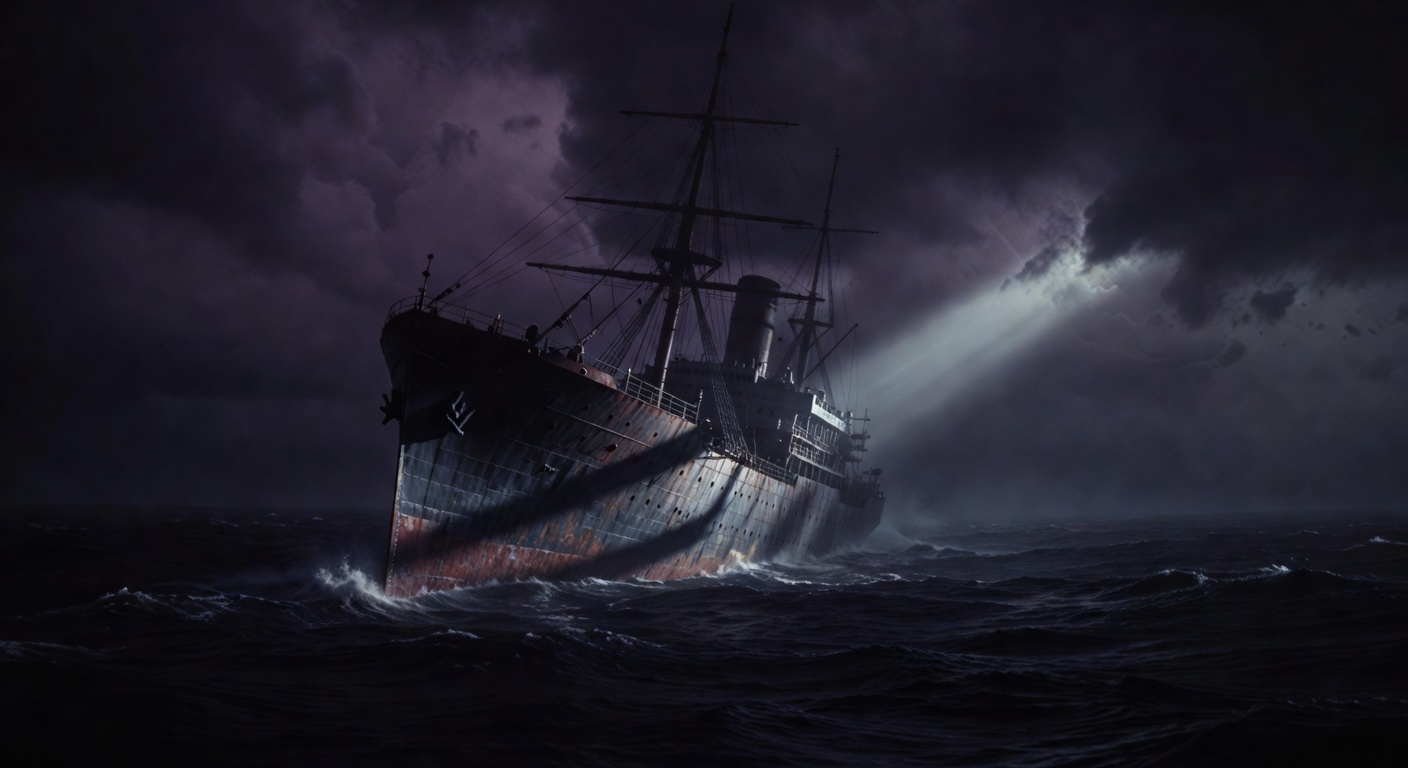
Imagine you’re standing on the deck of a massive steel behemoth, the salty spray whipping your face as the ship plows through churning Atlantic waves. It’s March 1918, World War I rages, and you’re part of the crew on the USS Cyclops, loaded with 10,600 tons of dense manganese ore, heading from Barbados to Baltimore. Everything seems routine—until it isn’t. Radio silence. No distress call. No debris. Just… gone. Poof. One of the largest U.S. Navy losses in history, 306 souls vanished without a whisper. This isn’t just a ghost story; it’s a rabbit hole that sucks you in, from structural flaws to mutant Nazis and beyond. Buckle up, truth-seekers—let’s chase the shadows of the USS Cyclops.
The Birth of a Beast: Building the Cyclops Legend
Let’s rewind to 1910. The USS Cyclops wasn’t born in some glamorous shipyard with champagne bottle-smashing fanfare. No, she was a workhorse from the start, launched by William Cramp & Sons in Philadelphia as a collier—a floating coal barge for the Navy. Picture this: 542 feet long, 65 feet wide, displacing a whopping 19,360 tons fully loaded. That’s bigger than the Titanic in some dimensions, though not as luxurious. Her one-stack, turbine-powered design screamed efficiency, hauling coal to fuel the war machine across oceans.
Why “Cyclops”? Straight from Greek myth—the one-eyed giants who forged Zeus’s thunderbolts. Ironic, right? Strength personified, but with a glaring flaw. Early on, she showed cracks—literally. In 1911, during builder’s trials, the Navy flagged structural weaknesses in her hull. Rivets popped like champagne corks under stress tests. They patched her up, but whispers of fragility lingered. By World War I, she was shuttling supplies from Brazil to the U.S., her decks groaning under cargo that pushed her limits.
Historical records from the Naval History and Heritage Command paint her as reliable yet cursed. Multiple captains rotated off her, citing unease. Captain George Worley, her final skipper, was a German-born naturalized American with a shady rep—rumors of mutinies and alcoholism swirled. Was he the one-eyed monster steering her to doom? Crew manifest showed 236 officers and men, plus 70 passengers—wives, kids, even a blacksmith. Overloaded? Check. Storm-prone route? Double check.
The Doomed Voyage: From Barbados to Oblivion
Fast-forward to February 1918. World War I is grinding on, U-boats prowl the seas, and America needs steel. Manganese ore from Brazil is the ticket—vital for munitions. The Cyclops had just survived a grueling run: Norfolk to Rio, then up to Barbados, dumping off coal and picking up that massive ore load. On March 4, she radioed USS Juno in Bridgetown: “Weather fair, all well.” No mention of the sister ships USS Proteus and USS Nereus—those behemoths would vanish similarly in 1941, hauling the same ore on the same route. Coincidence?
Captain Worley skipped the mandatory sailing report to San Juan—protocol be damned. She steamed north at 15 knots, fat with 10,600 tons of ore (her max was 12,500, but unevenly distributed low in the hold). Eyewitnesses in Barbados noted her listing to port, crew frantically shifting deck cargo to balance her. Weather reports? Squally, but nothing apocalyptic. Last ping: March 4 afternoon, calm seas, position 28°N 59°W—right in the Bermuda Triangle heart.
By March 9, Baltimore Navy Yard raises alarms. No-show. Secretary of the Navy Josephus Daniels cables searches. Planes from Punta Cana to Norfolk, destroyers sweeping 250,000 square miles. Nada. President Woodrow Wilson personally inquired. The Navy’s official report? “Overloaded, poorly ballasted, foundered in heavy weather.” But zero wreckage? No oil slicks? That’s when the paranoia kicks in.
Official Story: Mundane Disaster or Whitewash?
The Navy’s line was simple: she capsized under her own weight. That manganese ore? Super-dense, shifted in swells, turning stability into a death sentence. Experts like marine architect William Kimball testified the low center of gravity should’ve saved her—but if flooded or ore liquefied (a real phenomenon called dynamic loading), down she goes. No SOS because it happened fast—boilers explode, hull splits, end of transmission.
But hold up. A 1918 New York Times investigation (you can dig into it here) highlighted anomalies. No storm severe enough logged nearby. Sister ships survived identical loads. And that search? Futile because they hunted the wrong path—Cyclops zigzagged to dodge U-boats, per logs. Cover-up? Maybe to hide Worley’s incompetence.
Dive deeper: Autopsies on the “curse.” Cyclops had a history of mishaps—grounded in 1912, collided in 1915. Her engines? Coal-fired relics, prone to failure. Worley? Deserted a prior ship, SS Vicksburg, in 1917 amid theft rumors. Navy brass knew but sailed her anyway. Wartime desperation?
Enter the Triangle: Magnetic Mayhem and Methane Bubbles
Now, the fun stuff. Bermuda Triangle lore exploded post-Cyclops. Coined by Vincent Gaddis in 1964, this devil’s sea from Miami to Bermuda to Puerto Rico claims Flight 19, the Marilyn yacht, countless others. Cyclops fits like a glove—position matches. Theories?
Compass chaos: The Triangle’s “Agonic Line” where magnetic north equals true north, screwing navigation. Old compasses on Cyclops? Could’ve veered her into reefs. But she had gyrocompasses—modern for 1918.
Methane hydrates: Seabed gas pockets erupt, drop water density, sink ships instantly. No bubbles reported, but invisible doom? Plausible, per USGS studies.
Rogue waves: 100-footers from wave interference. Freak swells crumple freighters. Oceanographer Susan Casey in The Wave documents them—Cyclops size matches victims.
Skeptics yawn. Larry Kusche‘s The Bermuda Triangle Mystery Solved (1975) debunks: Bad weather, pilot error. Cyclops? Just another overloaded tub. But no wreckage? That’s the hook.
Conspiracy Corner: Mutiny, Monsters, and Missing Treasure
Here’s where we go full tinfoil. Mutiny theory: Worley, the “Hun” captain (anti-German hysteria peaked), plots with 70 German crew to scuttle her. Steal the ore? Sell to Kaiser? Bodies dumped, ship repainted as “SS Kate**? No records of such a vessel, but whispers persist.
Nazi superweapon: Time-slip to 1945? Aluminum Foo Fighters (Nazi orbs) zapped her? Or Die Glocke, the anti-gravity bell, warped her to Argentina. UFOlogist Kevin D. Randle ties it to Roswell-esque cover-ups.
Mutant angle: Lead-lined holds (ore rumor) bred bacteria? Crew hallucinated, fought krakens? Tabloid gold.
Treasure trove: Manganese worth millions today—black market pirates? Or Atlantis tech yanked her under.
Evidence? Thin. But Josephus Daniels diary notes “mutiny possible.” Declassified ONI files hint espionage. Fleet Admiral William D. Leahy called it “greatest mystery.”
Modern Echoes: Lessons from the Abyss
Fast-forward. No wreck found despite sonar sweeps. 2006 ROV hunts? Zilch. Climate models recreate her path—storm should’ve been survivable. National Underwater and Atmospheric Administration (NOAA) shrugs: “Unknown causes.”
Implications? Navy bulk carrier design changed post-Cyclops—better ballast laws. But the void haunts: Largest non-combat U.S. ship loss ever. Families waited decades for closure. Congressional hearings in 1918 fizzled.
What grips us? The nothingness. No closure, just questions. In a mapped world of GPS and satellites, how does a city-sized ship evaporate?
Down the Rabbit Hole
- Flight 19: The Lost Squadron – Five Navy bombers vanish in the Triangle same spot—alien abduction or magnetic madness?
- USS Proteus & Nereus: Cyclops Sisters’ Curse – Identical ore hauls, identical fates—curse or cargo conspiracy?
- Die Glocke: Nazi Time Machine – Did Hitler’s wonder weapon snag Cyclops in a wormhole?
- Bermuda Triangle Body Count – Full dossier on 50+ vanishings—patterns or paranoia?
- Captain Worley: Traitor or Fall Guy? – German roots, mutiny rumors—deep dive into the skipper’s secrets.
In the end, USS Cyclops isn’t solved—it’s a mirror for our fears: incompetence, the unknown, hidden hands. Official story holds water (pun intended), but the silence screams cover-up. Keep digging; the truth floats somewhere in those depths.
Disclaimer: This article explores historical events and theories for entertainment and education. No responsibility for lost sleep or late-night Google spirals.