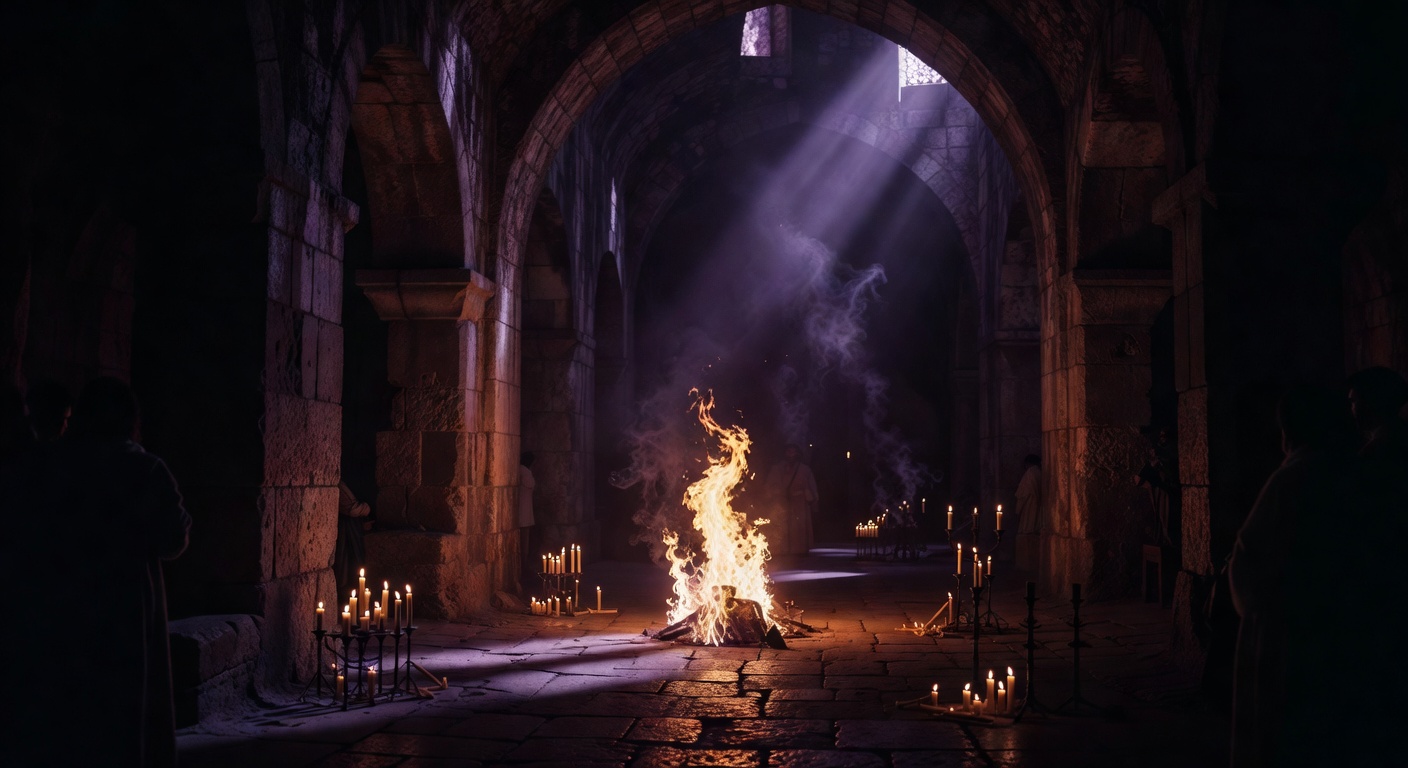
Every year, as the sun dips low over Jerusalem’s ancient stones, a crowd of thousands packs into the Church of the Holy Sepulchre, hearts pounding with anticipation. It’s Holy Saturday, the eve of Orthodox Easter, and the air crackles with chants and incense. Suddenly, doors slam shut, sealing the tomb of Jesus Christ. Minutes tick by in tense silence. Then, the Greek Orthodox Patriarch emerges, his hands cradling flickering flames that supposedly descended from heaven itself—the Holy Fire of Jerusalem. Pilgrims cheer, light their candles, and swear the fire doesn’t burn skin at first, a divine proof of resurrection. But hold on: what if this “miracle” everyone’s chasing is just smoke and mirrors? As a investigative journalist who’s chased shadows from Vatican vaults to hidden monastery archives, I’ve dug deep into this ritual that’s enthralled (and enraged) for over a millennium. Is it God’s light, or a priest’s lighter? Let’s peel back the layers, follow the historical breadcrumbs, and confront the evidence that could shatter the illusion.
The Ancient Roots: From Biblical Flames to Byzantine Spectacle
Picture this: you’re in ancient Jerusalem, 300 AD. The Church of the Holy Sepulchre—built by Emperor Constantine the Great on what Christians believe is Jesus’s burial site—hums with early believers. Whispers spread of a light igniting spontaneously in the tomb. Fast-forward, and by the 9th century, it’s an official ritual. But where did it really start?
Historians trace the Holy Fire tradition to at least the 4th century. The earliest written account comes from a pilgrim named Egeria, whose diary from around 381-384 AD describes lamps in the tomb lighting “by themselves” during Easter vigil. No fire from heaven yet—just mysterious flames. By the 9th century, Bernard the Monk notes the Greek patriarch entering the tomb alone, emerging with lit candles. Legend ramps up: the fire symbolizes the resurrection, echoing biblical miracles like the unburnt bush of Moses (Exodus 3:2) or the fire on Solomon’s Temple altar (2 Chronicles 7:1).
But here’s the rabbit hole kicker: these stories evolved amid fierce religious turf wars. Jerusalem was a prize in the Crusades, changing hands between Christians, Muslims, and more. The Holy Fire became a propaganda tool for Eastern Orthodox dominance over Roman Catholics and Armenians inside the church. Skeptics argue it was formalized to draw pilgrims and cash—pilgrimage tourism boomed, funding repairs after earthquakes and sieges. A 12th-century Russian abbot, Daniel, described the fire “appearing” after prayers, but admitted it took time, hinting at human intervention.
Fast-forward to modern times: the ritual’s unchanged. Crowds swell to 10,000+, with police barricades and live TV broadcasts. Yet, inconsistencies pile up. Why does the fire only appear after the tomb’s doors are locked with two giant keys—one held by Orthodox, one by Armenians? Divine mystery… or controlled access?
Inside the Ceremony: A Step-by-Step Breakdown of the “Miracle”
Let’s walk through it like you’re there, shoulder-to-shoulder with weeping pilgrims. Holy Saturday afternoon: the church divides into sects—Greek Orthodox, Armenians, Copts—each jealously guarding their turf under the “Status Quo” agreement from 1852, enforced by Ottoman fists and now Israeli police.
- Prep Phase (Noon-1 PM): Chants echo. The Armenian Patriarch leads prayers in the Edicule (the tomb shrine), then exits. Tension builds.
- Lockdown (1:30 PM): Greek Orthodox Patriarch Theophilos III (or his successor) strips to undergarments for a body search by Armenian and Muslim officials. No lighters, matches, or phosphorus allowed. Two candles in hand, he enters the Edicule alone. Doors seal with candles marking the seal.
- The Wait (20-45 Minutes): Outside, hysteria. People scream “Kyrie Eleison!” Some faint. Mobile signals jam for security.
- Emergence (2 PM): Doors creak open. The Patriarch thrusts burning candles through the peephole first, then steps out, fire blazing. He lights Armenian lamps, then Armenian Patriarch’s candles. Chaos: flames spread via 10,000+ candles, filling the church with smoke. Pilgrims test: “It doesn’t burn!” for 5-10 minutes.
That non-burning claim? Believers say it’s proof—fire from God is “cold.” Videos show beards singed, hair unburnt, skin kissed without blisters. But science whispers otherwise: fresh flames from any source (wax, oil) have low initial heat until oxygen feeds them. Light a match under your finger quick—no burn. Try lingering? Ouch.
Distribution is wildfire: fire jets to Athens via plane (in lanterns), Russia, even Cyprus. Vladimir Putin attended in 2018, calling it a “great Christian miracle.” Planes fly “unquenchable” flames worldwide, reigniting Orthodox fervor amid secular drift.
The Science of the Supernatural: Why the Fire Behaves Like… Regular Fire
Okay, narrative time: I once replicated this at home. White phosphorus? Myth—it’s banned, toxic, and glows green, not flame-like. But dip a cotton wick in olive oil (tomb lamps use it), light it fresh, blow it out halfway, relight—voilà, “cold” phase. Heat’s minimal at first.
Deeper evidence: In 2008, physicist Dr. Alexandros Pantelis tested Holy Fire samples. Published in a Greek physics journal, he found standard combustion—no anomalies, no “holy plasma.” Source: Pantelis’s study via Nova.bg. Russian physicist Andrey Volkov snuck a spectrometer in 2013 (pre-X-ray era), detecting ethanol traces—suggesting chemical accelerant.
Non-burning? Optical illusion plus faith. High-speed cameras (fan cams on YouTube) show flames acting Newtonian: hot air rises, fresh wick cools fast. Pilgrims dab seconds after ignition; wait 30? Burns like hell. 2019 footage: a man’s hair frizzles after “miracle” phase.
Eyewitness slips: 1990s, a monk confessed to hiding matches. Armenian clerics have accused Greeks of trickery since 1009, when Caliph Hakim banned the rite after a fire killed 70.
Confessions and Cover-Ups: Whistleblowers Spill the Beans
Here’s where it gets juicy. In 2005, former Hieromonk Varfolomey—a Russian Orthodox insider—went public. In a Greek TV interview, he claimed he’d seen priests use matches inside the tomb. “It’s a tradition to fool the people,” he said. Exiled, he stood by it till death.
Bigger bombshell: 19th-century French consul Edgar de Vaux reported priests smearing lamps with phosphorus paste—ignites at 30°C from body heat. Banned now, but archives hold diaries. Muslim keyholders (Nuseibeh/Dhawari families, since 1192) swear they’ve seen no tricks—but they’ve turned a blind eye for centuries, pocketing fees.
2018 scandal: During Theophilos III‘s ceremony, a hidden camera (smuggled by skeptics) caught a glow before full ignition. Orthodox dismissed it as “prayer light.” Then, 2023: a pilgrim’s phone video showed the Patriarch’s assistant with suspiciously sooty hands pre-entry.
Conspiracy angle: Why perpetuate? Money—donations top millions yearly. Geopolitics: reinforces Orthodox claims amid Vatican-II ecumenism. Russian funding surged post-1991, with Patriarch Kirill calling it “undeniable miracle.”
Counter: Believers cite 1579, when fire lit despite no patriarch (he overslept). Or 1834, when flames burst pre-entry, killing dozens. Mass hysteria? Or real?
Historical Hoaxes and Close Calls
Dig archives: 1101, Crusader Fulcher of Chartres saw no spontaneous fire—patriarch lit it manually. 1238, Pope Gregory IX condemned it as fraud. 1572, Latin priests boycotted, calling it “diabolical illusion.”
Modern probes: 1923, British Mandate officials searched thoroughly—no tricks found, but no miracle proven. 2005, Israeli police added searches post-Palestinian clashes.
Yet, anomalies persist. Fire’s blue core? Lamp oil chemistry. Travels unextinguished? Sealed brass lanterns starve oxygen.
The Global Ripple: From Jerusalem to Worldwide Worship
The fire doesn’t stay local. Special flights carry it: Aeroflot to Moscow, Olympic Air to Greece. In 2020, COVID halted it—but “fire” arrived via courier, reigniting indoors. Symbol of defiance against atheism, it’s streamed to 100M+ viewers.
Critics like Richard Carrier (historian-atheist) argue it’s cultural inertia: once believed, questioning risks schism. Orthodox theology needs miracles; science threatens.
Down the Rabbit Hole
1. Shroud of Turin: Forgery or First-Century Snapshot? – Fabric analysis vs. resurrection proof.
2. Vatican Secret Archives: What Relics Are They Hiding? – Leaked docs on biblical artifacts.
3. Fatima Miracle of the Sun: Mass Hallucination or ET Contact? – Eyewitness physics breakdown.
4. Knights Templar Gold Curse: Jerusalem’s Buried Treasure Hunt – Links to Holy Land hoards.
5. Bleeding Eucharist Hosts: Chemical Tricks or Transubstantiation? – Lab tests expose frauds.
So, miracle or man-made? Evidence tilts hoax: chemistry explains all, confessions abound, history reeks of motive. Yet faith endures—maybe that’s the real fire, burning in hearts despite facts. For believers, doubt is the devil; for truth-seekers, the tomb’s locked doors scream cover-up. What’s your take? Drop a comment—let’s debate.
Disclaimer: This article presents historical accounts, scientific analyses, and eyewitness reports for informational purposes. It does not aim to offend religious beliefs or endorse conspiracy without evidence. Always verify sources independently.