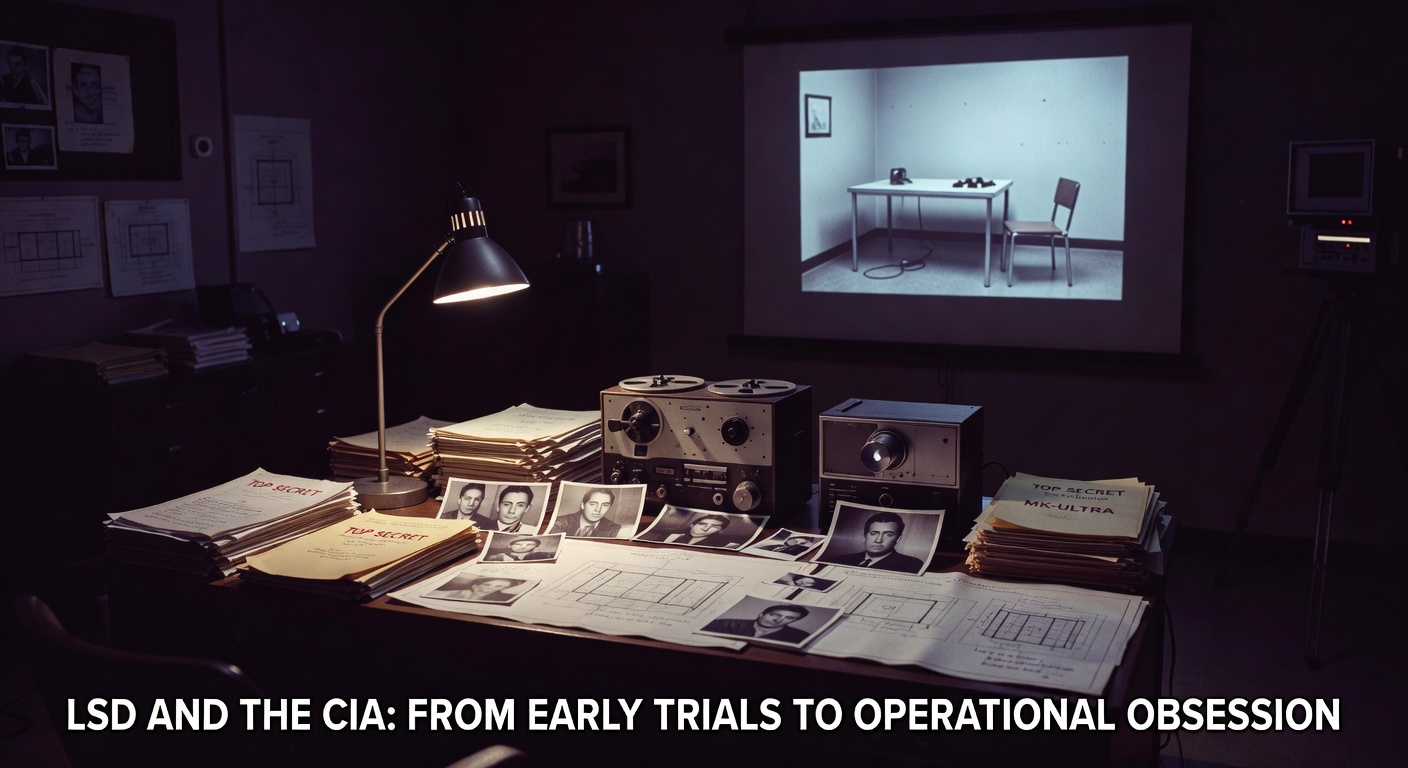
Imagine waking up one morning, sipping your coffee, and slowly realizing your mind is no longer your own. The walls breathe. Reality itself seems to fold inward. Now imagine you never agreed to any of this — that someone, somewhere, decided your consciousness was theirs to experiment with. For hundreds of Americans — soldiers, psychiatric patients, and unwitting civilians alike — this wasn’t a nightmare. It was Tuesday. And the person holding the dropper was Uncle Sam.
The story of the CIA and LSD is one of the most documented, most disturbing, and yet somehow still underappreciated chapters in American history. It’s not a story that lives only in the fever dreams of conspiracy theorists. It’s in the congressional record. It’s in the Senate Intelligence Committee’s own published findings from 1977. It’s in the boxes of documents that survived the shredder — because yes, most of the files were destroyed, and that itself should tell you something.
So let’s go back to the beginning. Let’s follow the white rabbit — or in this case, the colorless, odorless, tasteless liquid that the CIA became obsessed with for over two decades.
The Accidental Discovery That Changed Everything
It started, as many world-altering things do, with an accident. On April 19, 1943 — now celebrated in certain circles as “Bicycle Day” — a Swiss chemist named Albert Hofmann accidentally absorbed a tiny amount of a compound he’d synthesized five years earlier while working at Sandoz Pharmaceuticals in Basel. He’d originally created lysergic acid diethylamide — LSD-25 — while researching ergot fungus derivatives for pharmaceutical use. The compound had been shelved, unremarkable on paper.
That April afternoon, pedaling home from his laboratory, Hofmann experienced what he later described as a “not unpleasant intoxicated-like condition” — a profound alteration of perception that no substance had ever reliably produced at such infinitesimal doses. He had accidentally discovered the most potent psychoactive compound ever recorded. A few days later, he intentionally took what he assumed was a cautious dose: 250 micrograms. He was wrong about the caution. He experienced an intense, terrifying, and ultimately transformative voyage through altered consciousness.
Word spread quickly through European and American psychiatric circles. By the late 1940s, researchers were exploring LSD as a potential treatment for alcoholism, schizophrenia, and post-traumatic stress. Early clinical results were intriguing. But there was another set of eyes watching this compound’s development — eyes that saw something far less therapeutic in its extreme effects on perception and cognition.
Cold War Paranoia and the Birth of MKULTRA
To understand how the CIA ended up dosing unwitting civilians in rented hotel rooms, you have to understand the paranoia gripping American intelligence in the early Cold War. The “confessions” extracted from American POWs during the Korean War seemed almost supernatural in their completeness — soldiers returning home having apparently renounced their country with disturbing conviction. The term “brainwashing” entered the American lexicon, and with it came a deeply uncomfortable question: what if the Soviets already had a drug, a technique, something that could break a man’s will entirely?
The CIA didn’t wait to find out. In 1950, the agency launched Project ARTICHOKE, an early program exploring hypnosis, forced morphine addiction, and chemical interrogation. Before long, the agency’s attention zeroed in on LSD. In 1951, CIA officers purchased an enormous supply of the drug directly from Sandoz — ten kilograms, representing the equivalent of roughly 100 million doses — paying $240,000. Their intention was to corner the global supply before anyone else could.
By 1953, under the direction of CIA Director Allen Dulles, the agency formalized its mind-control research program under the now-infamous code name MKULTRA. The program, approved on April 13, 1953, authorized experiments across at least 150 separate research projects involving hypnosis, electroconvulsive therapy, sensory deprivation, psychological manipulation — and most prominently, LSD.
At the center of all of it was one man.
Sidney Gottlieb: The Sorcerer’s Apprentice
If MKULTRA had a face, it was Sidney Gottlieb. A chemist with a PhD from Caltech, a stammer, and a club foot, Gottlieb hardly looked the part of a Cold War villain. He kept goats. He danced folk dances. He composted. And as head of the CIA‘s Technical Services Staff, he also oversaw one of the most ethically catastrophic programs in American government history.
Gottlieb became convinced that LSD could be the key to unlocking human consciousness — or more precisely, to short-circuiting it. He believed the drug might render enemy agents incapable of lying, erase memories on command, or create a state of total psychological submission in which a subject would reveal secrets, adopt implanted beliefs, or carry out orders without conscious awareness. The concept sounds like science fiction. In practice, it was the framework for years of experiments.
Under Gottlieb’s direction, MKULTRA researchers administered LSD to mental patients, prisoners, drug addicts, and — crucially — to people who had no idea whatsoever that they were being dosed. The program didn’t just push ethical boundaries. It erased them entirely.
Operation Midnight Climax: LSD in the Real World
No subprogram captures the recklessness of the CIA‘s LSD obsession quite like Operation Midnight Climax. Beginning around 1954 and continuing through the early 1960s, the CIA established a series of safehouses in San Francisco and New York — apartments furnished to look like comfortable civilian flats, equipped with one-way mirrors and recording equipment.
The operation was run by George Hunter White, a flamboyant former narcotics agent who worked as a contractor for the CIA. White recruited sex workers to lure unsuspecting men — typically low-level criminals, drug users, people unlikely to be believed if they complained — to the apartments. There, drinks were spiked with LSD without the subjects’ knowledge or consent. CIA agents watched from behind the mirrors, taking notes.
White later wrote in a letter to Gottlieb: “I was a very minor missionary, actually a heretic, but I toiled wholeheartedly in the vineyards because it was fun, fun, fun.” Fun, he meant, in the sense of dosing strangers with powerful hallucinogens and watching what happened. The lack of scientific rigor was matched only by the complete absence of moral framework.
The subjects were never told. They never consented. Many were profoundly frightened by what they experienced. Some suffered lasting psychological harm. And for years, none of it was legally actionable because it didn’t officially exist.
Frank Olson: The Case That Cracked Everything Open
Of all the tragedies that emerged from MKULTRA‘s LSD program, the death of Frank Olson is the one that history remembers most clearly — and most controversially.
Olson was a U.S. Army biochemist who worked at Fort Detrick, the Army’s biological warfare research center in Maryland. He was also involved in various aspects of the CIA‘s mind-control research. In November 1952, at a remote retreat called Deep Creek Lodge, Olson was among a group of CIA and Army scientists who were secretly dosed with LSD by Sidney Gottlieb — without their knowledge or consent — as part of an experiment on “group dynamics.”
Olson had a severe and prolonged psychological reaction. He became withdrawn, anxious, and deeply disturbed in the days that followed. His colleagues noted that he seemed a changed man. Nine days after the dosing, on November 28, 1953, Frank Olson fell from the window of a New York City hotel room on the thirteenth floor. The official ruling was suicide.
His family was told he had a nervous breakdown and jumped. They were given $750,000 in a government settlement — with a non-disclosure component. It wasn’t until the 1975 Rockefeller Commission investigation into CIA abuses that the truth about Olson’s LSD exposure became public. President Ford personally apologized to Olson’s family. His son Eric never stopped pursuing the truth, and when Olson’s body was exhumed in 1994, a forensic examination suggested evidence inconsistent with a simple fall. The full story of what happened in that hotel room has never been conclusively established.
The Institutional Architecture: Universities, Hospitals, and Fronts
One of the most remarkable aspects of MKULTRA‘s LSD program was the scale of institutional complicity — or at least institutional ignorance — it required. The CIA didn’t run all of its experiments in-house. That would have been too visible, too traceable. Instead, it laundered funding through front organizations and channeled research money to universities, hospitals, and private research institutions across North America.
Among the institutions that received CIA-connected funding for LSD and mind-control research were prestigious universities and well-regarded psychiatric hospitals. Researchers at some institutions genuinely believed they were conducting legitimate psychiatric research with proper funding. Others were fully aware of the intelligence connection. The network was deliberately opaque — compartmentalized so that even participants often didn’t know who was ultimately paying for their work or why.
Harold Abramson, a New York physician and allergist with a side practice in psychiatry, was among the CIA’s key LSD researchers. He had been Olson’s treating doctor in the days before the fatal fall. He also conducted extensive LSD experiments on patients and research subjects, funded through channels that traced back to the agency. Abramson operated within a broader New York network of researchers who shared findings, subjects, and institutional cover in ways that were formally deniable but substantively coordinated.
The front organization structure was refined and expanded throughout the 1950s. The Society for the Investigation of Human Ecology (later the Human Ecology Fund) was perhaps the most prominent CIA-connected front, funneling money to social scientists, psychologists, and medical researchers who often had no idea where their grants ultimately originated. The Geschickter Fund for Medical Research served a similar purpose. This outsourcing of experimental ethics was by design — it gave the agency plausible deniability while dramatically expanding the scope of its research.
What the CIA Actually Learned — And Didn’t
Here’s the brutal irony buried in hundreds of pages of surviving MKULTRA documents: after years of experimenting, the CIA largely concluded that LSD was not the reliable mind-control tool they had hoped for.
The drug produced wildly unpredictable results. Different subjects responded in wildly different ways. Some became paranoid. Some became euphoric. Some experienced what seemed like profound psychological openings. A few experienced lasting psychological damage. But what almost no one experienced was the kind of robotic compliance, total truth-telling, or reliable memory erasure that the program’s architects had fantasized about. LSD did not make reliable truth serums. It did not create programmable assassins. It did not erase identities on command.
What it did do, in the hands of people without appropriate safety protocols, therapeutic support, or basic human decency toward their subjects, was cause significant and sometimes lasting harm. The CIA‘s own internal evaluations noted the drug’s inconsistency. Yet the program continued for years after these conclusions were reached — because, it seems, the experiments had taken on a momentum of their own, and the institutional culture of MKULTRA was not one that responded well to inconvenient findings.
The 1977 Senate Hearings: When the Curtain Finally Lifted
The story of MKULTRA might have remained almost entirely buried were it not for a combination of investigative journalism, congressional persistence, and a fortuitous filing error. In 1973, as the Watergate scandal unraveled the Nixon administration and congressional oversight of intelligence agencies began in earnest, CIA Director Richard Helms ordered the destruction of all MKULTRA files. Most were shredded.
But in 1977, a CIA archivist discovered a cache of approximately 20,000 documents that had been misfiled in a financial records warehouse and escaped the purge. These documents — along with earlier disclosures through the Church Committee investigations and a Freedom of Information Act request by journalist John Marks — provided the evidentiary foundation for the Senate Intelligence Committee hearings in 1977, during which former CIA officials testified about the program’s scope and methods.
The hearings were shocking in their revelations. Americans learned for the first time about safehouse operations, unwitting civilian dosing, the death of Frank Olson, and the extraordinary range of institutions that had participated in MKULTRA-connected research. Director Stansfield Turner acknowledged that the agency had engaged in “research on human subjects” that was “unethical and illicit.” The Senate was not amused. The American public was appalled.
The Legacy: What LSD Left Behind
The CIA‘s obsession with LSD had consequences that extended far beyond the classified world. Some historians have argued — compellingly — that the Agency’s early mass purchase of LSD and its subsequent distribution to researchers, hospitals, and academic institutions effectively seeded the drug into American culture in ways that contributed to the 1960s psychedelic explosion. Timothy Leary obtained his early supplies through networks that traced back to Sandoz Pharmaceuticals and the research community the CIA had helped fund. The agency didn’t intend to launch the counterculture. But its actions, its purchases, and its research pipeline helped make LSD far more available than it might otherwise have been.
There’s a dark irony in this that the CIA itself must have found profoundly uncomfortable: in its attempt to weaponize LSD as a tool of control and conformity, the agency may have inadvertently helped unleash one of the great anti-establishment cultural movements of the twentieth century.
For the victims of MKULTRA‘s experiments — the unwitting subjects, the institutionalized patients, the prisoners who couldn’t meaningfully consent, the soldiers who trusted their government — no irony is sufficient. Some sued. Some received settlements. Most never knew what had happened to them at all. The files were burned. The records were gone. Only fragments survived, and from those fragments we reconstruct a picture that is incomplete but damning enough.
Down the Rabbit Hole
- Unwitting Subjects: The Consent Problem at the Heart of MKULTRA — A deep dive into how the program systematically violated informed consent, and what legal and ethical frameworks existed (or didn’t) at the time.
- Harold Abramson and the New York LSD Circle — The story of the quiet physician at the center of the CIA’s New York research network, and his role in Frank Olson’s final days.
- Operation Midnight Climax: The Safehouses Where America Lost Its Mind — A detailed look at George Hunter White’s San Francisco and New York operations, and the people who were dosed without consent.
- The Destruction of MKULTRA Files in 1973: What Was Lost? — Richard Helms ordered the shredding. What might the surviving documents have revealed — and what questions can we still not answer because the records are gone?
- CIA Front Organizations: How Behavioral Research Was Outsourced — How the Human Ecology Fund, the Geschickter Fund, and other fronts allowed the CIA to fund ethically questionable research at arm’s length.
Disclaimer: This article is intended for educational and entertainment purposes. The events described are based on declassified documents, congressional testimony, and established historical record. Readers are encouraged to explore primary sources, review the Senate Intelligence Committee hearings, and draw their own conclusions. Conspiracy Realist does not make claims beyond what documented evidence supports.