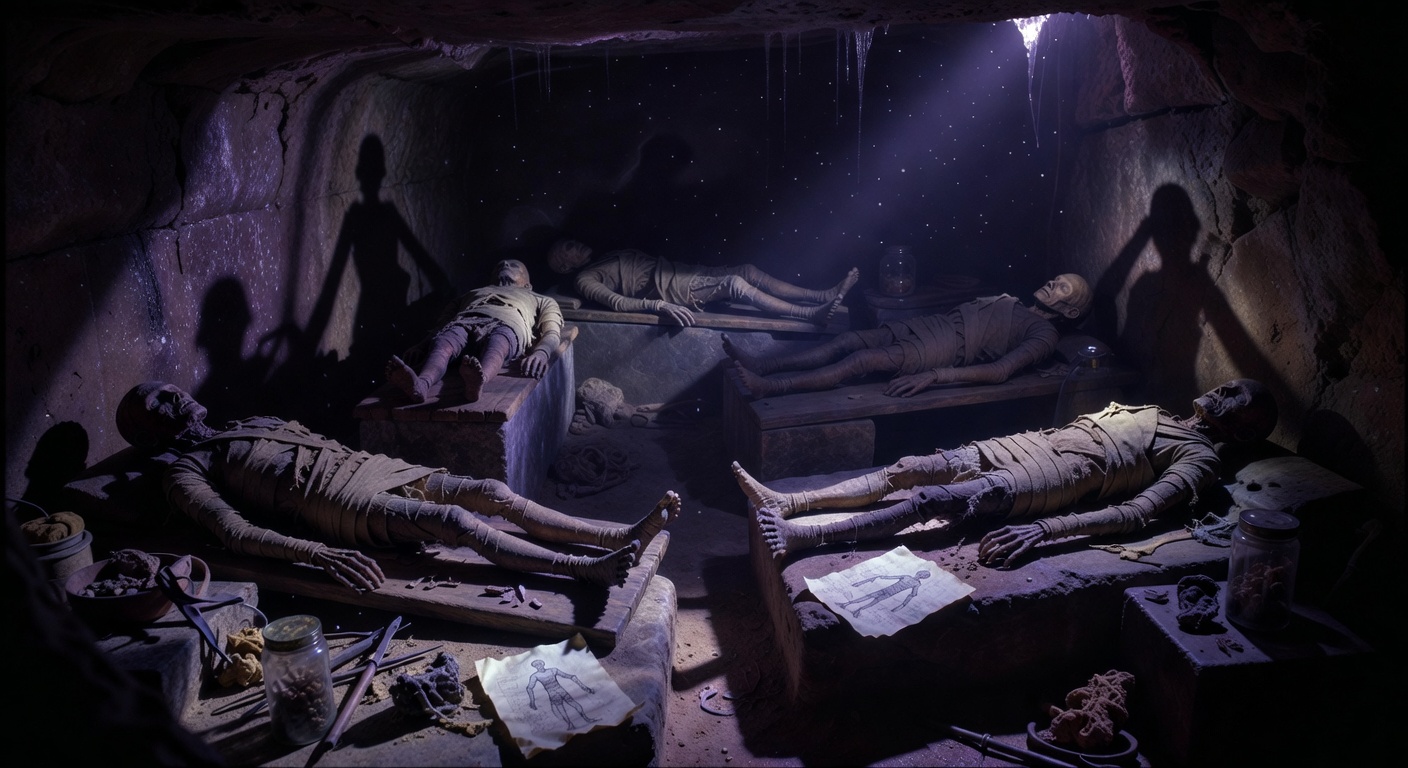
Imagine stumbling upon a cluster of mummified bodies in the sun-baked sands of Peru’s Nazca Desert—not your typical ancient humans, but creatures with elongated skulls, three-fingered hands, and toes that scream “alien” to anyone with eyes. It’s 2017, and a tomb raider named Jaime Maussan pulls back the veil on these so-called Nazca tridactyl mummies, igniting a firestorm that pits rogue scientists against the gatekeepers of mainstream archaeology. Fast-forward to 2025, and the debate rages on: Are these hoaxes cobbled from animal parts and glue, or evidence of something profoundly non-human buried in our history? Skeptics cry foul, but mounting DNA tests, carbon dating, and even fingerprint anomalies keep the story alive. Buckle up—this isn’t just about mummies; it’s a rabbit hole into rewritten human origins.
The Discovery: A Grave Robber’s Gamble Turns Global Sensation
Let’s rewind to the dusty dunes of Nazca-Palpa, Peru, home to the enigmatic Nazca Lines—those massive geoglyphs etched into the earth by a civilization that vanished over 1,500 years ago. In 2017, locals digging for ancient artifacts unearthed a trove that would shatter expectations. Sergio Mora, an archaeologist turned tomb raider, stumbled into branches of caverns filled with these bizarre specimens. Word spread like wildfire, and soon Jaime Maussan, the Mexican journalist infamous for UFO chases and ancient alien theories, got involved. He smuggled samples out for analysis, presenting them at press conferences that drew crowds from Lima to Mexico City.
These weren’t your run-of-the-mill mummies. Picture this: Bodies coated in a white, powdery substance later identified as diatomaceous earth—a natural preservative that keeps tissues intact for centuries. Sizes varied wildly, from pint-sized “figurines” some call juveniles to full-grown adults standing about 5’6″. The standout? Maria, a female-appearing specimen with tridactyl (three-fingered) hands and feet, no external ears, and an elongated skull that makes even Paracas skulls look tame. Carbon dating on Maria pegs her to 245-410 AD, smack in the Nazca culture’s heyday. If real, these beings walked the earth when the Romans ruled Europe and the Mayans built pyramids.
But here’s where it gets juicy: Peruvian authorities initially seized the site, declaring the mummies “dolls made of animal bones.” Yet, in a twist, Peru’s Congress held hearings in 2024, with lawmakers debating whether to classify them as national cultural patrimony. Why the flip? Independent scans showed these weren’t crude fakes—X-rays revealed articulated bones, internal organs, and even metal implants in some digits. One prosecutor, José Luis Orihuela, admitted after tomography: “They have a human skeleton, but strange characteristics.”
Anatomy of the Anomalous: What Makes Them “Tridactyl”?
Let’s dissect the features that fuel the frenzy. These mummies aren’t subtle mods; they’re a symphony of weird.
- Tridactyl Extremities: Three long, slender fingers per hand, three toes per foot—no thumbs, no pinkies. Joints bend in unnatural ways, with phalanges longer than human norms. X-rays from Dr. José Zalce, former Mexican Navy surgeon, show fully formed skeletal structures, not glued-together fabrications.
- Elongated Crania: Skulls stretched to 30% longer than human maximums, with a single parietal plate instead of two. No sutures deformed by binding, per CT scans—suggesting natural growth, like deliberate cranial deformation but cranked to 11.
- Facial Oddities: No external ears, just auditory canals. Eyes appear larger, with reddish pigments. Some have three “pharyngeal fringes” instead of uvulas.
- That Powdery Coating: Diatomaceous earth, rich in silica, encases them. It’s not paint; it’s embedded, preserving soft tissues like skin and muscles. One analysis found no signs of modern tampering—no synthetic glues, no fresh cuts.
Smaller specimens like Wawita (a 20-inch “child”) mirror the adults, hinting at a species, not dolls. Dismantling one “fake” figurine in 2018 revealed… more mummified tissue, not papier-mâché. Critics say they’re llama or human parts rearranged, but why the consistent anatomy across dozens? And why do they flex at the waist without crumbling, as shown in live demos?
DNA Deep Dive: 30% Unknown—Human or Hybrid?
The real bombshell? The genes. Early 2018 tests by Peruvian labs dismissed them outright, but independent labs begged to differ. Dr. Edgar Heredia‘s team at Mexico’s National Autonomous University extracted DNA from skin and bone, finding mitochondrial DNA matching humans at 77%—but nuclear DNA with 30% “unclassified” sequences. No matches in GenBank, the world’s largest genetic database.
By 2023, Jaime Maussan paraded this before Mexico’s Congress, with Dr. David Ruiz Vela testifying: “They are real biological organisms.” Skeptics like Flavio Estrada from Peru’s forensic institute countered with “modern assembly,” but their biopsies ignored soft tissue DNA.
Enter Abraxas Biosystems‘ 2024-2025 report—a game-changer. Their metagenomic sequencing on Maria confirmed humanoid chromosomes (46, like us) but flagged anomalies: Proteins not coded by human genes, and sequences hinting at “deliberate genetic engineering.” A March 2025 ResearchGate paper by Dr. Ricardo Rangel dropped a nuke: An African cladosporium fungus in Maria‘s liver. Ancient Peru-Africa trade? Pre-Columbian contact? Or parallel evolution? Read the full study here. Mainstream outlets like Live Science called it contamination, but controls showed none.
Human DNA? Yes, but mutated—egg proteins in Maria‘s ovaries suggest fertility, yet incompatible with Homo sapiens. Hybrid theory? Proponents say part-human, part-“unknown primate” or engineered being. Critics? “Contaminated samples.” But chain-of-custody docs from Abraxas hold up.
Fingerprints and Forensics: No Human Match
July 2024 brought fingerprints. Dr. Joshua McDowell‘s team analyzed dermal ridges on Maria‘s hands: Loops and whorls, yes—but patterns defying human minutiae standards. Published in the Journal of Forensic Identification, they concluded: “Non-human dermatoglyphics.” Imagine FBI databases spitting out “no match” on an ancient handprint. Add 3D scans showing lightweight bones (hollow like birds’) and you’re left wondering: Avians? Reptilians? Or just really weird humans?
Tomography by Dr. Zalce revealed three-chambered hearts in some, like reptiles or birds—not four-chambered mammalian. Livers with eight lobes. Eggs with embryos in juveniles. If hoaxed, it’s Oscar-worthy biotech.
The Controversy: Gatekeepers vs. Truth-Seekers
Mainstream archaeology screams “hoax!” National Geographic labeled them “modern fabrications” in 2018, citing bone glue. Peru banned exports, jailing diggers. But cracks show: UNESCO monitors the site; Peru’s Ministry of Culture now hedges, calling for more tests.
Conspiracy angle? Cover-up to protect Darwinian timelines. Graham Hancock tweeted in 2024: “If real, they rewrite everything.” Gaia TV documentaries amplify, but peer-review lags—journals reject “fringe” papers. Yet, Abraxas‘ data is public, replicable.
Counter: Bio-engineer Dr. Julia Mossbridge warns of ethical lapses, but admits: “Anomalies exist; dismissals feel premature.”
Peru’s Pivot: From Seizure to Sanctuary?
2024 hearings flipped the script. Congresswoman Daniela Chavez pushed protection: “These could be pre-Hispanic.” A 2025 resolution eyes museum display. Why? Scans prove life’s signatures—eggshell proteins, viable nests. If fakes, why not debunk fully? Cost? Politics? Or fear of the implications?
Down the Rabbit Hole
1. Paracas Skulls: Elongated crania from Peru—natural or engineered? Link to Nazca hybrids?
2. Ancient Aliens in the Andes: Did extraterrestrials bio-tinker South American civs?
3. Pre-Columbian Transoceanic Contact: African fungi hint at lost trade routes.
4. Modern Human Hybrids: DARPA gene-editing echoes ancient tech?
5. Nazca Lines’ True Purpose: Runways for tridactyl visitors?
In the end, the Nazca tridactyl mummies defy easy burial. Hoax demands genius-level fakery across labs worldwide; reality demands we question origins. As Abraxas chief Dr. Steven Greer (wait, no—John Warner) puts it: “Science evolves by anomalies.” Will Peru unveil them? Will DNA silence doubters? One thing’s clear: This mystery won’t mummify quietly. Stay tuned—the desert guards its secrets, but the truth digs its way out.
Disclaimer: This article presents evidence from public sources and independent analyses. Readers should approach with critical thinking; official scientific consensus deems the mummies likely hoaxes pending exhaustive peer review.