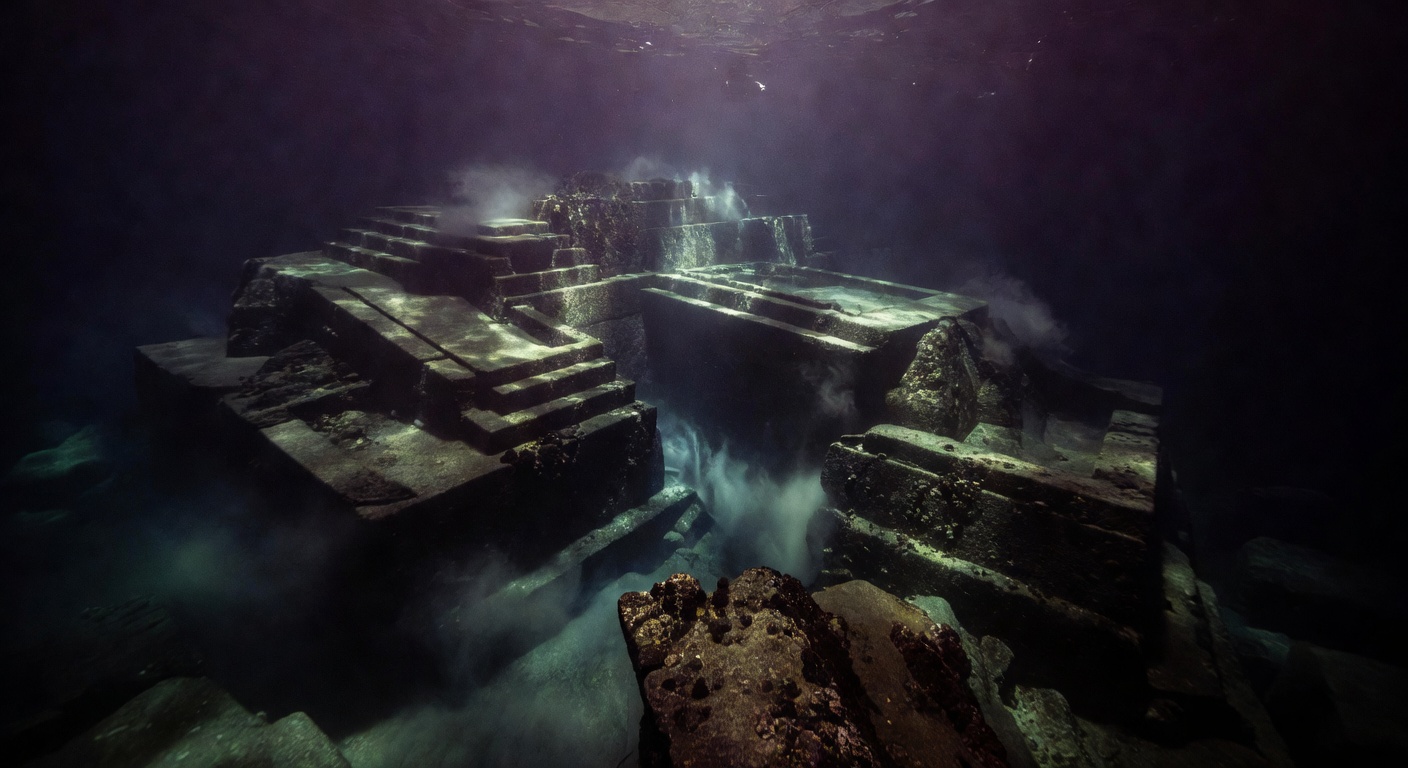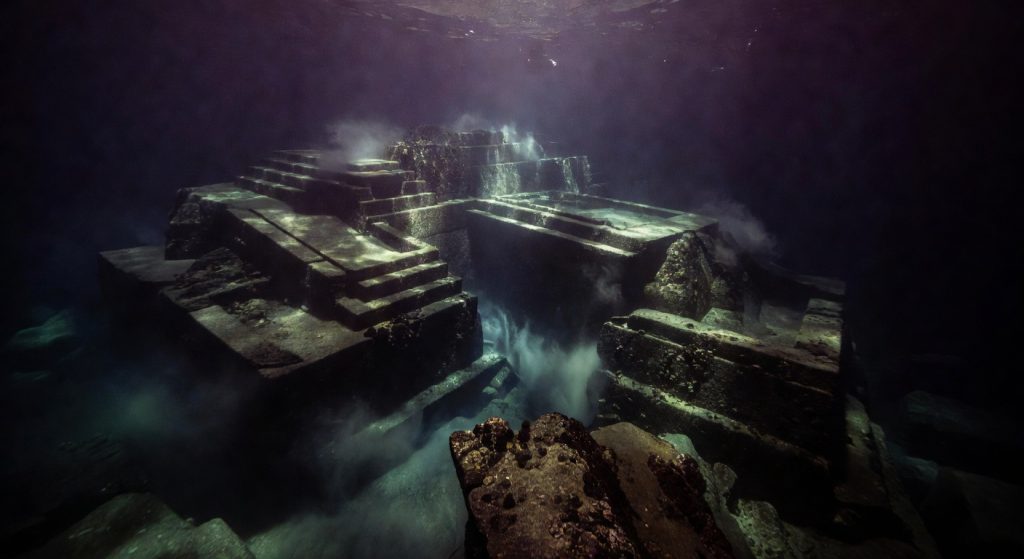
Imagine you’re scuba diving off the remote shores of Yonaguni Island, Japan, chasing schools of tropical fish through crystal-clear waters. Suddenly, your light catches something impossible: massive, pyramid-like steps carved into the seafloor, sharp angles defying the chaos of nature, stretching out like the bones of a forgotten city. This isn’t a Hollywood set—it’s the Yonaguni Monument, a submerged enigma that’s been taunting divers, archaeologists, and conspiracy enthusiasts since 1986. Is it the smoking gun for a lost Ice Age civilization, proof of extraterrestrial architects, or just Mother Nature’s cruel prank? Buckle up, because we’re plunging deep into this underwater rabbit hole, where every shadow hides a theory wilder than the last.
The Accidental Discovery That Rocked the World
Let’s rewind to that fateful day in the summer of 1986. Local dive tour operator Kihachiro Aratake wasn’t hunting for history—he was scouting prime spots for his clients amid Yonaguni’s rugged coral reefs. At around 25 meters (82 feet) deep, his spotlight swept across what looked like terraced cliffs, but sharper, more deliberate. Flat platforms, right-angled steps, even what seemed like carved pillars—all etched into solid sandstone.
Word spread like wildfire in diving circles. By the early ’90s, Japanese marine geologist Masaaki Kimura from the University of the Ryukyus was leading expeditions, snapping photos and measurements that fueled the fire. The main structure? A behemoth 50 meters long, 20 meters wide, and rising 25 meters from the seabed—like a sunken skyscraper with staircases wide enough for processions. Surrounding it: smaller formations resembling plazas, roads, and even a turtle-shaped rock that some swear is a deliberate sculpture.
But here’s the kicker: Yonaguni sits at the edge of the Japanese continental shelf, in an area prone to massive earthquakes and tsunamis. Could rising seas at the end of the last Ice Age—around 12,000-10,000 years ago—have swallowed an entire metropolis? That’s the hook that turned a dive site into a global obsession.
Man-Made Marvel or Natural Freak? The Core Debate
At its heart, the Yonaguni Monument debate boils down to human hands versus the whims of geology. Skeptics, led by figures like Robert Schoch (the geologist who dated the Sphinx way younger than mainstream Egyptologists claim), argue it’s pareidolia on steroids—our brains seeing faces in clouds, but here it’s cities in cracked rock.
Natural formation theory points to sandstone jointing, a process where tectonic stress fractures rock into neat blocks. Waves and currents then polish the edges, mimicking steps. Wolf Wichmann, a German geologist, dove in (pun intended) during the 2000s, concluding it’s all Mother Nature: “The steps are just fractured layers, exaggerated by erosion.” Japanese authorities lean this way too, classifying it as a natural monument.
But proponents? They see straight-up architecture. Masaaki Kimura spent years mapping the site, cataloging over 10,000 square meters of formations. He points to:
- 90-degree angles sharper than most ancient quarries.
- Interlocking blocks like Lego from hell.
- Symmetrical terraces descending like ziggurats.
- Carvings resembling faces, animals, and glyphs—too precise for random erosion.
Kimura’s hypothesis: This is Mu, the lost Pacific continent from 19th-century theosophist James Churchward‘s books. Mu supposedly sank in a cataclysm, mirroring Atlantis from Plato’s tales. Yonaguni? Its crown jewel, submerged when sea levels rose 120 meters post-Ice Age, wiping out a civilization advanced enough for mega-engineering.
Diving Deeper: Evidence That Keeps Skeptics Up at Night
Let’s get granular. Divers report “roads” running hundreds of meters, branching at intersections. One “grand staircase” drops 10 meters in precise steps. Then there’s the “platform”—a flat expanse with what looks like a giant sundial or altar. Kimura even found what he calls human footprints etched in the stone, plus tool marks.
Carbon dating? Tricky underwater, but shells on the structures clock in at 2,000-8,000 years old, while the rock itself dates to 20,000+ years via geological strata. That’s pre-Jomon culture, Japan’s oldest known pottery makers. No known society from then had the chops for this scale—think Göbekli Tepe in Turkey, but wetter and older.
Comparisons abound: The angles echo Sacsayhuamán in Peru or Puma Punku in Bolivia, sites conspiracy circles link to a global “pre-flood” network. Local Ryukyu folklore whispers of ancient underwater kingdoms and star gods—coincidence?
For a reputable deep dive, check out this National Geographic piece from 2001 on Yonaguni’s mysteries, where even skeptics admit the site’s “eerie precision” demands a second look.
The Alien Twist: When Humans Just Aren’t Enough
Now, we hit the turbo-charged conspiracy lane. If Yonaguni’s too advanced for Stone Age tech, who built it? Enter the extraterrestrials. Proponents like Graham Hancock (author of Fingerprints of the Gods) flirt with this, suggesting “gods from the stars” seeded knowledge worldwide.
Kimura himself hedges toward alien aid: “The precision requires lasers or sonic tools we don’t have today.” Picture ETs landing in the Pacific, teaching locals mega-masonry before jetting off—or building it themselves as a base. Erich von Däniken (Chariots of the Gods) fans see Yonaguni as an airport runway or power plant, its “steps” launch ramps for ancient vimanas (flying craft from Hindu epics).
Evidence? Subtle stuff: The site’s alignment with solstices, like many megaliths. Magnetic anomalies detected by divers—could be tech residue? And those “statues”—a hammerhead shark relief or owl-like face that scream intentional symbolism. Tie it to Dogon tribe star knowledge or Nazca lines, and you’ve got a narrative of global alien intervention.
Skeptics scoff: “Aliens? Really?” But proponents counter, “If not aliens, explain the tech gap.” It’s a rabbit hole where Plato‘s Atlantis meets Zecharia Sitchin‘s Anunnaki.
Geological Smackdown: What the Rocks Really Say
To play fair, let’s unpack the science. Yonaguni’s made of Miocene sandstone (15-20 million years old), prone to vertical fracturing from seismic activity. The Okinawa Trough nearby pulls plates apart, creating those clean breaks. Marine biologist Patrick D. Nunn argues currents shaped it post-fracture, citing similar “stepped” coasts worldwide, like Taiwan’s Yehliu Geopark.
Yet anomalies persist. Why no coral growth on “steps” like nearby rocks? Why do fractures align perfectly across vast areas? A 2019 study in Journal of Asian Earth Sciences modeled the tectonics, admitting some features “defy easy natural explanation.” Even Schoch concedes: “If man-made, it’s revolutionary.”
Expeditions continue—drones and sonar in the 2020s reveal extensions spanning 2 km. Is it a city block or a fractured hillside? The jury’s out, but the debate’s hotter than ever.
Cultural Echoes and Modern Implications
Yonaguni isn’t isolated. Ryukyuan shamans speak of Ryugu-jo, an undersea palace ruled by Dragon King. Matches the layout eerily. Globally, rising seas hide more: Dwarka off India, Bimini Road in the Bahamas—all potential Ice Age casualties.
What if Yonaguni proves advanced antediluvian societies? It rewrites history—no agriculture needed for pyramids. Climate change adds urgency: Warming seas could bury it deeper. Japan’s government protects it as natural, banning digs, fueling cover-up claims.
Tourism booms—dive tours pack in believers. But whispers persist: Suppressed research? Freemason-style secrecy? Hancock urges: “Explore before it’s lost.”
Expert Voices: From Believers to Debunkers
Masaaki Kimura: “100% man-made. Mu’s capital.”
Robert Schoch: “Natural, but paradigm-shifting geology.”
Graham Hancock: “Hints at forgotten chapter of humanity.”
Wolf Wichmann: “Erosion’s masterpiece—no tools required.”
Podcasts like Joe Rogan Experience (#1743 with Hancock) dissect it, blending science and speculation.
Why Yonaguni Still Haunts Us
Over 2,000 words in, and the mystery endures because it taps our primal itch: Were we wrong about human potential? Did stars intervene? Yonaguni isn’t just rocks—it’s a mirror to our curiosity, challenging “consensus” history. Dive it yourself (safely), study the sonar maps, chase the myths. The truth? Probably a mix: Nature sculpted, humans (or others) refined.
Down the Rabbit Hole
1. Göbekli Tepe: The Turkish Temple That Upends Timeline – Older than agriculture, built by “hunter-gatherer” geniuses?
2. Bimini Road: Bahamas’ Sunken Highway to Atlantis – Natural or paved path to a lost world?
3. Mu and Lemuria: Forgotten Pacific Twins of Atlantis – Churchward’s maps vs. modern geology.
4. Puma Punku: Bolivia’s Laser-Cut Megaliths – Alien tech or forgotten stonemasons?
5. Dogon Star Knowledge: African Tribe’s Sirius Secrets – Proof of extraterrestrial teachers?
Disclaimer: This article is for entertainment and educational purposes. Explore these theories critically—facts evolve with new evidence.