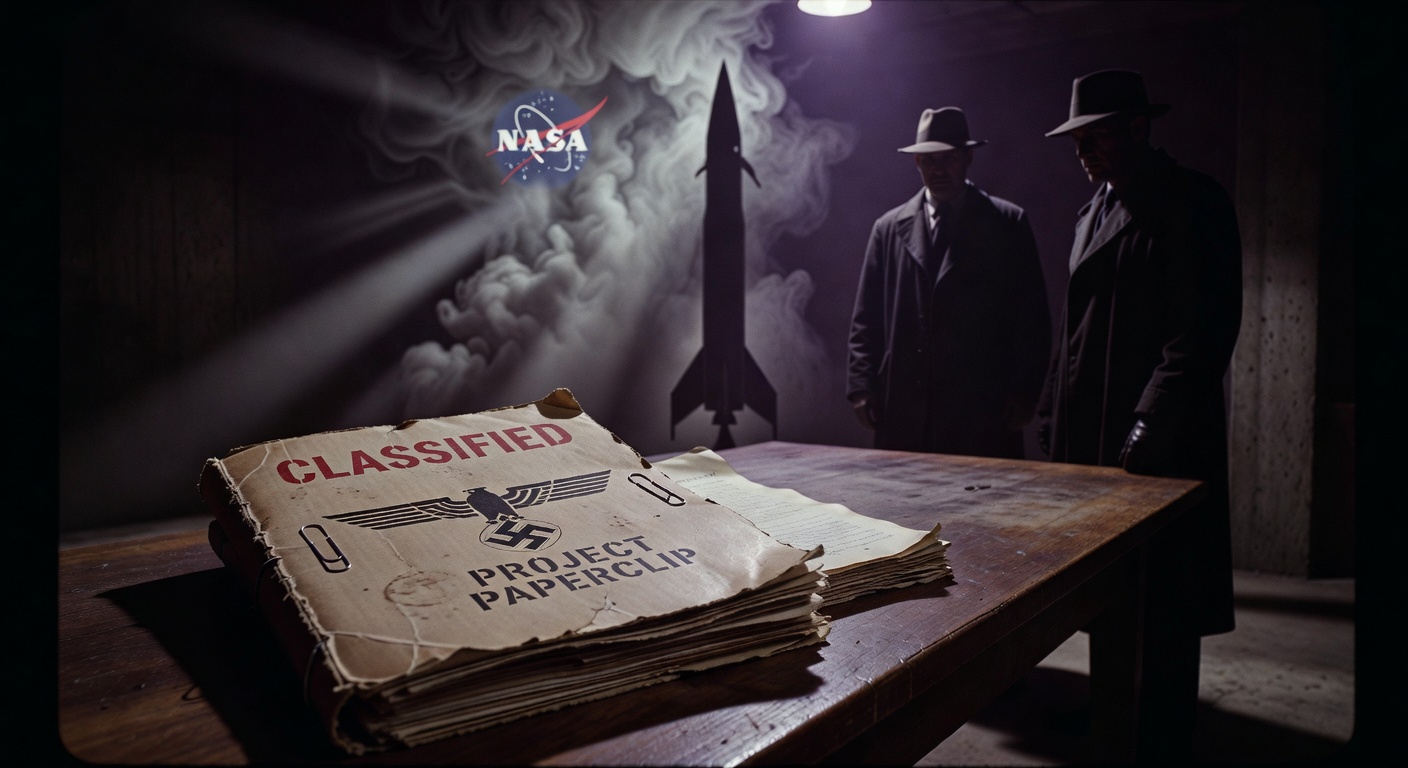
On July 20, 1969, Neil Armstrong stepped onto the moon — the culmination of American ingenuity, Cold War determination, and roughly $25 billion in taxpayer money. The rocket that carried him there was designed by Wernher von Braun, a man who had spent the war years designing V-2 rockets that rained death on London, and who oversaw a factory where concentration camp prisoners died by the thousands building his machines.
This isn’t disputed history. It’s documented in declassified government archives, available to anyone willing to look. Yet somehow, it rarely appears in the triumphant narratives of American space achievement.
That omission didn’t happen by accident. It happened by design — courtesy of a secret government program called Project Paperclip.
What Was Project Paperclip?
In the final months of World War II, as Allied forces swept across Europe, U.S. intelligence agencies faced a peculiar problem: Germany’s top scientists — the people who had built the Third Reich’s most advanced weapons — were about to fall into someone’s hands. The question was whose.
The answer, as far as Washington was concerned, was going to be America’s.
What began in 1945 as Operation Overcast, targeting rocket scientists, quickly evolved into something far more ambitious. Renamed “Project Paperclip” in 1946 — allegedly because officers used paperclips to attach new biographical summaries to personnel files — the program expanded to recruit over 1,600 German scientists, engineers, and technicians across aerospace, aviation medicine, chemical weapons, biological research, intelligence, and nuclear science.
There was just one problem: President Truman had explicitly ordered that no one with Nazi ties be admitted.
The solution was breathtakingly simple: change the records.
The Men Who Made America Fly
Wernher von Braun is the most famous face of Project Paperclip. Celebrated American hero. Director of NASA’s Marshall Space Flight Center. Father of the Saturn V rocket. Also: a Nazi Party member since 1937, an SS officer who rose to the rank of Sturmbannführer (Major), and the designer of the V-2 rockets that killed approximately 9,000 civilians across Britain and Belgium.
Worse still, those rockets weren’t built in clean factories. They were assembled at Mittelbau-Dora, a subcamp of Buchenwald carved into a mountain in central Germany. Prisoners — primarily from France, the Soviet Union, and Poland — worked in freezing underground tunnels, dying from exhaustion, disease, beatings, and summary executions. Estimates suggest 12,000 to 20,000 people died building von Braun’s rockets. That’s more deaths than the rockets themselves caused.
Whether von Braun personally witnessed specific atrocities remains debated. That he knew about the conditions and kept working is not.
Arthur Rudolph managed the Mittelwerk factory at Dora. He later managed the Saturn V program — the rocket that took humanity to the moon. In 1984, confronted with evidence of his wartime role, Rudolph renounced his U.S. citizenship and returned to Germany rather than face trial.
Kurt Debus, a V-2 engineer who wore his SS uniform to work and reported colleagues to the Gestapo, became the first director of Kennedy Space Center.
Hubertus Strughold — dubbed “the father of space medicine” — headed the Luftwaffe’s aviation medicine institute, where doctors conducted lethal experiments on concentration camp prisoners: freezing them to death, decompressing them in altitude chambers, forcing them to drink seawater. Strughold’s name graced a library at Brooks Air Force Base for decades before it was finally removed in 2006.
How They Erased the Past
Truman’s 1945 directive was explicit: no one who had been “a member of the Nazi Party, and more than a nominal participant in its activities, or an active supporter of Nazi militarism” was to be admitted to the United States.
The Joint Intelligence Objectives Agency (JIOA), which ran Paperclip, had a workaround: rewrite the dossiers. Security reports flagging recruits as “ardent Nazis” were suppressed or revised. Affiliations were downgraded from “active member” to “nominal.” SS ranks disappeared from official biographies. New, sanitized summaries were paperclipped to the files and sent up the chain.
When Army intelligence officers objected, they were overruled. When the State Department raised concerns, they were told national security took priority. When Justice Department investigators later tried to build cases, they found evidence destroyed, still classified, or both.
This wasn’t a rogue operation. It was systematic, deliberate policy — sanctioned at the highest levels of the U.S. government.
The Medical Experiments Hidden in Plain Sight
Rocket scientists attract the most attention, but some of the most disturbing Paperclip recruits were physicians who had run experiments that, in any other context, would have been prosecuted as crimes against humanity.
The Dachau hypothermia experiments — in which prisoners were immersed in ice water to study the limits of human cold tolerance for the benefit of downed Luftwaffe pilots — killed approximately 100 people. The data generated by those deaths was quietly incorporated into American research for decades, a controversy that still animates medical ethics debates today.
In the high-altitude experiments, prisoners were placed in low-pressure chambers simulating extreme altitude bailouts. Many died from air embolisms. Doctors then autopsied the bodies to study the effects, meticulously documenting what happened to a human body when the sky became lethal.
Dr. Walter Schreiber, a surgeon general in the Nazi medical hierarchy who had direct oversight of human experimentation programs, was brought to America and installed at the Air Force School of Aviation Medicine in Texas. He was only removed after journalist Drew Pearson exposed him in a 1952 newspaper column — and even then, he wasn’t prosecuted. He was quietly transferred to Argentina.
The connections between Paperclip’s medical recruits and subsequent American programs — particularly the CIA’s MK-Ultra experiments — are documented rather than speculative. The agency’s interest in drugs, hypnosis, and psychological manipulation drew directly on Nazi research methodology. Several Paperclip scientists consulted on or participated in these programs during the 1950s and 1960s.
The Cold War Justification
The standard defense of Project Paperclip goes like this: the Cold War made it necessary. If America hadn’t recruited these scientists, the Soviets would have. Better us than them.
This argument is worth examining seriously, because it’s not entirely wrong — and that’s precisely what makes it so dangerous.
Yes, the Soviets did recruit German scientists. Operation Osoaviakhim in October 1946 forcibly relocated roughly 2,500 German specialists and their families to the Soviet Union overnight. But the Soviets used them primarily for knowledge transfer and sent most back to Germany by the mid-1950s. They didn’t grant them citizenship, careers, and institutional prestige the way America did.
The necessity argument also assumes these specific individuals were irreplaceable — that American science couldn’t have reached the moon without men who had used slave labor and watched prisoners die. That claim is, at minimum, unproven.
And it ignores the deeper cost: by rewarding war criminals with new identities and prestigious careers, America signaled that technical utility could purchase immunity from accountability. That precedent didn’t vanish with Paperclip. It echoed through every subsequent decision to protect a useful asset over pursuing justice.
The Slow Unraveling
For decades, Project Paperclip was officially denied, then minimized, then slowly acknowledged as documents trickled out of archives.
In 1985, the Justice Department’s Office of Special Investigations began investigating Nazi war criminals who had entered the United States. They discovered that Paperclip records had been systematically withheld from them — evidence hidden from the very agency tasked with prosecution.
The 1998 Nazi War Crimes Disclosure Act forced a broader declassification effort. What emerged confirmed what researchers had long alleged: the program was larger, the moral compromises deeper, and the cover-up more deliberate than the official story had ever admitted.
In 2014, journalist Annie Jacobsen published Operation Paperclip, drawing on thousands of newly declassified documents. Her conclusion: the program was not a regrettable wartime exception. It was a foundational choice about what kind of nation America intended to be in the Cold War — and it was made with clear eyes.
Significant gaps remain. Full lists of recruits and their post-immigration activities are still incomplete. Documentation of experiments conducted on American soil using Nazi methods remains partially classified. The connections between Paperclip scientists and pharmaceutical companies have never been fully mapped.
The Legacy That Persists
Project Paperclip didn’t end when the last scientist was recruited. Its consequences rippled through American institutions that still exist today.
NASA’s foundational culture was shaped by men who had served a totalitarian regime — men accustomed to operating under extreme pressure, with human life treated as an acceptable variable in the engineering equation. Whether that contributed to the institutional failures that produced disasters like Challenger and Columbia is worth asking.
The defense industry absorbed Paperclip scientists who designed missiles, nerve agents, and biological weapons delivery systems. Their methods and assumptions persisted long after they retired.
Intelligence agencies integrated Nazi spymasters and counterintelligence specialists whose tradecraft had been honed against their own citizens. The techniques they brought — mass surveillance, informant networks, psychological manipulation — found new applications targeting Americans. The systematic targeting of civil rights organizations under COINTELPRO shares an institutional lineage with those imported methods.
And the pattern of official deception that Paperclip established — the falsified records, the suppressed reports, the classified cover — became a template. Not an aberration. A template.
Conclusion: Comfortable Truths and Convenient Silences
Project Paperclip is not a secret. The broad outlines have been publicly acknowledged for decades. You can find it in history books, academic papers, and government archives.
What remains conspicuously absent is the reckoning — the honest accounting of what it meant that America built its space program, its defense industry, and its intelligence apparatus with help from men who had designed weapons using slave labor and supervised the murder of concentration camp prisoners.
The rockets that reached the moon were magnificent. The men who designed them were complicated, in the way that war criminals are always complicated when they’re useful. America chose utility over justice, then filed that choice away beneath a paperclip.
The documents are there, in the archives, for anyone willing to look. Most people aren’t. And some of those who are have been asking the same question for decades: what else is filed away under paperclips we haven’t found yet?
Down the Rabbit Hole
- MK-Ultra: The CIA’s Mind Control Blueprint — The documented program that drew directly on Nazi research methodology, running covert experiments on unwitting American citizens from the 1950s through the 1970s.
- Operation Gladio: NATO’s Secret Army — The declassified “stay-behind” network that recruited former fascists and Nazi collaborators across Europe during the Cold War, with CIA involvement.
- Unit 731: Japan’s War Crimes the U.S. Also Covered Up — How American intelligence made the same calculus with Japanese biological warfare researchers — trading immunity for data, accountability for intelligence.
- The Church Committee: When Congress Finally Looked — The 1975 Senate investigation that cracked open the CIA, NSA, and FBI’s domestic surveillance programs, revealing how Paperclip-era methods had been turned on American citizens.
- Mittelbau-Dora: The Factory That Built the Moon Rocket — A deep dive into the concentration camp where von Braun’s V-2s were assembled, and the prisoners whose deaths powered the space race.
This article is intended for educational and entertainment purposes. The events described are documented in declassified government records and published historical research. Readers are encouraged to explore primary sources and form their own conclusions.