Menu

USS George Eastman and Project SHAD

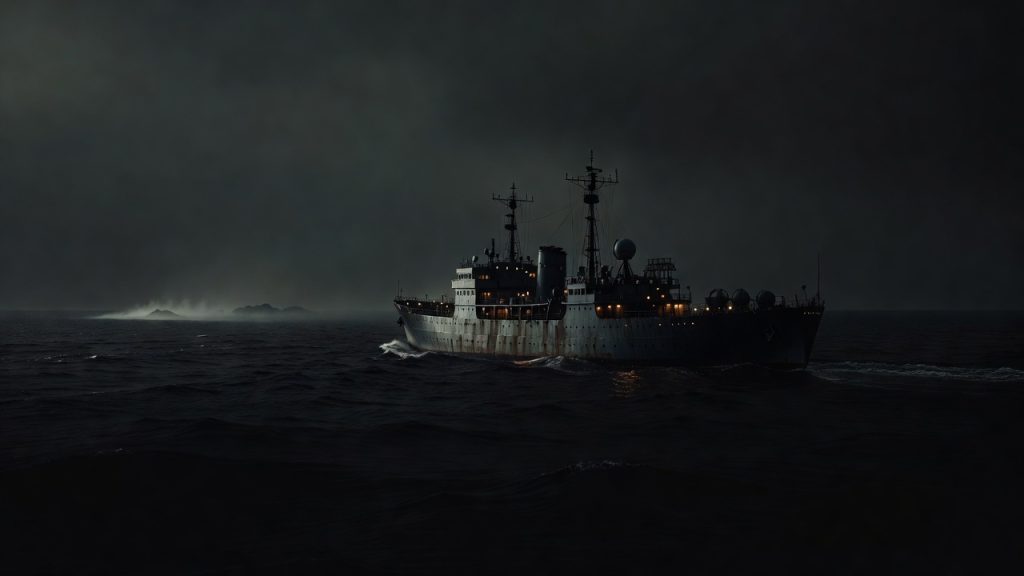
USS George Eastman at sea during Project SHAD — ConspiracyRealist.com

USS George Eastman and Project SHAD

Night on the Pacific can make any ship look like a ghost, but the USS George Eastman was something stranger: a converted Liberty ship rebuilt for scientific measurement and Cold War experiments the public would not fully hear about for decades. Off Hawaii, far from headlines, it moved through simulant clouds, nerve-agent trials, and shipboard defense exercises under Project SHAD. Officially, it was research. To critics, it looked like a floating instrument of a hidden security state.

The Case For

A real ship at the center of real secret testing

The first reason to take the USS George Eastman seriously is simple: the ship and the missions are documented. The Naval History and Heritage Command says the vessel began life as a Liberty-type cargo ship before the Navy converted it into a miscellaneous auxiliary loaded with scientific instruments, including nuclear detection devices. NHHC also notes that the ship could be operated as a “robot ship” from a protected control cubicle. By the early 1960s, the ship had shifted from fallout measurement and ship-protection studies into wider defense research in the Pacific.

That is where Project SHAD enters the story. According to the Defense Department’s Health.mil overview of Project 112/SHAD, the sea-based tests were designed to identify U.S. warships’ vulnerabilities to chemical and biological attack and to develop procedures that would preserve war-fighting capability under those conditions. This was not a rumor program. It was a formal Cold War test system later reconstructed from classified records.

The ship shows up again and again in the released record

The strongest documentary pattern is repetition. The National Academies’ overview of SHAD testing lists the George Eastman in multiple operations, including Eager Belle I, Eager Belle II, Flower Drum I, Magic Sword, and Fearless Johnny. A ship that keeps reappearing across biological, chemical, and operational-defense exercises starts to look less like a supporting prop and more like a floating laboratory central to the program.

The official Flower Drum, Phase I fact sheet is especially hard to wave away. It states that the purposes of the 1964 test were to find a simulant for sarin, assess shipboard vulnerability to an enveloping toxic vapor, and compare penetration properties between actual sarin and a simulant. The George Eastman was the test ship. The same fact sheet says the vessel was exposed through a bow-mounted gas turbine and by simulated envelopment through direct injection into the ship’s air supply system. In plain English: this was not just observing a problem from a distance. The ship itself was the instrument.

The pattern continued in 1965. The official Fearless Johnny fact sheet says the George Eastman was the test subject vessel for all trials as the military evaluated contamination from an aerial-delivered chemical weapon system using VX nerve agent and a VX simulant. Read that twice. The same hull shows up in sarin-related work, VX-related work, biological simulant testing, and defensive washdown studies. If people describe the George Eastman as a secret floating lab, the declassified record gives them a real foundation.

That wider pattern also fits the broader record in our Project SHAD deep dive and the narrower sarin-specific record in Flower Drum I.

The Realist’s Eye

Secret does not automatically mean lawless

This is where the story needs discipline. The existence of classified testing does not prove every darker claim attached to it. The released Flower Drum fact sheet describes protective masks, team check-in procedures, controlled access to the safety citadel, and post-test aeration procedures. Fearless Johnny likewise reads like a structured military trial rather than an improvised human experiment. That does not make the program comfortable. It does mean we should distinguish between documented secrecy and imagined sadism.

There is also a difference between “central to SHAD” and “the hidden core of all Cold War biowarfare.” The George Eastman clearly participated in several important tests, but the surviving public record does not justify claiming it was the single master platform for every covert naval chemical or biological operation. That would go beyond the documents.

The records are real, but they are incomplete

Another problem is the archive itself. Health.mil says the classified information related to SHAD was not completely cataloged or located in one facility, and that the closure of the Deseret Test Center made reconstruction harder decades later. The 2004 GAO report on Project 112 concluded that DoD had likely identified the major tests, but probably had not identified all potentially exposed personnel. That strengthens the case that secrecy and bureaucratic fragmentation were real. It also weakens sweeping claims that we now possess a full, final map of everything the ship did.

The long-term health record is also less decisive than many would like. The National Academies’ SHAD studies did not find clear evidence of a broad, specific long-term health signature across the veteran population studied. That does not erase the ethical question of secret exposure testing, delayed disclosure, or incomplete rosters. But it does mean the cleanest documented accusation is not “the ship poisoned everyone and the evidence proves it.” The cleaner accusation is narrower: the military used the George Eastman in classified chemical and biological defense tests, then took decades to reconstruct and disclose that history.

If anything, the realist tension sits in the middle: enough evidence survives to show that the ship played a repeated role in SHAD, but not enough to justify turning every unanswered question into a solved conspiracy.

What We Know For Certain

  • The USS George Eastman was a converted Liberty ship used by the Navy for scientific and defense research, according to Naval History and Heritage Command.
  • Health.mil says Project SHAD was the sea-based portion of Project 112, created to test warship vulnerability to chemical and biological attack.
  • The National Academies lists the George Eastman in multiple SHAD tests, including Eager Belle, Flower Drum I, Magic Sword, and Fearless Johnny.
  • The Flower Drum I fact sheet says the ship was exposed to candidate sarin simulants and actual sarin.
  • The Fearless Johnny fact sheet says the ship served as the test subject vessel in VX-related contamination and washdown trials.

The Unanswered Questions

  • How complete are the surviving crew rosters and participant records for every George Eastman SHAD operation?
  • How much did individual sailors know, in real time, about the exact substances involved in each test series?
  • What additional classified or lost documents once described the ship’s role in operations beyond the better-known fact sheets?
  • Why did it take until the 2000s for veterans and the public to receive a reconstructed account of missions conducted in the 1960s?

The Closer — You Decide

The USS George Eastman does not need myth to be disturbing. The Navy’s own historians place it inside America’s Cold War research state. DoD’s own fact sheets place it in SHAD tests involving biological simulants, sarin-related trials, and VX-related contamination work. The archive is incomplete. The secrecy was real. The ship was there. Whether you see a necessary defense platform, a floating black box of the Cold War, or something in between, the evidence is on the table. You decide.

dive down the rabbit hole

USS George Eastman and Project SHAD

S-FX.com
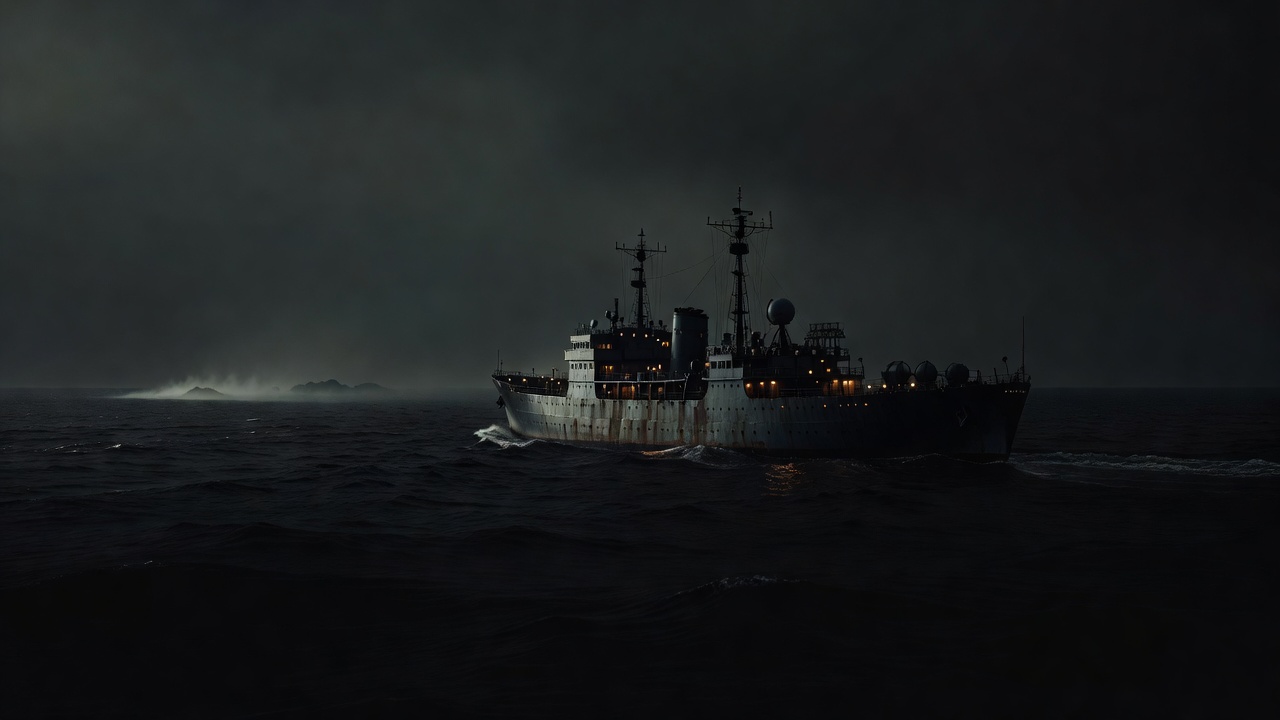
USS George Eastman at sea during Project SHAD — ConspiracyRealist.com

USS George Eastman and Project SHAD

Night on the Pacific can make any ship look like a ghost, but the USS George Eastman was something stranger: a converted Liberty ship rebuilt for scientific measurement and Cold War experiments the public would not fully hear about for decades. Off Hawaii, far from headlines, it moved through simulant clouds, nerve-agent trials, and shipboard defense exercises under Project SHAD. Officially, it was research. To critics, it looked like a floating instrument of a hidden security state.

The Case For

A real ship at the center of real secret testing

The first reason to take the USS George Eastman seriously is simple: the ship and the missions are documented. The Naval History and Heritage Command says the vessel began life as a Liberty-type cargo ship before the Navy converted it into a miscellaneous auxiliary loaded with scientific instruments, including nuclear detection devices. NHHC also notes that the ship could be operated as a “robot ship” from a protected control cubicle. By the early 1960s, the ship had shifted from fallout measurement and ship-protection studies into wider defense research in the Pacific.

That is where Project SHAD enters the story. According to the Defense Department’s Health.mil overview of Project 112/SHAD, the sea-based tests were designed to identify U.S. warships’ vulnerabilities to chemical and biological attack and to develop procedures that would preserve war-fighting capability under those conditions. This was not a rumor program. It was a formal Cold War test system later reconstructed from classified records.

The ship shows up again and again in the released record

The strongest documentary pattern is repetition. The National Academies’ overview of SHAD testing lists the George Eastman in multiple operations, including Eager Belle I, Eager Belle II, Flower Drum I, Magic Sword, and Fearless Johnny. A ship that keeps reappearing across biological, chemical, and operational-defense exercises starts to look less like a supporting prop and more like a floating laboratory central to the program.

The official Flower Drum, Phase I fact sheet is especially hard to wave away. It states that the purposes of the 1964 test were to find a simulant for sarin, assess shipboard vulnerability to an enveloping toxic vapor, and compare penetration properties between actual sarin and a simulant. The George Eastman was the test ship. The same fact sheet says the vessel was exposed through a bow-mounted gas turbine and by simulated envelopment through direct injection into the ship’s air supply system. In plain English: this was not just observing a problem from a distance. The ship itself was the instrument.

The pattern continued in 1965. The official Fearless Johnny fact sheet says the George Eastman was the test subject vessel for all trials as the military evaluated contamination from an aerial-delivered chemical weapon system using VX nerve agent and a VX simulant. Read that twice. The same hull shows up in sarin-related work, VX-related work, biological simulant testing, and defensive washdown studies. If people describe the George Eastman as a secret floating lab, the declassified record gives them a real foundation.

That wider pattern also fits the broader record in our Project SHAD deep dive and the narrower sarin-specific record in Flower Drum I.

The Realist’s Eye

Secret does not automatically mean lawless

This is where the story needs discipline. The existence of classified testing does not prove every darker claim attached to it. The released Flower Drum fact sheet describes protective masks, team check-in procedures, controlled access to the safety citadel, and post-test aeration procedures. Fearless Johnny likewise reads like a structured military trial rather than an improvised human experiment. That does not make the program comfortable. It does mean we should distinguish between documented secrecy and imagined sadism.

There is also a difference between “central to SHAD” and “the hidden core of all Cold War biowarfare.” The George Eastman clearly participated in several important tests, but the surviving public record does not justify claiming it was the single master platform for every covert naval chemical or biological operation. That would go beyond the documents.

The records are real, but they are incomplete

Another problem is the archive itself. Health.mil says the classified information related to SHAD was not completely cataloged or located in one facility, and that the closure of the Deseret Test Center made reconstruction harder decades later. The 2004 GAO report on Project 112 concluded that DoD had likely identified the major tests, but probably had not identified all potentially exposed personnel. That strengthens the case that secrecy and bureaucratic fragmentation were real. It also weakens sweeping claims that we now possess a full, final map of everything the ship did.

The long-term health record is also less decisive than many would like. The National Academies’ SHAD studies did not find clear evidence of a broad, specific long-term health signature across the veteran population studied. That does not erase the ethical question of secret exposure testing, delayed disclosure, or incomplete rosters. But it does mean the cleanest documented accusation is not “the ship poisoned everyone and the evidence proves it.” The cleaner accusation is narrower: the military used the George Eastman in classified chemical and biological defense tests, then took decades to reconstruct and disclose that history.

If anything, the realist tension sits in the middle: enough evidence survives to show that the ship played a repeated role in SHAD, but not enough to justify turning every unanswered question into a solved conspiracy.

What We Know For Certain

  • The USS George Eastman was a converted Liberty ship used by the Navy for scientific and defense research, according to Naval History and Heritage Command.
  • Health.mil says Project SHAD was the sea-based portion of Project 112, created to test warship vulnerability to chemical and biological attack.
  • The National Academies lists the George Eastman in multiple SHAD tests, including Eager Belle, Flower Drum I, Magic Sword, and Fearless Johnny.
  • The Flower Drum I fact sheet says the ship was exposed to candidate sarin simulants and actual sarin.
  • The Fearless Johnny fact sheet says the ship served as the test subject vessel in VX-related contamination and washdown trials.

The Unanswered Questions

  • How complete are the surviving crew rosters and participant records for every George Eastman SHAD operation?
  • How much did individual sailors know, in real time, about the exact substances involved in each test series?
  • What additional classified or lost documents once described the ship’s role in operations beyond the better-known fact sheets?
  • Why did it take until the 2000s for veterans and the public to receive a reconstructed account of missions conducted in the 1960s?

The Closer — You Decide

The USS George Eastman does not need myth to be disturbing. The Navy’s own historians place it inside America’s Cold War research state. DoD’s own fact sheets place it in SHAD tests involving biological simulants, sarin-related trials, and VX-related contamination work. The archive is incomplete. The secrecy was real. The ship was there. Whether you see a necessary defense platform, a floating black box of the Cold War, or something in between, the evidence is on the table. You decide.

USS George Eastman and Project SHAD

USS George Eastman at sea during Project SHAD — ConspiracyRealist.com

USS George Eastman and Project SHAD

Night on the Pacific can make any ship look like a ghost, but the USS George Eastman was something stranger: a converted Liberty ship rebuilt for scientific measurement and Cold War experiments the public would not fully hear about for decades. Off Hawaii, far from headlines, it moved through simulant clouds, nerve-agent trials, and shipboard defense exercises under Project SHAD. Officially, it was research. To critics, it looked like a floating instrument of a hidden security state.

The Case For

A real ship at the center of real secret testing

The first reason to take the USS George Eastman seriously is simple: the ship and the missions are documented. The Naval History and Heritage Command says the vessel began life as a Liberty-type cargo ship before the Navy converted it into a miscellaneous auxiliary loaded with scientific instruments, including nuclear detection devices. NHHC also notes that the ship could be operated as a “robot ship” from a protected control cubicle. By the early 1960s, the ship had shifted from fallout measurement and ship-protection studies into wider defense research in the Pacific.

That is where Project SHAD enters the story. According to the Defense Department’s Health.mil overview of Project 112/SHAD, the sea-based tests were designed to identify U.S. warships’ vulnerabilities to chemical and biological attack and to develop procedures that would preserve war-fighting capability under those conditions. This was not a rumor program. It was a formal Cold War test system later reconstructed from classified records.

The ship shows up again and again in the released record

The strongest documentary pattern is repetition. The National Academies’ overview of SHAD testing lists the George Eastman in multiple operations, including Eager Belle I, Eager Belle II, Flower Drum I, Magic Sword, and Fearless Johnny. A ship that keeps reappearing across biological, chemical, and operational-defense exercises starts to look less like a supporting prop and more like a floating laboratory central to the program.

The official Flower Drum, Phase I fact sheet is especially hard to wave away. It states that the purposes of the 1964 test were to find a simulant for sarin, assess shipboard vulnerability to an enveloping toxic vapor, and compare penetration properties between actual sarin and a simulant. The George Eastman was the test ship. The same fact sheet says the vessel was exposed through a bow-mounted gas turbine and by simulated envelopment through direct injection into the ship’s air supply system. In plain English: this was not just observing a problem from a distance. The ship itself was the instrument.

The pattern continued in 1965. The official Fearless Johnny fact sheet says the George Eastman was the test subject vessel for all trials as the military evaluated contamination from an aerial-delivered chemical weapon system using VX nerve agent and a VX simulant. Read that twice. The same hull shows up in sarin-related work, VX-related work, biological simulant testing, and defensive washdown studies. If people describe the George Eastman as a secret floating lab, the declassified record gives them a real foundation.

That wider pattern also fits the broader record in our Project SHAD deep dive and the narrower sarin-specific record in Flower Drum I.

The Realist’s Eye

Secret does not automatically mean lawless

This is where the story needs discipline. The existence of classified testing does not prove every darker claim attached to it. The released Flower Drum fact sheet describes protective masks, team check-in procedures, controlled access to the safety citadel, and post-test aeration procedures. Fearless Johnny likewise reads like a structured military trial rather than an improvised human experiment. That does not make the program comfortable. It does mean we should distinguish between documented secrecy and imagined sadism.

There is also a difference between “central to SHAD” and “the hidden core of all Cold War biowarfare.” The George Eastman clearly participated in several important tests, but the surviving public record does not justify claiming it was the single master platform for every covert naval chemical or biological operation. That would go beyond the documents.

The records are real, but they are incomplete

Another problem is the archive itself. Health.mil says the classified information related to SHAD was not completely cataloged or located in one facility, and that the closure of the Deseret Test Center made reconstruction harder decades later. The 2004 GAO report on Project 112 concluded that DoD had likely identified the major tests, but probably had not identified all potentially exposed personnel. That strengthens the case that secrecy and bureaucratic fragmentation were real. It also weakens sweeping claims that we now possess a full, final map of everything the ship did.

The long-term health record is also less decisive than many would like. The National Academies’ SHAD studies did not find clear evidence of a broad, specific long-term health signature across the veteran population studied. That does not erase the ethical question of secret exposure testing, delayed disclosure, or incomplete rosters. But it does mean the cleanest documented accusation is not “the ship poisoned everyone and the evidence proves it.” The cleaner accusation is narrower: the military used the George Eastman in classified chemical and biological defense tests, then took decades to reconstruct and disclose that history.

If anything, the realist tension sits in the middle: enough evidence survives to show that the ship played a repeated role in SHAD, but not enough to justify turning every unanswered question into a solved conspiracy.

What We Know For Certain

  • The USS George Eastman was a converted Liberty ship used by the Navy for scientific and defense research, according to Naval History and Heritage Command.
  • Health.mil says Project SHAD was the sea-based portion of Project 112, created to test warship vulnerability to chemical and biological attack.
  • The National Academies lists the George Eastman in multiple SHAD tests, including Eager Belle, Flower Drum I, Magic Sword, and Fearless Johnny.
  • The Flower Drum I fact sheet says the ship was exposed to candidate sarin simulants and actual sarin.
  • The Fearless Johnny fact sheet says the ship served as the test subject vessel in VX-related contamination and washdown trials.

The Unanswered Questions

  • How complete are the surviving crew rosters and participant records for every George Eastman SHAD operation?
  • How much did individual sailors know, in real time, about the exact substances involved in each test series?
  • What additional classified or lost documents once described the ship’s role in operations beyond the better-known fact sheets?
  • Why did it take until the 2000s for veterans and the public to receive a reconstructed account of missions conducted in the 1960s?

The Closer — You Decide

The USS George Eastman does not need myth to be disturbing. The Navy’s own historians place it inside America’s Cold War research state. DoD’s own fact sheets place it in SHAD tests involving biological simulants, sarin-related trials, and VX-related contamination work. The archive is incomplete. The secrecy was real. The ship was there. Whether you see a necessary defense platform, a floating black box of the Cold War, or something in between, the evidence is on the table. You decide.

Table of contents