Menu

Flower Drum I: SHAD’s Sarin Sea Test

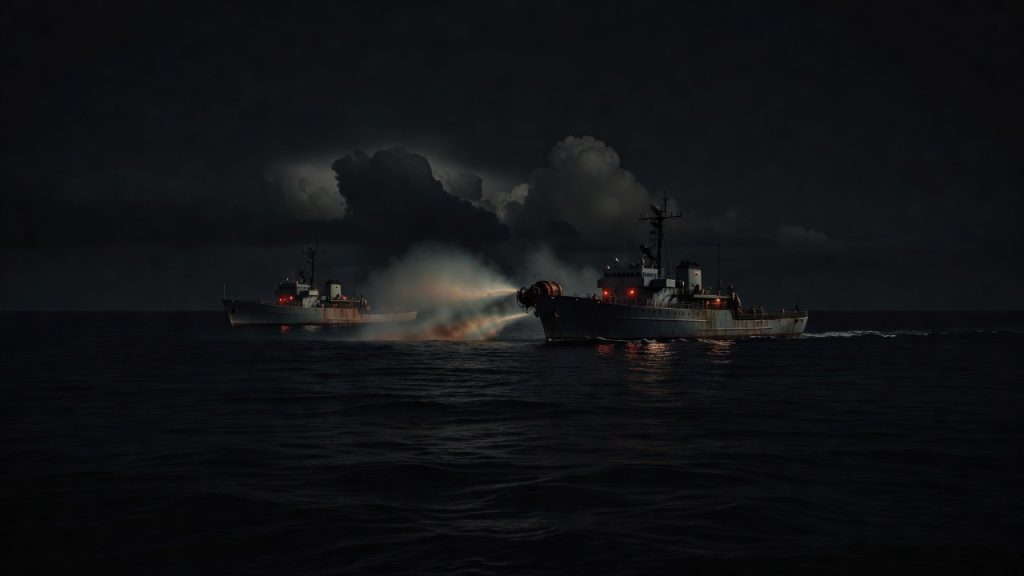
Project SHAD Flower Drum I ships at sea — ConspiracyRealist.com

Flower Drum I: SHAD’s Sarin Sea Test

Night over the Pacific. Two research ships move through black water while a machine on the bow turns a war plan into weather. No headlines. No public warning. In 1964, the Pentagon ran a sea test called Flower Drum I. The bland codename hid a reality: the Navy was not only searching for a stand-in for sarin. According to the declassified record, it also compared that stand-in against nerve agent at sea.

The Case For

Flower Drum I was a documented SHAD test that used actual sarin

The strongest reason to take Flower Drum I seriously is that the Pentagon eventually described it in plain terms. In the official Health.mil fact sheet for Flower Drum, Phase I, the Defense Department says the purposes of the test were to find a simulant for sarin, assess shipboard vulnerability to an enveloping vapor of toxic agent, and establish comparative penetration properties for a simulant and actual sarin. That is not rumor language. It is operational language.

The same fact sheet says the USS George Eastman was exposed to candidate sarin simulants as well as sarin nerve agent, with trials conducted off Hawaii during February through April and again in August through September 1964. Another ship, the USS Granville S. Hall, was also involved. The release method matters. The test agent was disseminated from a gas turbine mounted on the bow, and simulated envelopment also included direct injection into the ship’s air supply system. This was not a classroom model of chemical attack. It was a field test built around real ships and shipboard penetration.

The test appears to be the hinge between sarin trials and later simulant-heavy SHAD work

The Flower Drum I fact sheet says sulfur dioxide and methylacetoacetate were trialed as simulants for sarin, and that methylacetoacetate was selected for more comprehensive comparative testing. That detail makes Flower Drum I more than an isolated Cold War curiosity. It looks like the bridge between live-agent experimentation and later tests built around the newly chosen stand-in.

You can see that continuity in the broader Project SHAD record. The 2007 National Academies overview of SHAD lists Flower Drum I with sarin, sulfur dioxide, and methylacetoacetate, while later tests such as High Low rely on methylacetoacetate alone. In other words, Flower Drum I appears to be where the military worked out whether a less lethal chemical could mimic the behavior of a live nerve agent closely enough to carry the rest of the program.

That gives the conspiracy case real weight. A secret program did not merely imagine nerve-agent attack conditions. It built them, measured them, and refined them until the military had a reusable model for shipboard chemical vulnerability. The surviving paperwork suggests the government learned what it needed and then moved on, while the public learned almost nothing for decades.

The Realist’s Eye

The record confirms sarin was involved, but not every darkest implication

This is where the story has to stay disciplined. Flower Drum I is stronger than many SHAD stories because the fact sheet explicitly mentions actual sarin. But the same document also describes safety controls that complicate the lurid version. During sarin dissemination, the disseminator crew wore M5 protective ensembles, while other personnel in the Safety Citadel wore protective masks. After dissemination ceased, anyone leaving the protected area was supposed to remain masked until the ship was cleared. The fact sheet says aeration continued until an M15A1 detector kit indicated no nerve agent remained in the exhaust air.

That does not erase the ethical problem. It does narrow what can honestly be claimed. The public record supports saying Flower Drum I involved real sarin in a classified shipboard test. It does not support saying the Navy casually sprayed an unprotected crew with lethal nerve agent for sport. The test was dangerous by nature, but the surviving file also shows planners trying to contain that danger inside a rigid procedure.

The bigger scandal may be secrecy, consent, and the fragmentary archive

The Department of Veterans Affairs says the Defense Department only began declassifying and sharing Project 112 and SHAD information with VA in 2000. That delay matters. A program can leave a stain even when its safety procedures were more substantial than rumor suggests. A classified exposure test kept from the public, from many veterans, and from normal scrutiny for decades creates its own credibility crisis.

The 2004 GAO report on Project 112 concluded that DoD had likely identified the major tests, but probably had not identified all potentially exposed personnel. That finding should cool anyone claiming a perfect hidden archive exists somewhere with every answer neatly preserved. It should also sharpen the real concern. We know enough to confirm the test, the ships, the substances, and the mission. We do not know enough to say every participant was fully informed, fully tracked, or fully accounted for later.

So the realist position is uncomfortable for both camps. Flower Drum I is not a myth stitched together from veteran lore. But it is also not a blank check for every broader allegation about SHAD. The strongest documented conclusion is narrower and still unsettling: the military used an operational ship to compare candidate simulants against actual sarin, then allowed that history to sit in the dark for decades.

If there is a broader lesson, it sits in the site’s government secrets archive: sometimes the scandal is bureaucratic secrecy, delayed disclosure, and a record reconstructed only after the people inside it have aged into history.

What We Know For Certain

  • Flower Drum I was a real Project SHAD test, designated 64-2, conducted off Hawaii in 1964 by the U.S. Army’s Deseret Test Center.
  • The USS George Eastman was exposed to candidate sarin simulants as well as actual sarin nerve agent, according to the official fact sheet.
  • Sulfur dioxide and methylacetoacetate were tested as candidate simulants, and methylacetoacetate was selected for further comparative work.
  • The test used a bow-mounted gas turbine and also simulated envelopment through direct injection into the ship’s air supply system.
  • DoD only began declassifying and sharing SHAD information with VA in 2000, decades after the test took place.

The Unanswered Questions

  • How fully were participating sailors briefed on the fact that actual sarin, not only simulants, was part of Flower Drum I?
  • What internal results convinced planners that methylacetoacetate was the best sarin stand-in for later SHAD work?
  • How complete are the personnel rosters and follow-up records for the ships involved in Flower Drum I?
  • Why did it take decades for the test’s basic details to become available to veterans and the public?

The Closer — You Decide

Flower Drum I does not need embellishment. The declassified version is already strange enough: a Cold War sea trial off Hawaii, a Navy research ship wrapped in test clouds, and a government file admitting that the comparison included real sarin. Maybe that was grim but rational defense planning in an era obsessed with worst-case war. Maybe it was a line crossed under classification and only softened later by official language. The ships were real. The agent was real. The delay in telling the story was real too. The evidence is on the table. You decide.

dive down the rabbit hole

Flower Drum I: SHAD’s Sarin Sea Test

S-FX.com
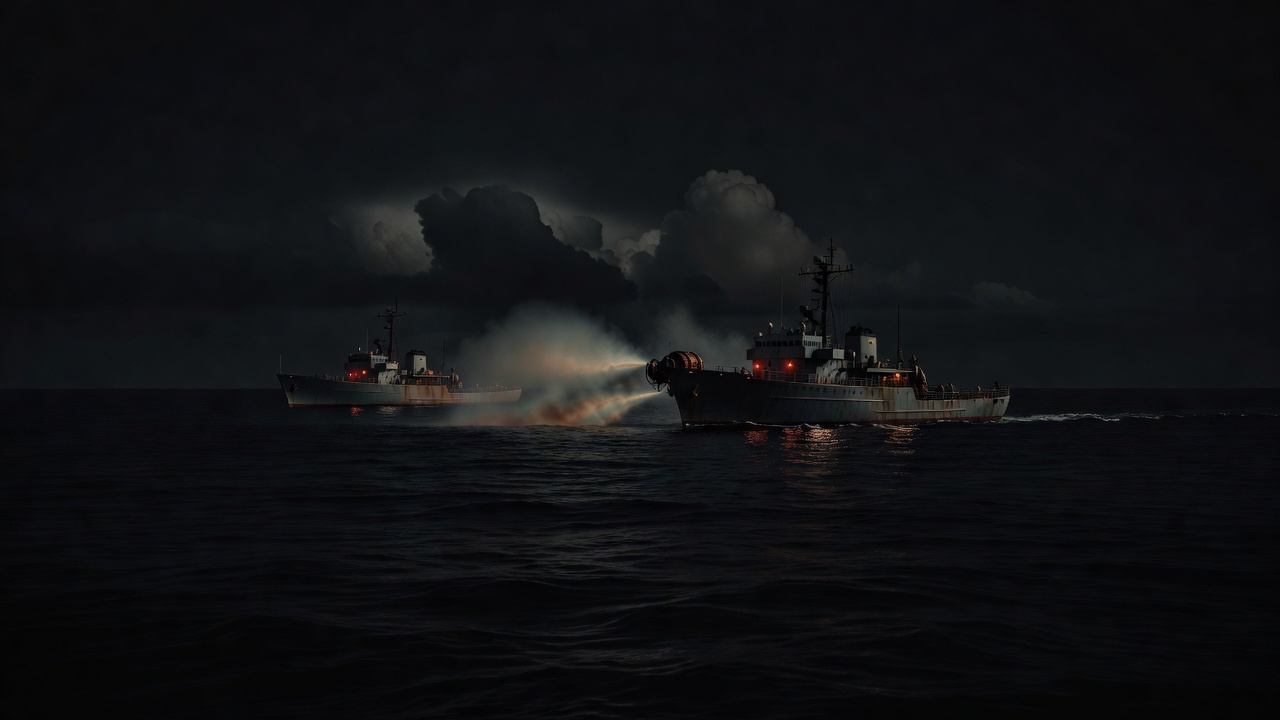
Project SHAD Flower Drum I ships at sea — ConspiracyRealist.com

Flower Drum I: SHAD’s Sarin Sea Test

Night over the Pacific. Two research ships move through black water while a machine on the bow turns a war plan into weather. No headlines. No public warning. In 1964, the Pentagon ran a sea test called Flower Drum I. The bland codename hid a reality: the Navy was not only searching for a stand-in for sarin. According to the declassified record, it also compared that stand-in against nerve agent at sea.

The Case For

Flower Drum I was a documented SHAD test that used actual sarin

The strongest reason to take Flower Drum I seriously is that the Pentagon eventually described it in plain terms. In the official Health.mil fact sheet for Flower Drum, Phase I, the Defense Department says the purposes of the test were to find a simulant for sarin, assess shipboard vulnerability to an enveloping vapor of toxic agent, and establish comparative penetration properties for a simulant and actual sarin. That is not rumor language. It is operational language.

The same fact sheet says the USS George Eastman was exposed to candidate sarin simulants as well as sarin nerve agent, with trials conducted off Hawaii during February through April and again in August through September 1964. Another ship, the USS Granville S. Hall, was also involved. The release method matters. The test agent was disseminated from a gas turbine mounted on the bow, and simulated envelopment also included direct injection into the ship’s air supply system. This was not a classroom model of chemical attack. It was a field test built around real ships and shipboard penetration.

The test appears to be the hinge between sarin trials and later simulant-heavy SHAD work

The Flower Drum I fact sheet says sulfur dioxide and methylacetoacetate were trialed as simulants for sarin, and that methylacetoacetate was selected for more comprehensive comparative testing. That detail makes Flower Drum I more than an isolated Cold War curiosity. It looks like the bridge between live-agent experimentation and later tests built around the newly chosen stand-in.

You can see that continuity in the broader Project SHAD record. The 2007 National Academies overview of SHAD lists Flower Drum I with sarin, sulfur dioxide, and methylacetoacetate, while later tests such as High Low rely on methylacetoacetate alone. In other words, Flower Drum I appears to be where the military worked out whether a less lethal chemical could mimic the behavior of a live nerve agent closely enough to carry the rest of the program.

That gives the conspiracy case real weight. A secret program did not merely imagine nerve-agent attack conditions. It built them, measured them, and refined them until the military had a reusable model for shipboard chemical vulnerability. The surviving paperwork suggests the government learned what it needed and then moved on, while the public learned almost nothing for decades.

The Realist’s Eye

The record confirms sarin was involved, but not every darkest implication

This is where the story has to stay disciplined. Flower Drum I is stronger than many SHAD stories because the fact sheet explicitly mentions actual sarin. But the same document also describes safety controls that complicate the lurid version. During sarin dissemination, the disseminator crew wore M5 protective ensembles, while other personnel in the Safety Citadel wore protective masks. After dissemination ceased, anyone leaving the protected area was supposed to remain masked until the ship was cleared. The fact sheet says aeration continued until an M15A1 detector kit indicated no nerve agent remained in the exhaust air.

That does not erase the ethical problem. It does narrow what can honestly be claimed. The public record supports saying Flower Drum I involved real sarin in a classified shipboard test. It does not support saying the Navy casually sprayed an unprotected crew with lethal nerve agent for sport. The test was dangerous by nature, but the surviving file also shows planners trying to contain that danger inside a rigid procedure.

The bigger scandal may be secrecy, consent, and the fragmentary archive

The Department of Veterans Affairs says the Defense Department only began declassifying and sharing Project 112 and SHAD information with VA in 2000. That delay matters. A program can leave a stain even when its safety procedures were more substantial than rumor suggests. A classified exposure test kept from the public, from many veterans, and from normal scrutiny for decades creates its own credibility crisis.

The 2004 GAO report on Project 112 concluded that DoD had likely identified the major tests, but probably had not identified all potentially exposed personnel. That finding should cool anyone claiming a perfect hidden archive exists somewhere with every answer neatly preserved. It should also sharpen the real concern. We know enough to confirm the test, the ships, the substances, and the mission. We do not know enough to say every participant was fully informed, fully tracked, or fully accounted for later.

So the realist position is uncomfortable for both camps. Flower Drum I is not a myth stitched together from veteran lore. But it is also not a blank check for every broader allegation about SHAD. The strongest documented conclusion is narrower and still unsettling: the military used an operational ship to compare candidate simulants against actual sarin, then allowed that history to sit in the dark for decades.

If there is a broader lesson, it sits in the site’s government secrets archive: sometimes the scandal is bureaucratic secrecy, delayed disclosure, and a record reconstructed only after the people inside it have aged into history.

What We Know For Certain

  • Flower Drum I was a real Project SHAD test, designated 64-2, conducted off Hawaii in 1964 by the U.S. Army’s Deseret Test Center.
  • The USS George Eastman was exposed to candidate sarin simulants as well as actual sarin nerve agent, according to the official fact sheet.
  • Sulfur dioxide and methylacetoacetate were tested as candidate simulants, and methylacetoacetate was selected for further comparative work.
  • The test used a bow-mounted gas turbine and also simulated envelopment through direct injection into the ship’s air supply system.
  • DoD only began declassifying and sharing SHAD information with VA in 2000, decades after the test took place.

The Unanswered Questions

  • How fully were participating sailors briefed on the fact that actual sarin, not only simulants, was part of Flower Drum I?
  • What internal results convinced planners that methylacetoacetate was the best sarin stand-in for later SHAD work?
  • How complete are the personnel rosters and follow-up records for the ships involved in Flower Drum I?
  • Why did it take decades for the test’s basic details to become available to veterans and the public?

The Closer — You Decide

Flower Drum I does not need embellishment. The declassified version is already strange enough: a Cold War sea trial off Hawaii, a Navy research ship wrapped in test clouds, and a government file admitting that the comparison included real sarin. Maybe that was grim but rational defense planning in an era obsessed with worst-case war. Maybe it was a line crossed under classification and only softened later by official language. The ships were real. The agent was real. The delay in telling the story was real too. The evidence is on the table. You decide.

Flower Drum I: SHAD’s Sarin Sea Test

Project SHAD Flower Drum I ships at sea — ConspiracyRealist.com

Flower Drum I: SHAD’s Sarin Sea Test

Night over the Pacific. Two research ships move through black water while a machine on the bow turns a war plan into weather. No headlines. No public warning. In 1964, the Pentagon ran a sea test called Flower Drum I. The bland codename hid a reality: the Navy was not only searching for a stand-in for sarin. According to the declassified record, it also compared that stand-in against nerve agent at sea.

The Case For

Flower Drum I was a documented SHAD test that used actual sarin

The strongest reason to take Flower Drum I seriously is that the Pentagon eventually described it in plain terms. In the official Health.mil fact sheet for Flower Drum, Phase I, the Defense Department says the purposes of the test were to find a simulant for sarin, assess shipboard vulnerability to an enveloping vapor of toxic agent, and establish comparative penetration properties for a simulant and actual sarin. That is not rumor language. It is operational language.

The same fact sheet says the USS George Eastman was exposed to candidate sarin simulants as well as sarin nerve agent, with trials conducted off Hawaii during February through April and again in August through September 1964. Another ship, the USS Granville S. Hall, was also involved. The release method matters. The test agent was disseminated from a gas turbine mounted on the bow, and simulated envelopment also included direct injection into the ship’s air supply system. This was not a classroom model of chemical attack. It was a field test built around real ships and shipboard penetration.

The test appears to be the hinge between sarin trials and later simulant-heavy SHAD work

The Flower Drum I fact sheet says sulfur dioxide and methylacetoacetate were trialed as simulants for sarin, and that methylacetoacetate was selected for more comprehensive comparative testing. That detail makes Flower Drum I more than an isolated Cold War curiosity. It looks like the bridge between live-agent experimentation and later tests built around the newly chosen stand-in.

You can see that continuity in the broader Project SHAD record. The 2007 National Academies overview of SHAD lists Flower Drum I with sarin, sulfur dioxide, and methylacetoacetate, while later tests such as High Low rely on methylacetoacetate alone. In other words, Flower Drum I appears to be where the military worked out whether a less lethal chemical could mimic the behavior of a live nerve agent closely enough to carry the rest of the program.

That gives the conspiracy case real weight. A secret program did not merely imagine nerve-agent attack conditions. It built them, measured them, and refined them until the military had a reusable model for shipboard chemical vulnerability. The surviving paperwork suggests the government learned what it needed and then moved on, while the public learned almost nothing for decades.

The Realist’s Eye

The record confirms sarin was involved, but not every darkest implication

This is where the story has to stay disciplined. Flower Drum I is stronger than many SHAD stories because the fact sheet explicitly mentions actual sarin. But the same document also describes safety controls that complicate the lurid version. During sarin dissemination, the disseminator crew wore M5 protective ensembles, while other personnel in the Safety Citadel wore protective masks. After dissemination ceased, anyone leaving the protected area was supposed to remain masked until the ship was cleared. The fact sheet says aeration continued until an M15A1 detector kit indicated no nerve agent remained in the exhaust air.

That does not erase the ethical problem. It does narrow what can honestly be claimed. The public record supports saying Flower Drum I involved real sarin in a classified shipboard test. It does not support saying the Navy casually sprayed an unprotected crew with lethal nerve agent for sport. The test was dangerous by nature, but the surviving file also shows planners trying to contain that danger inside a rigid procedure.

The bigger scandal may be secrecy, consent, and the fragmentary archive

The Department of Veterans Affairs says the Defense Department only began declassifying and sharing Project 112 and SHAD information with VA in 2000. That delay matters. A program can leave a stain even when its safety procedures were more substantial than rumor suggests. A classified exposure test kept from the public, from many veterans, and from normal scrutiny for decades creates its own credibility crisis.

The 2004 GAO report on Project 112 concluded that DoD had likely identified the major tests, but probably had not identified all potentially exposed personnel. That finding should cool anyone claiming a perfect hidden archive exists somewhere with every answer neatly preserved. It should also sharpen the real concern. We know enough to confirm the test, the ships, the substances, and the mission. We do not know enough to say every participant was fully informed, fully tracked, or fully accounted for later.

So the realist position is uncomfortable for both camps. Flower Drum I is not a myth stitched together from veteran lore. But it is also not a blank check for every broader allegation about SHAD. The strongest documented conclusion is narrower and still unsettling: the military used an operational ship to compare candidate simulants against actual sarin, then allowed that history to sit in the dark for decades.

If there is a broader lesson, it sits in the site’s government secrets archive: sometimes the scandal is bureaucratic secrecy, delayed disclosure, and a record reconstructed only after the people inside it have aged into history.

What We Know For Certain

  • Flower Drum I was a real Project SHAD test, designated 64-2, conducted off Hawaii in 1964 by the U.S. Army’s Deseret Test Center.
  • The USS George Eastman was exposed to candidate sarin simulants as well as actual sarin nerve agent, according to the official fact sheet.
  • Sulfur dioxide and methylacetoacetate were tested as candidate simulants, and methylacetoacetate was selected for further comparative work.
  • The test used a bow-mounted gas turbine and also simulated envelopment through direct injection into the ship’s air supply system.
  • DoD only began declassifying and sharing SHAD information with VA in 2000, decades after the test took place.

The Unanswered Questions

  • How fully were participating sailors briefed on the fact that actual sarin, not only simulants, was part of Flower Drum I?
  • What internal results convinced planners that methylacetoacetate was the best sarin stand-in for later SHAD work?
  • How complete are the personnel rosters and follow-up records for the ships involved in Flower Drum I?
  • Why did it take decades for the test’s basic details to become available to veterans and the public?

The Closer — You Decide

Flower Drum I does not need embellishment. The declassified version is already strange enough: a Cold War sea trial off Hawaii, a Navy research ship wrapped in test clouds, and a government file admitting that the comparison included real sarin. Maybe that was grim but rational defense planning in an era obsessed with worst-case war. Maybe it was a line crossed under classification and only softened later by official language. The ships were real. The agent was real. The delay in telling the story was real too. The evidence is on the table. You decide.

Table of contents