Menu

The Nimitz Encounter: Navy Pilots Speak Out

The Nimitz Encounter: Navy Pilots Speak Out

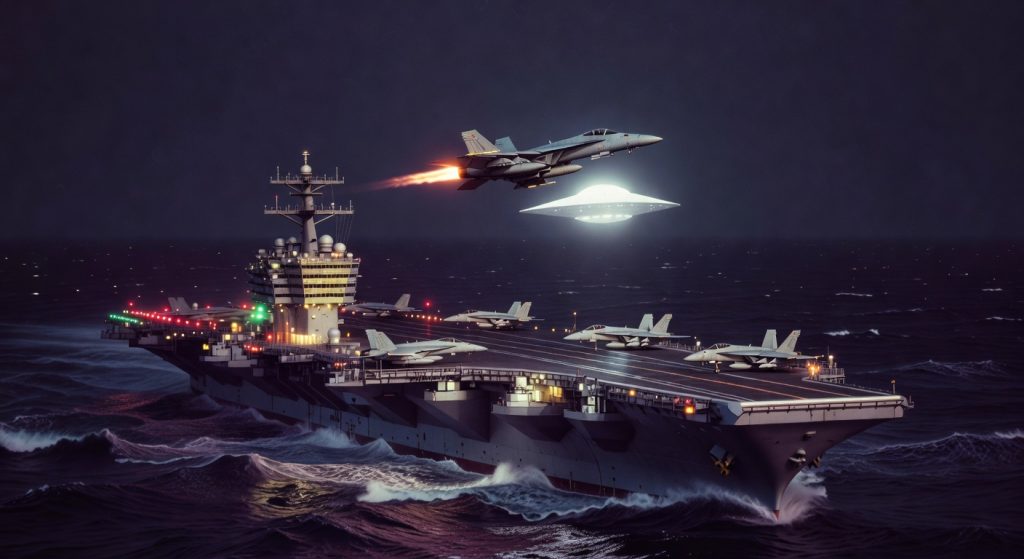
It was supposed to be a routine training exercise. Two F/A-18F Super Hornets peeling off from the USS Nimitz carrier strike group, 40 miles off the coast of San Diego, on a clear November morning in 2004. What Commander David Fravor encountered that day would haunt him for years — not because it was terrifying in a Hollywood sense, but because it was impossible. And he knew exactly what aircraft could and couldn’t do.

This wasn’t a weather balloon. This wasn’t swamp gas. This was a craft that defied every known principle of aerodynamics, hovered effortlessly above a churning, boiling patch of ocean, mirrored the movements of a combat-trained Navy pilot with apparent intent, and then — in an instant — simply vanished.

The Nimitz encounter is arguably the most credible, most documented, and most consequential UAP event in modern history. It involves multiple trained military observers, corroborating radar data, electro-optical sensor footage, and ultimately, an acknowledgment from the Pentagon itself. Yet for over a decade, it was buried. Quietly. Deliberately.

Welcome to the story they didn’t want you to know — and the pilots who refused to stay silent.

Two Weeks of Anomalies: The Radar Picture Nobody Could Explain

Before Commander Fravor ever laid eyes on the object, the crew of the USS Princeton — an Aegis-class guided-missile cruiser operating as the Nimitz strike group’s most sophisticated sensor platform — had been tracking something extraordinary for nearly two weeks.

Senior Chief Kevin Day, the Princeton’s lead radar operator, was watching objects appear on his screens at altitudes above 80,000 feet. These weren’t commercial aircraft. They weren’t military jets. They would drop from the upper atmosphere to just above the ocean’s surface in seconds — a rate of descent that would turn any human pilot into paste. Then they would simply hover. Sometimes they would disappear entirely. Sometimes there were multiple objects. Sometimes just one.

Day later described the experience in interviews as deeply unsettling — not because the objects seemed threatening, but because his instruments, among the most advanced in the United States Navy, could not explain what they were tracking. The AN/SPY-1 radar system aboard the Princeton is not prone to ghost returns or sensor artifacts. It is the backbone of the Navy’s Aegis Combat System, designed to track and engage multiple simultaneous threats. It was telling him something was there. His eyes told him nothing.

What made the radar picture even more alarming was the pattern. These objects weren’t random. They appeared in the same general area, day after day. Whatever they were, they seemed to know where the strike group was operating.

The Intercept: Fravor Goes Up

On November 14, 2004, Commander Fravor and his wingman, Commander Jim Slaight, were scrambled to investigate one of these anomalous contacts. Flying in their F/A-18F Super Hornets, they were directed to a location where the Princeton had been tracking an object descending from altitude.

What Fravor saw when he arrived has since become one of the most discussed eyewitness accounts in the history of UAP research. Below him, the ocean was churning — a roughly 100-meter circle of white water, as if something just beneath the surface was disturbing it from below. And above that churning water, hovering effortlessly, was the object.

White. Smooth. Approximately 40 feet long. Oblong, shaped like a giant Tic Tac. No wings. No rotors. No visible exhaust. No markings. It moved erratically — not randomly, but with what Fravor later described as almost playful intent — darting left and right, ascending and descending, all without any of the aerodynamic signatures a conventional aircraft would produce.

Fravor decided to intercept. He began a slow spiraling descent toward the object. The object responded. As Fravor banked toward it, the Tic Tac mirrored his movements, climbing toward him from below — a behavior that suggested either a remarkably sophisticated automated system or deliberate, intelligent control. When Fravor made an aggressive cut to try to close the distance, the object reacted instantly. It accelerated away at a speed he described as unlike anything he’d ever seen — not a gradual increase in velocity, but an instantaneous leap, from hover to hypersonic, with zero visible propulsion.

It was gone in seconds. The entire engagement lasted roughly five minutes.

“I want to be clear,” Fravor later told reporters. “I’m not telling you this was an alien spacecraft. I’m telling you it was not something we have — and it was not something any adversary we know of has either.”

The FLIR Footage: When the Camera Sees What the Eye Can’t Explain

Fravor’s was not the only intercept that day. A second flight of F/A-18s was vectored to the area shortly after Fravor’s engagement. One of those pilots, Lieutenant Chad Underwood, managed to capture the object on his aircraft’s Forward-Looking Infrared (FLIR) camera — a piece of footage that would eventually become the most scrutinized piece of film in UAP history.

The footage, now known officially as the “FLIR1” video, shows a white oblong object moving across the screen, with the targeting system struggling to maintain a lock. At one point, the object appears to accelerate rapidly and exit the frame. The camera operators can be heard expressing disbelief. The object exhibits no thermal exhaust plume — no sign of conventional propulsion of any kind.

For years, this footage circulated in classified channels. Then, in December 2017, The New York Times published a bombshell investigation revealing not only the existence of the Nimitz footage, but of a secret Pentagon program established to study exactly these kinds of encounters. The program was called the Advanced Aerospace Threat Identification Program — or AATIP.

The public reaction was, to put it mildly, significant.

AATIP: The $22 Million Secret

The Advanced Aerospace Threat Identification Program was not a fringe effort. It was a congressionally funded, Pentagon-run program with a budget of $22 million over five years, established largely at the urging of then-Senate Majority Leader Harry Reid of Nevada — a man not typically associated with UFO research, but who had grown genuinely concerned about what military pilots were encountering.

The program was run by Luis Elizondo, a career intelligence officer who spent years inside the U.S. government studying UAP incidents, analyzing sensor data, and trying to build a coherent picture of what these objects might be. Elizondo resigned from the Pentagon in 2017, citing frustration with internal resistance to taking the phenomenon seriously. His resignation letter, sent directly to then-Secretary of Defense James Mattis, warned that the United States was failing to adequately address a potential national security threat.

Elizondo has since become one of the most prominent voices in the UAP disclosure movement, consistently maintaining that what pilots like Fravor encountered represents technology that is not American, not from any known adversary, and not explainable by current scientific frameworks. His willingness to speak publicly — carefully, methodically, and without sensationalism — has lent the UAP conversation a credibility it previously lacked.

AATIP’s work fed directly into the creation of the UAP Task Force in 2020, and later the All-domain Anomaly Resolution Office (AARO), institutionalizing UAP investigation within the U.S. defense apparatus for the first time in modern history. Some would argue this represents genuine progress toward transparency. Others — including many researchers and former officials — argue it represents a carefully managed limited hangout, designed to control the narrative while keeping the most sensitive information buried. The question of who within the Deep State apparatus controls this information, and why, remains very much open.

The Five Observables: A Framework That Changes Everything

One of Elizondo’s most significant contributions to the public UAP conversation is what he calls the Five Observables — a framework derived from the analysis of multiple UAP incidents, including the Nimitz encounter, that describes the consistent performance characteristics of these objects. They are:

  • Anti-gravity lift — Movement with no visible means of aerodynamic lift, no wings, no rotors, operating in defiance of known physics.
  • Instantaneous acceleration — Velocity changes that would be physically fatal to any biological occupant under known gravitational constraints.
  • Hypersonic velocity without signatures — Movement at speeds far exceeding Mach 5 without the sonic boom, heat signature, or plasma ionization trail that such speeds would normally generate.
  • Low observability — The ability to evade or confuse conventional radar and optical systems, appearing and disappearing seemingly at will.
  • Trans-medium travel — Movement seamlessly between air, water, and potentially space, without any apparent change in propulsion or vehicle configuration.

These five characteristics, taken together, don’t describe any aircraft in any known nation’s inventory — not in 2004, and not today. They describe something operating on principles of physics that we either don’t fully understand or haven’t yet discovered. For those inclined toward the more speculative end of the spectrum, they describe exactly what you’d expect from technology that may have been reverse-engineered from non-human sources.

Congress Takes Notice: Fravor Under Oath

For years, the Nimitz encounter lived primarily in the realm of aviation forums, UFO conferences, and late-night talk shows. That changed definitively in 2023, when Commander David Fravor testified before Congress — under oath — about what he witnessed that November morning two decades earlier.

Fravor’s congressional testimony was remarkable not for any new revelations, but for its tone. Here was a decorated, 18-year Navy veteran, a man who flew combat missions and commanded a fighter squadron, sitting before the United States Congress and saying, plainly and without qualification: I saw something that cannot be explained by any technology I’m aware of, and I believe it represents a genuine national security concern.

He was joined in that testimony by other witnesses, including David Grusch — a former intelligence officer who dropped what may be the most explosive claim in the history of UAP disclosure. Grusch testified, under oath and with legal protections as a federal whistleblower, that the United States government has been in possession of non-human craft and biological remains for decades, and that a secret, unacknowledged special access program exists to study and potentially exploit this technology — all while systematically deceiving Congress about its existence.

David Grusch’s claims remain unverified in the public domain. The Pentagon has denied them. But Grusch has not walked them back. He has provided his testimony to the Inspector General of the Intelligence Community, which reportedly found his claims “credible and urgent.” The machinery of official denial has been working overtime — but the cracks are showing.

The implications of Grusch’s testimony — if even partially accurate — connect directly to questions about who ultimately controls access to transformative technologies and whether the public interest is being served — or deliberately subverted.

The Pentagon Confirms: “Unidentified”

In April 2020, the Department of Defense took an extraordinary step. It officially released three UAP videos — including the Nimitz FLIR footage — and confirmed that they were authentic recordings made by U.S. Navy personnel, that they had never been officially authorized for release, and that the objects depicted remain unidentified.

That word — unidentified — carries more weight than it might initially appear. This was not a statement from a retired pilot, a think tank, or a documentary filmmaker. This was the official position of the United States military. They filmed something. They don’t know what it was. And they thought the public should know.

The release came after years of pressure from researchers, journalists, and former officials. It came after the 2017 New York Times story cracked the dam. It came after Luis Elizondo went public. It came after pilots like Fravor began giving interviews. The official confirmation, in other words, was not a spontaneous act of transparency — it was the result of sustained, determined effort by people who believed the truth was being suppressed.

Those inclined toward skepticism will note that “unidentified” doesn’t mean “alien.” It means exactly what it says: we don’t know what it is. And that’s fair. But in a world where the United States military operates the most sophisticated sensor arrays, the most advanced aircraft, and the largest defense intelligence apparatus in human history — “we don’t know” is a remarkable admission. It is, at minimum, an acknowledgment that something real is happening in our skies that we cannot explain.

What Are We Actually Dealing With? The Competing Theories

The honest answer is: nobody outside a very small, very classified circle knows for certain. But the competing explanations each carry their own troubling implications.

Foreign Adversary Technology

The most conventional explanation is that Russia or China has developed a classified aerospace technology so far beyond what U.S. intelligence estimates suggested that it caught the entire defense establishment off guard. This would represent a catastrophic intelligence failure of historic proportions. It would also raise the question of why, if this is Chinese or Russian technology, it has been operating freely in U.S. military airspace for decades without any diplomatic incident, arms control discussion, or retaliatory response.

Secret U.S. Programs

A second theory holds that these are American black-budget programs so compartmentalized that even senior military officers and radar operators with active security clearances aren’t read in. This would explain why pilots are sometimes scrambled to intercept them — a strange choice if command knew what they were — but would require a level of internal secrecy that strains credulity over a period of decades and across multiple administrations.

Sensor Malfunction or Perceptual Error

The skeptic’s fallback. But this explanation grows increasingly thin when applied to the Nimitz case specifically. We are not talking about a single pilot’s visual observation. We are talking about corroborating data from the Princeton’s Aegis radar system, multiple pilots in multiple aircraft visually confirming the same object simultaneously, and electro-optical FLIR footage that the Pentagon itself authenticated. Dismissing all of that as sensor error requires a significant suspension of analytical rigor.

Non-Human Intelligence

The explanation that the establishment has the greatest structural incentive to avoid. If even a fraction of what David Grusch has testified to is accurate, then humanity has been operating for decades under a profound and deliberate deception — one with implications that extend far beyond national security into the deepest questions of what we are, where we came from, and whether we are alone. The anomalous ocean disturbance observed by Fravor — that churning circle of white water — has led some researchers to speculate about trans-medium capabilities: a craft entering or exiting the ocean beneath. The idea of unidentified objects operating beneath our oceans as readily as in our skies is not new to those who study this phenomenon closely.

Why This Matters: Beyond the Spectacle

It would be easy to treat the Nimitz encounter as a compelling piece of military folklore — a ghost story for the jet age. But that framing misses the point entirely.

What the Nimitz case established, definitively, is that the United States government knew about these objects, funded programs to study them, and actively withheld that information from the public and from Congress for years. That is not speculation. That is documented fact. The question is not whether a cover-up occurred — the question is what was being covered up, and why.

The pilots who spoke out — Fravor, Underwood, and others who have shared their experiences in subsequent years — did so at personal and professional risk. In a culture where stigma around UAP reporting has historically been severe enough to end careers, their willingness to go on the record represents a form of moral courage that deserves to be taken seriously.

The broader disclosure movement, from AATIP to the UAP Task Force to Grusch’s whistleblower testimony, represents something genuinely unprecedented: a slow, grinding, institutionally contested effort to bring one of the most consequential secrets in human history into the light. Whether that effort will succeed — and whether what it reveals will be the full truth or a carefully managed partial disclosure — remains to be seen.

What we know for certain is this: on November 14, 2004, Commander David Fravor saw something in the skies above the Pacific Ocean that he could not explain. The Navy’s best sensors confirmed it. The camera captured it. The Pentagon eventually acknowledged it. And the world, for the most part, went back to sleep.

Some of us, though, are still watching the skies.

Down the Rabbit Hole

  • The USS Roosevelt Encounters: Nimitz Was Not Alone — A deep dive into the 2014–2015 UAP incidents involving pilots from the USS Theodore Roosevelt, who reported nearly identical encounters on the East Coast and whose footage also ended up in the Pentagon’s official UAP releases.
  • Luis Elizondo and the AATIP Files: What the Pentagon Still Won’t Release — An investigation into what remains classified from the Advanced Aerospace Threat Identification Program, and what Elizondo has hinted at in interviews that has never made it into public reporting.
  • David Grusch: Whistleblower or Controlled Disclosure? — Examining the background, credibility, and possible motivations behind the most explosive UAP testimony in congressional history, and asking whether even the whistleblowers are part of a larger information management strategy.
  • Trans-Medium UAPs: The Underwater UFO Problem — Exploring decades of credible reports of unidentified submerged objects (USOs) from naval personnel around the world, and what the Nimitz ocean disturbance might tell us about craft that operate as comfortably beneath the waves as above them.
  • The Skinwalker Ranch Connection: AATIP’s Other Research — Tracing the lesser-known thread of AATIP’s funding and research to Skinwalker Ranch in Utah, and what it reveals about the government’s willingness to investigate phenomena that fall far outside conventional scientific frameworks.

The content presented in this article is intended for entertainment and educational exploration purposes only. While every effort has been made to accurately represent documented events, public testimony, and credible reporting, readers are strongly encouraged to conduct their own independent research and draw their own conclusions. The existence of classified programs, the nature of UAP phenomena, and the motivations of the individuals and institutions involved remain subjects of active public debate. Question everything — including us.

dive down the rabbit hole

The Nimitz Encounter: Navy Pilots Speak Out

Conspiracy Realist
The Nimitz Encounter: Navy Pilots Speak Out

It was supposed to be a routine training exercise. Two F/A-18F Super Hornets peeling off from the USS Nimitz carrier strike group, 40 miles off the coast of San Diego, on a clear November morning in 2004. What Commander David Fravor encountered that day would haunt him for years — not because it was terrifying in a Hollywood sense, but because it was impossible. And he knew exactly what aircraft could and couldn’t do.

This wasn’t a weather balloon. This wasn’t swamp gas. This was a craft that defied every known principle of aerodynamics, hovered effortlessly above a churning, boiling patch of ocean, mirrored the movements of a combat-trained Navy pilot with apparent intent, and then — in an instant — simply vanished.

The Nimitz encounter is arguably the most credible, most documented, and most consequential UAP event in modern history. It involves multiple trained military observers, corroborating radar data, electro-optical sensor footage, and ultimately, an acknowledgment from the Pentagon itself. Yet for over a decade, it was buried. Quietly. Deliberately.

Welcome to the story they didn’t want you to know — and the pilots who refused to stay silent.

Two Weeks of Anomalies: The Radar Picture Nobody Could Explain

Before Commander Fravor ever laid eyes on the object, the crew of the USS Princeton — an Aegis-class guided-missile cruiser operating as the Nimitz strike group’s most sophisticated sensor platform — had been tracking something extraordinary for nearly two weeks.

Senior Chief Kevin Day, the Princeton’s lead radar operator, was watching objects appear on his screens at altitudes above 80,000 feet. These weren’t commercial aircraft. They weren’t military jets. They would drop from the upper atmosphere to just above the ocean’s surface in seconds — a rate of descent that would turn any human pilot into paste. Then they would simply hover. Sometimes they would disappear entirely. Sometimes there were multiple objects. Sometimes just one.

Day later described the experience in interviews as deeply unsettling — not because the objects seemed threatening, but because his instruments, among the most advanced in the United States Navy, could not explain what they were tracking. The AN/SPY-1 radar system aboard the Princeton is not prone to ghost returns or sensor artifacts. It is the backbone of the Navy’s Aegis Combat System, designed to track and engage multiple simultaneous threats. It was telling him something was there. His eyes told him nothing.

What made the radar picture even more alarming was the pattern. These objects weren’t random. They appeared in the same general area, day after day. Whatever they were, they seemed to know where the strike group was operating.

The Intercept: Fravor Goes Up

On November 14, 2004, Commander Fravor and his wingman, Commander Jim Slaight, were scrambled to investigate one of these anomalous contacts. Flying in their F/A-18F Super Hornets, they were directed to a location where the Princeton had been tracking an object descending from altitude.

What Fravor saw when he arrived has since become one of the most discussed eyewitness accounts in the history of UAP research. Below him, the ocean was churning — a roughly 100-meter circle of white water, as if something just beneath the surface was disturbing it from below. And above that churning water, hovering effortlessly, was the object.

White. Smooth. Approximately 40 feet long. Oblong, shaped like a giant Tic Tac. No wings. No rotors. No visible exhaust. No markings. It moved erratically — not randomly, but with what Fravor later described as almost playful intent — darting left and right, ascending and descending, all without any of the aerodynamic signatures a conventional aircraft would produce.

Fravor decided to intercept. He began a slow spiraling descent toward the object. The object responded. As Fravor banked toward it, the Tic Tac mirrored his movements, climbing toward him from below — a behavior that suggested either a remarkably sophisticated automated system or deliberate, intelligent control. When Fravor made an aggressive cut to try to close the distance, the object reacted instantly. It accelerated away at a speed he described as unlike anything he’d ever seen — not a gradual increase in velocity, but an instantaneous leap, from hover to hypersonic, with zero visible propulsion.

It was gone in seconds. The entire engagement lasted roughly five minutes.

“I want to be clear,” Fravor later told reporters. “I’m not telling you this was an alien spacecraft. I’m telling you it was not something we have — and it was not something any adversary we know of has either.”

The FLIR Footage: When the Camera Sees What the Eye Can’t Explain

Fravor’s was not the only intercept that day. A second flight of F/A-18s was vectored to the area shortly after Fravor’s engagement. One of those pilots, Lieutenant Chad Underwood, managed to capture the object on his aircraft’s Forward-Looking Infrared (FLIR) camera — a piece of footage that would eventually become the most scrutinized piece of film in UAP history.

The footage, now known officially as the “FLIR1” video, shows a white oblong object moving across the screen, with the targeting system struggling to maintain a lock. At one point, the object appears to accelerate rapidly and exit the frame. The camera operators can be heard expressing disbelief. The object exhibits no thermal exhaust plume — no sign of conventional propulsion of any kind.

For years, this footage circulated in classified channels. Then, in December 2017, The New York Times published a bombshell investigation revealing not only the existence of the Nimitz footage, but of a secret Pentagon program established to study exactly these kinds of encounters. The program was called the Advanced Aerospace Threat Identification Program — or AATIP.

The public reaction was, to put it mildly, significant.

AATIP: The $22 Million Secret

The Advanced Aerospace Threat Identification Program was not a fringe effort. It was a congressionally funded, Pentagon-run program with a budget of $22 million over five years, established largely at the urging of then-Senate Majority Leader Harry Reid of Nevada — a man not typically associated with UFO research, but who had grown genuinely concerned about what military pilots were encountering.

The program was run by Luis Elizondo, a career intelligence officer who spent years inside the U.S. government studying UAP incidents, analyzing sensor data, and trying to build a coherent picture of what these objects might be. Elizondo resigned from the Pentagon in 2017, citing frustration with internal resistance to taking the phenomenon seriously. His resignation letter, sent directly to then-Secretary of Defense James Mattis, warned that the United States was failing to adequately address a potential national security threat.

Elizondo has since become one of the most prominent voices in the UAP disclosure movement, consistently maintaining that what pilots like Fravor encountered represents technology that is not American, not from any known adversary, and not explainable by current scientific frameworks. His willingness to speak publicly — carefully, methodically, and without sensationalism — has lent the UAP conversation a credibility it previously lacked.

AATIP’s work fed directly into the creation of the UAP Task Force in 2020, and later the All-domain Anomaly Resolution Office (AARO), institutionalizing UAP investigation within the U.S. defense apparatus for the first time in modern history. Some would argue this represents genuine progress toward transparency. Others — including many researchers and former officials — argue it represents a carefully managed limited hangout, designed to control the narrative while keeping the most sensitive information buried. The question of who within the Deep State apparatus controls this information, and why, remains very much open.

The Five Observables: A Framework That Changes Everything

One of Elizondo’s most significant contributions to the public UAP conversation is what he calls the Five Observables — a framework derived from the analysis of multiple UAP incidents, including the Nimitz encounter, that describes the consistent performance characteristics of these objects. They are:

  • Anti-gravity lift — Movement with no visible means of aerodynamic lift, no wings, no rotors, operating in defiance of known physics.
  • Instantaneous acceleration — Velocity changes that would be physically fatal to any biological occupant under known gravitational constraints.
  • Hypersonic velocity without signatures — Movement at speeds far exceeding Mach 5 without the sonic boom, heat signature, or plasma ionization trail that such speeds would normally generate.
  • Low observability — The ability to evade or confuse conventional radar and optical systems, appearing and disappearing seemingly at will.
  • Trans-medium travel — Movement seamlessly between air, water, and potentially space, without any apparent change in propulsion or vehicle configuration.

These five characteristics, taken together, don’t describe any aircraft in any known nation’s inventory — not in 2004, and not today. They describe something operating on principles of physics that we either don’t fully understand or haven’t yet discovered. For those inclined toward the more speculative end of the spectrum, they describe exactly what you’d expect from technology that may have been reverse-engineered from non-human sources.

Congress Takes Notice: Fravor Under Oath

For years, the Nimitz encounter lived primarily in the realm of aviation forums, UFO conferences, and late-night talk shows. That changed definitively in 2023, when Commander David Fravor testified before Congress — under oath — about what he witnessed that November morning two decades earlier.

Fravor’s congressional testimony was remarkable not for any new revelations, but for its tone. Here was a decorated, 18-year Navy veteran, a man who flew combat missions and commanded a fighter squadron, sitting before the United States Congress and saying, plainly and without qualification: I saw something that cannot be explained by any technology I’m aware of, and I believe it represents a genuine national security concern.

He was joined in that testimony by other witnesses, including David Grusch — a former intelligence officer who dropped what may be the most explosive claim in the history of UAP disclosure. Grusch testified, under oath and with legal protections as a federal whistleblower, that the United States government has been in possession of non-human craft and biological remains for decades, and that a secret, unacknowledged special access program exists to study and potentially exploit this technology — all while systematically deceiving Congress about its existence.

David Grusch’s claims remain unverified in the public domain. The Pentagon has denied them. But Grusch has not walked them back. He has provided his testimony to the Inspector General of the Intelligence Community, which reportedly found his claims “credible and urgent.” The machinery of official denial has been working overtime — but the cracks are showing.

The implications of Grusch’s testimony — if even partially accurate — connect directly to questions about who ultimately controls access to transformative technologies and whether the public interest is being served — or deliberately subverted.

The Pentagon Confirms: “Unidentified”

In April 2020, the Department of Defense took an extraordinary step. It officially released three UAP videos — including the Nimitz FLIR footage — and confirmed that they were authentic recordings made by U.S. Navy personnel, that they had never been officially authorized for release, and that the objects depicted remain unidentified.

That word — unidentified — carries more weight than it might initially appear. This was not a statement from a retired pilot, a think tank, or a documentary filmmaker. This was the official position of the United States military. They filmed something. They don’t know what it was. And they thought the public should know.

The release came after years of pressure from researchers, journalists, and former officials. It came after the 2017 New York Times story cracked the dam. It came after Luis Elizondo went public. It came after pilots like Fravor began giving interviews. The official confirmation, in other words, was not a spontaneous act of transparency — it was the result of sustained, determined effort by people who believed the truth was being suppressed.

Those inclined toward skepticism will note that “unidentified” doesn’t mean “alien.” It means exactly what it says: we don’t know what it is. And that’s fair. But in a world where the United States military operates the most sophisticated sensor arrays, the most advanced aircraft, and the largest defense intelligence apparatus in human history — “we don’t know” is a remarkable admission. It is, at minimum, an acknowledgment that something real is happening in our skies that we cannot explain.

What Are We Actually Dealing With? The Competing Theories

The honest answer is: nobody outside a very small, very classified circle knows for certain. But the competing explanations each carry their own troubling implications.

Foreign Adversary Technology

The most conventional explanation is that Russia or China has developed a classified aerospace technology so far beyond what U.S. intelligence estimates suggested that it caught the entire defense establishment off guard. This would represent a catastrophic intelligence failure of historic proportions. It would also raise the question of why, if this is Chinese or Russian technology, it has been operating freely in U.S. military airspace for decades without any diplomatic incident, arms control discussion, or retaliatory response.

Secret U.S. Programs

A second theory holds that these are American black-budget programs so compartmentalized that even senior military officers and radar operators with active security clearances aren’t read in. This would explain why pilots are sometimes scrambled to intercept them — a strange choice if command knew what they were — but would require a level of internal secrecy that strains credulity over a period of decades and across multiple administrations.

Sensor Malfunction or Perceptual Error

The skeptic’s fallback. But this explanation grows increasingly thin when applied to the Nimitz case specifically. We are not talking about a single pilot’s visual observation. We are talking about corroborating data from the Princeton’s Aegis radar system, multiple pilots in multiple aircraft visually confirming the same object simultaneously, and electro-optical FLIR footage that the Pentagon itself authenticated. Dismissing all of that as sensor error requires a significant suspension of analytical rigor.

Non-Human Intelligence

The explanation that the establishment has the greatest structural incentive to avoid. If even a fraction of what David Grusch has testified to is accurate, then humanity has been operating for decades under a profound and deliberate deception — one with implications that extend far beyond national security into the deepest questions of what we are, where we came from, and whether we are alone. The anomalous ocean disturbance observed by Fravor — that churning circle of white water — has led some researchers to speculate about trans-medium capabilities: a craft entering or exiting the ocean beneath. The idea of unidentified objects operating beneath our oceans as readily as in our skies is not new to those who study this phenomenon closely.

Why This Matters: Beyond the Spectacle

It would be easy to treat the Nimitz encounter as a compelling piece of military folklore — a ghost story for the jet age. But that framing misses the point entirely.

What the Nimitz case established, definitively, is that the United States government knew about these objects, funded programs to study them, and actively withheld that information from the public and from Congress for years. That is not speculation. That is documented fact. The question is not whether a cover-up occurred — the question is what was being covered up, and why.

The pilots who spoke out — Fravor, Underwood, and others who have shared their experiences in subsequent years — did so at personal and professional risk. In a culture where stigma around UAP reporting has historically been severe enough to end careers, their willingness to go on the record represents a form of moral courage that deserves to be taken seriously.

The broader disclosure movement, from AATIP to the UAP Task Force to Grusch’s whistleblower testimony, represents something genuinely unprecedented: a slow, grinding, institutionally contested effort to bring one of the most consequential secrets in human history into the light. Whether that effort will succeed — and whether what it reveals will be the full truth or a carefully managed partial disclosure — remains to be seen.

What we know for certain is this: on November 14, 2004, Commander David Fravor saw something in the skies above the Pacific Ocean that he could not explain. The Navy’s best sensors confirmed it. The camera captured it. The Pentagon eventually acknowledged it. And the world, for the most part, went back to sleep.

Some of us, though, are still watching the skies.

Down the Rabbit Hole

  • The USS Roosevelt Encounters: Nimitz Was Not Alone — A deep dive into the 2014–2015 UAP incidents involving pilots from the USS Theodore Roosevelt, who reported nearly identical encounters on the East Coast and whose footage also ended up in the Pentagon’s official UAP releases.
  • Luis Elizondo and the AATIP Files: What the Pentagon Still Won’t Release — An investigation into what remains classified from the Advanced Aerospace Threat Identification Program, and what Elizondo has hinted at in interviews that has never made it into public reporting.
  • David Grusch: Whistleblower or Controlled Disclosure? — Examining the background, credibility, and possible motivations behind the most explosive UAP testimony in congressional history, and asking whether even the whistleblowers are part of a larger information management strategy.
  • Trans-Medium UAPs: The Underwater UFO Problem — Exploring decades of credible reports of unidentified submerged objects (USOs) from naval personnel around the world, and what the Nimitz ocean disturbance might tell us about craft that operate as comfortably beneath the waves as above them.
  • The Skinwalker Ranch Connection: AATIP’s Other Research — Tracing the lesser-known thread of AATIP’s funding and research to Skinwalker Ranch in Utah, and what it reveals about the government’s willingness to investigate phenomena that fall far outside conventional scientific frameworks.

The content presented in this article is intended for entertainment and educational exploration purposes only. While every effort has been made to accurately represent documented events, public testimony, and credible reporting, readers are strongly encouraged to conduct their own independent research and draw their own conclusions. The existence of classified programs, the nature of UAP phenomena, and the motivations of the individuals and institutions involved remain subjects of active public debate. Question everything — including us.

The Nimitz Encounter: Navy Pilots Speak Out

The Nimitz Encounter: Navy Pilots Speak Out

It was supposed to be a routine training exercise. Two F/A-18F Super Hornets peeling off from the USS Nimitz carrier strike group, 40 miles off the coast of San Diego, on a clear November morning in 2004. What Commander David Fravor encountered that day would haunt him for years — not because it was terrifying in a Hollywood sense, but because it was impossible. And he knew exactly what aircraft could and couldn’t do.

This wasn’t a weather balloon. This wasn’t swamp gas. This was a craft that defied every known principle of aerodynamics, hovered effortlessly above a churning, boiling patch of ocean, mirrored the movements of a combat-trained Navy pilot with apparent intent, and then — in an instant — simply vanished.

The Nimitz encounter is arguably the most credible, most documented, and most consequential UAP event in modern history. It involves multiple trained military observers, corroborating radar data, electro-optical sensor footage, and ultimately, an acknowledgment from the Pentagon itself. Yet for over a decade, it was buried. Quietly. Deliberately.

Welcome to the story they didn’t want you to know — and the pilots who refused to stay silent.

Two Weeks of Anomalies: The Radar Picture Nobody Could Explain

Before Commander Fravor ever laid eyes on the object, the crew of the USS Princeton — an Aegis-class guided-missile cruiser operating as the Nimitz strike group’s most sophisticated sensor platform — had been tracking something extraordinary for nearly two weeks.

Senior Chief Kevin Day, the Princeton’s lead radar operator, was watching objects appear on his screens at altitudes above 80,000 feet. These weren’t commercial aircraft. They weren’t military jets. They would drop from the upper atmosphere to just above the ocean’s surface in seconds — a rate of descent that would turn any human pilot into paste. Then they would simply hover. Sometimes they would disappear entirely. Sometimes there were multiple objects. Sometimes just one.

Day later described the experience in interviews as deeply unsettling — not because the objects seemed threatening, but because his instruments, among the most advanced in the United States Navy, could not explain what they were tracking. The AN/SPY-1 radar system aboard the Princeton is not prone to ghost returns or sensor artifacts. It is the backbone of the Navy’s Aegis Combat System, designed to track and engage multiple simultaneous threats. It was telling him something was there. His eyes told him nothing.

What made the radar picture even more alarming was the pattern. These objects weren’t random. They appeared in the same general area, day after day. Whatever they were, they seemed to know where the strike group was operating.

The Intercept: Fravor Goes Up

On November 14, 2004, Commander Fravor and his wingman, Commander Jim Slaight, were scrambled to investigate one of these anomalous contacts. Flying in their F/A-18F Super Hornets, they were directed to a location where the Princeton had been tracking an object descending from altitude.

What Fravor saw when he arrived has since become one of the most discussed eyewitness accounts in the history of UAP research. Below him, the ocean was churning — a roughly 100-meter circle of white water, as if something just beneath the surface was disturbing it from below. And above that churning water, hovering effortlessly, was the object.

White. Smooth. Approximately 40 feet long. Oblong, shaped like a giant Tic Tac. No wings. No rotors. No visible exhaust. No markings. It moved erratically — not randomly, but with what Fravor later described as almost playful intent — darting left and right, ascending and descending, all without any of the aerodynamic signatures a conventional aircraft would produce.

Fravor decided to intercept. He began a slow spiraling descent toward the object. The object responded. As Fravor banked toward it, the Tic Tac mirrored his movements, climbing toward him from below — a behavior that suggested either a remarkably sophisticated automated system or deliberate, intelligent control. When Fravor made an aggressive cut to try to close the distance, the object reacted instantly. It accelerated away at a speed he described as unlike anything he’d ever seen — not a gradual increase in velocity, but an instantaneous leap, from hover to hypersonic, with zero visible propulsion.

It was gone in seconds. The entire engagement lasted roughly five minutes.

“I want to be clear,” Fravor later told reporters. “I’m not telling you this was an alien spacecraft. I’m telling you it was not something we have — and it was not something any adversary we know of has either.”

The FLIR Footage: When the Camera Sees What the Eye Can’t Explain

Fravor’s was not the only intercept that day. A second flight of F/A-18s was vectored to the area shortly after Fravor’s engagement. One of those pilots, Lieutenant Chad Underwood, managed to capture the object on his aircraft’s Forward-Looking Infrared (FLIR) camera — a piece of footage that would eventually become the most scrutinized piece of film in UAP history.

The footage, now known officially as the “FLIR1” video, shows a white oblong object moving across the screen, with the targeting system struggling to maintain a lock. At one point, the object appears to accelerate rapidly and exit the frame. The camera operators can be heard expressing disbelief. The object exhibits no thermal exhaust plume — no sign of conventional propulsion of any kind.

For years, this footage circulated in classified channels. Then, in December 2017, The New York Times published a bombshell investigation revealing not only the existence of the Nimitz footage, but of a secret Pentagon program established to study exactly these kinds of encounters. The program was called the Advanced Aerospace Threat Identification Program — or AATIP.

The public reaction was, to put it mildly, significant.

AATIP: The $22 Million Secret

The Advanced Aerospace Threat Identification Program was not a fringe effort. It was a congressionally funded, Pentagon-run program with a budget of $22 million over five years, established largely at the urging of then-Senate Majority Leader Harry Reid of Nevada — a man not typically associated with UFO research, but who had grown genuinely concerned about what military pilots were encountering.

The program was run by Luis Elizondo, a career intelligence officer who spent years inside the U.S. government studying UAP incidents, analyzing sensor data, and trying to build a coherent picture of what these objects might be. Elizondo resigned from the Pentagon in 2017, citing frustration with internal resistance to taking the phenomenon seriously. His resignation letter, sent directly to then-Secretary of Defense James Mattis, warned that the United States was failing to adequately address a potential national security threat.

Elizondo has since become one of the most prominent voices in the UAP disclosure movement, consistently maintaining that what pilots like Fravor encountered represents technology that is not American, not from any known adversary, and not explainable by current scientific frameworks. His willingness to speak publicly — carefully, methodically, and without sensationalism — has lent the UAP conversation a credibility it previously lacked.

AATIP’s work fed directly into the creation of the UAP Task Force in 2020, and later the All-domain Anomaly Resolution Office (AARO), institutionalizing UAP investigation within the U.S. defense apparatus for the first time in modern history. Some would argue this represents genuine progress toward transparency. Others — including many researchers and former officials — argue it represents a carefully managed limited hangout, designed to control the narrative while keeping the most sensitive information buried. The question of who within the Deep State apparatus controls this information, and why, remains very much open.

The Five Observables: A Framework That Changes Everything

One of Elizondo’s most significant contributions to the public UAP conversation is what he calls the Five Observables — a framework derived from the analysis of multiple UAP incidents, including the Nimitz encounter, that describes the consistent performance characteristics of these objects. They are:

  • Anti-gravity lift — Movement with no visible means of aerodynamic lift, no wings, no rotors, operating in defiance of known physics.
  • Instantaneous acceleration — Velocity changes that would be physically fatal to any biological occupant under known gravitational constraints.
  • Hypersonic velocity without signatures — Movement at speeds far exceeding Mach 5 without the sonic boom, heat signature, or plasma ionization trail that such speeds would normally generate.
  • Low observability — The ability to evade or confuse conventional radar and optical systems, appearing and disappearing seemingly at will.
  • Trans-medium travel — Movement seamlessly between air, water, and potentially space, without any apparent change in propulsion or vehicle configuration.

These five characteristics, taken together, don’t describe any aircraft in any known nation’s inventory — not in 2004, and not today. They describe something operating on principles of physics that we either don’t fully understand or haven’t yet discovered. For those inclined toward the more speculative end of the spectrum, they describe exactly what you’d expect from technology that may have been reverse-engineered from non-human sources.

Congress Takes Notice: Fravor Under Oath

For years, the Nimitz encounter lived primarily in the realm of aviation forums, UFO conferences, and late-night talk shows. That changed definitively in 2023, when Commander David Fravor testified before Congress — under oath — about what he witnessed that November morning two decades earlier.

Fravor’s congressional testimony was remarkable not for any new revelations, but for its tone. Here was a decorated, 18-year Navy veteran, a man who flew combat missions and commanded a fighter squadron, sitting before the United States Congress and saying, plainly and without qualification: I saw something that cannot be explained by any technology I’m aware of, and I believe it represents a genuine national security concern.

He was joined in that testimony by other witnesses, including David Grusch — a former intelligence officer who dropped what may be the most explosive claim in the history of UAP disclosure. Grusch testified, under oath and with legal protections as a federal whistleblower, that the United States government has been in possession of non-human craft and biological remains for decades, and that a secret, unacknowledged special access program exists to study and potentially exploit this technology — all while systematically deceiving Congress about its existence.

David Grusch’s claims remain unverified in the public domain. The Pentagon has denied them. But Grusch has not walked them back. He has provided his testimony to the Inspector General of the Intelligence Community, which reportedly found his claims “credible and urgent.” The machinery of official denial has been working overtime — but the cracks are showing.

The implications of Grusch’s testimony — if even partially accurate — connect directly to questions about who ultimately controls access to transformative technologies and whether the public interest is being served — or deliberately subverted.

The Pentagon Confirms: “Unidentified”

In April 2020, the Department of Defense took an extraordinary step. It officially released three UAP videos — including the Nimitz FLIR footage — and confirmed that they were authentic recordings made by U.S. Navy personnel, that they had never been officially authorized for release, and that the objects depicted remain unidentified.

That word — unidentified — carries more weight than it might initially appear. This was not a statement from a retired pilot, a think tank, or a documentary filmmaker. This was the official position of the United States military. They filmed something. They don’t know what it was. And they thought the public should know.

The release came after years of pressure from researchers, journalists, and former officials. It came after the 2017 New York Times story cracked the dam. It came after Luis Elizondo went public. It came after pilots like Fravor began giving interviews. The official confirmation, in other words, was not a spontaneous act of transparency — it was the result of sustained, determined effort by people who believed the truth was being suppressed.

Those inclined toward skepticism will note that “unidentified” doesn’t mean “alien.” It means exactly what it says: we don’t know what it is. And that’s fair. But in a world where the United States military operates the most sophisticated sensor arrays, the most advanced aircraft, and the largest defense intelligence apparatus in human history — “we don’t know” is a remarkable admission. It is, at minimum, an acknowledgment that something real is happening in our skies that we cannot explain.

What Are We Actually Dealing With? The Competing Theories

The honest answer is: nobody outside a very small, very classified circle knows for certain. But the competing explanations each carry their own troubling implications.

Foreign Adversary Technology

The most conventional explanation is that Russia or China has developed a classified aerospace technology so far beyond what U.S. intelligence estimates suggested that it caught the entire defense establishment off guard. This would represent a catastrophic intelligence failure of historic proportions. It would also raise the question of why, if this is Chinese or Russian technology, it has been operating freely in U.S. military airspace for decades without any diplomatic incident, arms control discussion, or retaliatory response.

Secret U.S. Programs

A second theory holds that these are American black-budget programs so compartmentalized that even senior military officers and radar operators with active security clearances aren’t read in. This would explain why pilots are sometimes scrambled to intercept them — a strange choice if command knew what they were — but would require a level of internal secrecy that strains credulity over a period of decades and across multiple administrations.

Sensor Malfunction or Perceptual Error

The skeptic’s fallback. But this explanation grows increasingly thin when applied to the Nimitz case specifically. We are not talking about a single pilot’s visual observation. We are talking about corroborating data from the Princeton’s Aegis radar system, multiple pilots in multiple aircraft visually confirming the same object simultaneously, and electro-optical FLIR footage that the Pentagon itself authenticated. Dismissing all of that as sensor error requires a significant suspension of analytical rigor.

Non-Human Intelligence

The explanation that the establishment has the greatest structural incentive to avoid. If even a fraction of what David Grusch has testified to is accurate, then humanity has been operating for decades under a profound and deliberate deception — one with implications that extend far beyond national security into the deepest questions of what we are, where we came from, and whether we are alone. The anomalous ocean disturbance observed by Fravor — that churning circle of white water — has led some researchers to speculate about trans-medium capabilities: a craft entering or exiting the ocean beneath. The idea of unidentified objects operating beneath our oceans as readily as in our skies is not new to those who study this phenomenon closely.

Why This Matters: Beyond the Spectacle

It would be easy to treat the Nimitz encounter as a compelling piece of military folklore — a ghost story for the jet age. But that framing misses the point entirely.

What the Nimitz case established, definitively, is that the United States government knew about these objects, funded programs to study them, and actively withheld that information from the public and from Congress for years. That is not speculation. That is documented fact. The question is not whether a cover-up occurred — the question is what was being covered up, and why.

The pilots who spoke out — Fravor, Underwood, and others who have shared their experiences in subsequent years — did so at personal and professional risk. In a culture where stigma around UAP reporting has historically been severe enough to end careers, their willingness to go on the record represents a form of moral courage that deserves to be taken seriously.

The broader disclosure movement, from AATIP to the UAP Task Force to Grusch’s whistleblower testimony, represents something genuinely unprecedented: a slow, grinding, institutionally contested effort to bring one of the most consequential secrets in human history into the light. Whether that effort will succeed — and whether what it reveals will be the full truth or a carefully managed partial disclosure — remains to be seen.

What we know for certain is this: on November 14, 2004, Commander David Fravor saw something in the skies above the Pacific Ocean that he could not explain. The Navy’s best sensors confirmed it. The camera captured it. The Pentagon eventually acknowledged it. And the world, for the most part, went back to sleep.

Some of us, though, are still watching the skies.

Down the Rabbit Hole

  • The USS Roosevelt Encounters: Nimitz Was Not Alone — A deep dive into the 2014–2015 UAP incidents involving pilots from the USS Theodore Roosevelt, who reported nearly identical encounters on the East Coast and whose footage also ended up in the Pentagon’s official UAP releases.
  • Luis Elizondo and the AATIP Files: What the Pentagon Still Won’t Release — An investigation into what remains classified from the Advanced Aerospace Threat Identification Program, and what Elizondo has hinted at in interviews that has never made it into public reporting.
  • David Grusch: Whistleblower or Controlled Disclosure? — Examining the background, credibility, and possible motivations behind the most explosive UAP testimony in congressional history, and asking whether even the whistleblowers are part of a larger information management strategy.
  • Trans-Medium UAPs: The Underwater UFO Problem — Exploring decades of credible reports of unidentified submerged objects (USOs) from naval personnel around the world, and what the Nimitz ocean disturbance might tell us about craft that operate as comfortably beneath the waves as above them.
  • The Skinwalker Ranch Connection: AATIP’s Other Research — Tracing the lesser-known thread of AATIP’s funding and research to Skinwalker Ranch in Utah, and what it reveals about the government’s willingness to investigate phenomena that fall far outside conventional scientific frameworks.

The content presented in this article is intended for entertainment and educational exploration purposes only. While every effort has been made to accurately represent documented events, public testimony, and credible reporting, readers are strongly encouraged to conduct their own independent research and draw their own conclusions. The existence of classified programs, the nature of UAP phenomena, and the motivations of the individuals and institutions involved remain subjects of active public debate. Question everything — including us.

Table of contents