

Methylacetoacetate: SHAD’s Sarin Stand-In
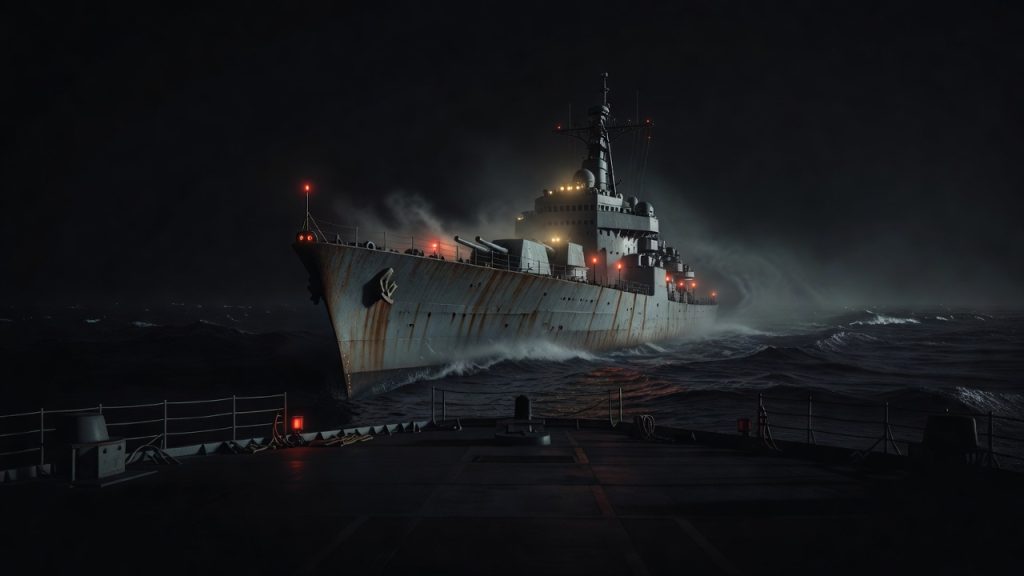
Before sunrise off San Diego, the destroyer moved through a cloud nobody on the evening news was ever meant to see. The bow cut into Pacific air while a turbine disseminator fed a chemical simulant forward into the ship’s path, wrapping steel, vents, and sailors in a rehearsal for an attack that had not happened. The Cold War loved euphemisms. Purple Sage was one of them. Beneath the soft codename sat a hard question: when the Navy practiced surviving a nerve-agent strike at sea, how much of the experiment was about protecting a ship — and how much was about testing what a crew could endure inside secrecy?
The Case For
The chemical was real, the test was real, and the purpose was explicit.
The strongest reason to take methylacetoacetate seriously is that the Pentagon eventually identified it by name. In the Defense Department’s official Purple Sage fact sheet, methylacetoacetate is listed as the chemical warfare test agent used as a sarin nerve-agent simulant. The same document says Purple Sage ran from January 5 through February 3, 1966, in the Pacific off San Diego, and that the USS Herbert J. Thomas was enveloped by a test cloud released through a turbine disseminator mounted on the bow.
That matters because it moves the story out of rumor and into the record. This was not a secondhand tale from late-night radio. It was part of Project SHAD, the shipboard branch of Project 112, a Defense Department effort designed to measure how vulnerable U.S. warships were to chemical and biological attack while maintaining operational capability.
Methylacetoacetate was part of a larger Cold War testing logic.
A 2016 National Academies review of SHAD states that Purple Sage consisted of 21 trials using methylacetoacetate to simulate envelopment of the test ship by sarin. That same annex notes that methylacetoacetate also appeared in earlier SHAD operations such as Flower Drum I and High Low. In other words, the compound was not a one-off improvisation. It sat inside a repeatable doctrine: use a stand-in chemical, replicate an attack profile, and study what happens to the ship and the people inside it.
The Purple Sage fact sheet says the primary objective was to evaluate the experimental Shipboard Toxicological Operational Protection System, or STOPS, against a gaseous chemical attack under operational conditions. A second objective was even more revealing. The test also measured the effect of wearing MK5 or M17 protective masks for four hours on the operational efficiency of the crew. That turns methylacetoacetate into more than a technical detail. It became the vehicle for a human performance trial conducted aboard an active destroyer under classified conditions.
Seen that way, the conspiratorial edge is not that the government hid some imaginary wonder-chemical. It is that military planners normalized a system in which real crews were placed inside exposure scenarios to generate readiness data. The euphemism “simulant” softens the atmosphere, but the scenario being modeled was a sarin-style nerve-agent attack. The chemical may not have been sarin. The doctrine orbiting it absolutely was.
The Realist’s Eye
A sarin simulant is not sarin, and the record does not prove catastrophic harm.
This is where the story has to stay disciplined. The same Defense Department fact sheet that makes Purple Sage undeniable also limits what can honestly be claimed. It describes methylacetoacetate as a simulant, not a live nerve agent. It lists the likely health effects as low to moderate irritation to the eyes, skin, and respiratory tract, along with possible gastrointestinal irritation. It also says EPA did not consider it a hazardous material and did not identify it as a known carcinogen.
That does not erase the ethical problem. It does mean there is a real difference between “the Navy tested a sarin simulant in a classified readiness program” and “the Navy secretly attacked its own sailors with sarin.” The first claim is documented. The second is not.
The secrecy is documented. The long-term medical case is murkier.
The Veterans Administration says the Department of Defense only began declassifying and sharing Project 112 and SHAD information with VA in 2000, decades after the tests took place. That delay is one reason suspicion still clings to the program. When records surface forty years late, trust does not arrive with them.
But late disclosure is not the same thing as proof of a hidden casualty scandal. VA’s own Project SHAD research page says there is no clear evidence of specific long-term health effects associated with participation in SHAD, while also continuing to study the issue. Congress still recognized the fog around the program. In House Report 108-213, lawmakers supported VA care eligibility for SHAD veterans without requiring them to prove a direct service connection for every illness. That is not a declaration that methylacetoacetate caused a known epidemic of injury. It is an admission that the government’s secrecy and recordkeeping left veterans carrying uncertainty they did not consent to create. If you want the broader pattern, the site’s government secrets archive shows just how often Cold War readiness programs stayed buried until veterans forced disclosure.
So the realist tension remains. Methylacetoacetate may have been chosen precisely because it was less dangerous than sarin. But the deeper issue was procedural, not chemical: who approved putting service members into classified exposure drills, what they were told, and why the public learned the details only after the Cold War was over. The compound itself may be mundane. The doctrine behind its use is not.
What We Know For Certain
- Purple Sage was an official Project SHAD test, designated 66-5, conducted from January 5 to February 3, 1966, off San Diego.
- The USS Herbert J. Thomas participated, and the testing organization was the U.S. Army Deseret Test Center.
- Methylacetoacetate was identified in official Defense Department records as a sarin nerve-agent simulant.
- The simulant was dispersed through a turbine disseminator on the bow of the ship to envelop the vessel in a test cloud.
- Purple Sage also evaluated the effect of four hours of protective-mask use on crew efficiency.
The Unanswered Questions
- What briefings did the crew receive about methylacetoacetate and the exact purpose of Purple Sage before trials began?
- Where are the full operational-performance results from the four-hour mask trials, and how much remains redacted or missing?
- Why was methylacetoacetate reused across multiple SHAD-related scenarios rather than confined to a single validation test?
- How did military planners decide what counted as acceptable risk when sailors became part of classified readiness experiments?
The Closer — You Decide
Methylacetoacetate does not sound like the stuff of legend. That may be exactly why it matters. Quiet chemicals, bland fact sheets, and delayed disclosures are how the Cold War often hid in plain sight. The surviving documents show a Navy destroyer rehearsing survival inside a simulated nerve-agent scenario, with sailors expected to keep functioning while the data rolled in. Maybe that was prudent defense planning. Maybe it was a line crossed under the cover of urgency and classification. The record is real. The tension is real. The evidence is on the table. You decide.


