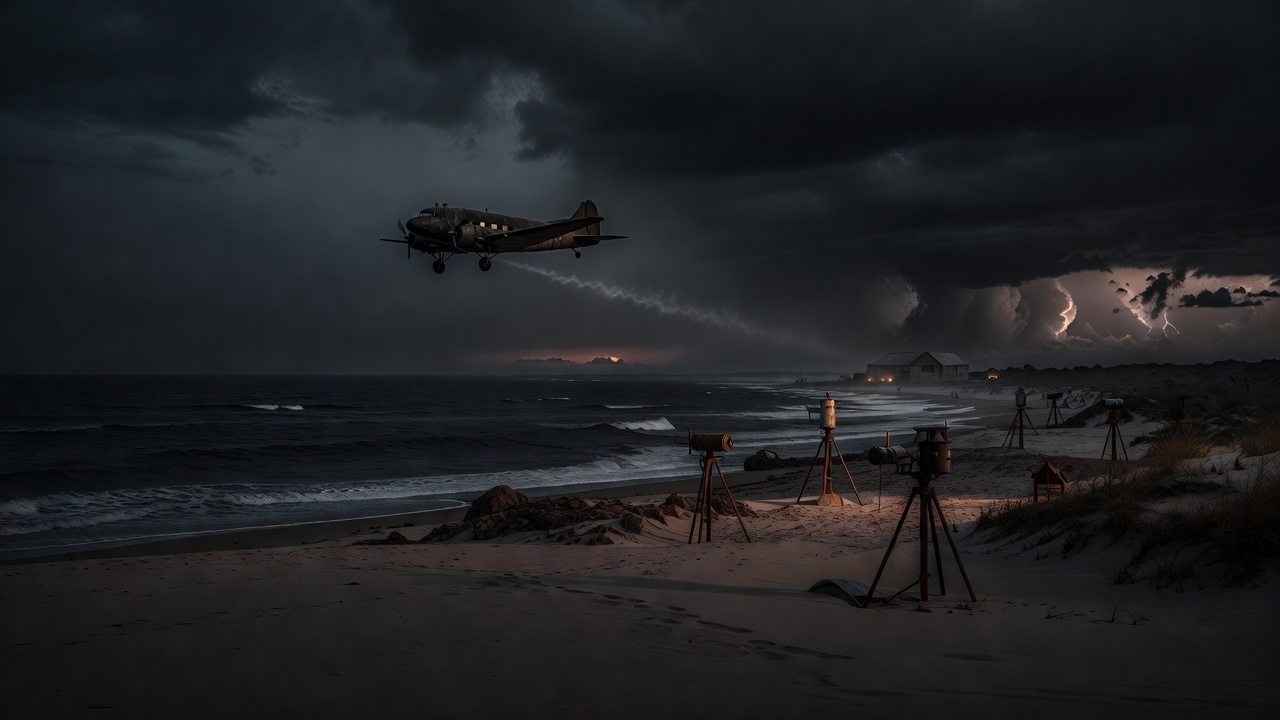
Some Cold War files read like confessions. Others read like math homework with a body count missing. In August 1957, an Army Biological Labs memo reduced an invisible cloud to variables: first arrival, peak recovery, cessation. But behind that bloodless vocabulary sat a much colder question. If an aerosol cloud was released and rode the wind inland, how well could the Army predict when it would arrive, how strong it would hit, and when it would finally pass? Operation Dew II did not test a warhead over a city. It tested the timing logic that could make one thinkable.
The Case For
A cloud-tracking memo that looked past the shoreline
The strongest case for taking Operation Dew II seriously begins with the public record itself. Appendix B of the National Research Council’s 1997 report Toxicologic Assessment of the Army’s Zinc Cadmium Sulfide Dispersion Tests identifies Operation DEW II as a Camp Detrick program involving fluorescent particles and Lycopodium spores released from an aircraft. The same appendix ties Dew I to Dugway Special Report 162 and identifies Dew II with Dugway Special Report 179, titled An Experimental Study of Long Range Aerosol Cloud Travel Involving Ground Deposition of Biological Spore Material, dated June 1, 1953. That matters because Dew II was not framed as a local curiosity. It sat inside a formal effort to understand long-range aerosol cloud travel in operational terms. The National Academies text is available through the NCBI Bookshelf version of Appendix B.
The later 1957 memo deepens that picture. In Relationship Between Times of Arrival of Cloud, Peak Recovery and Cessation for Operation Dew II, Army Biological Labs author Victor S. Palmer wrote that the Dew II cloud-travel data appeared to show relationships similar to those already observed in radiological fallout studies. The memo did not treat the aerosol as a vague atmospheric phenomenon. It tried to express the time of peak recovery and the time of cessation as functions of the cloud’s first arrival. In plain English, the Army wanted predictive timing rules: if the front edge of a cloud reached a point at a certain hour, how long until the strongest concentration arrived, and how long until the cloud was effectively gone?
The method section makes the military logic even clearer. Palmer noted that the available Dew II data came from rough files in the Meteorology Branch because the sequential sampling data were not contained in the published report. Samplers were changed only at two-hour intervals, dissemination lasted roughly 30 to 40 minutes, and the report acknowledged a possible timing error approaching two hours. Even with those limits, the memo found the pattern useful enough to recommend the same kind of analysis for Operation LAC’s continental aerosol trials. That recommendation appears in the FOIA-released document now publicly hosted by The Black Vault’s copy of the Dew II memorandum.
If Dew I asked whether a cloud could come ashore, Dew II asked whether its behavior could be predicted well enough to make large-area dispersion planning more precise. That is why the memo matters. It suggests the Army was moving from demonstration to forecasting.
The Realist’s Eye
Important evidence, but not a complete smoking gun
The memo is real. The Dew II operation is real. The predictive ambition is real. But none of that means every darker conclusion attached to Dew II is automatically proved.
First, the evidentiary chain is incomplete. The National Research Council noted that Dew II corresponded to Dugway Special Report 179, a classified document not available to the NRC in the open record it summarized. What we have in public today is a later technical memorandum built from operational data, not the entire original Dew II file. That leaves room for caution. A surviving analytic memo can reveal what researchers cared about without preserving every detail about test design, command intent, or possible downstream consequences.
Second, the memo itself admits its own limitations. Palmer said the Dew II sampling had poor time resolution because filters were changed only every two hours. He also noted that dissemination occurred over a 30-to-40-minute window, making exact arrival and peak times difficult to pin down. Some observed scatter, he wrote, might reflect the weakness of the sampling rather than the cloud’s true behavior. In other words, this was not a perfect predictive machine. It was a rough Cold War attempt to build one.
Third, there is a temptation to overread the technical language. The fact that Army analysts compared aerosol timing to radiological fallout does not prove a hidden plan to attack U.S. civilians. It shows intellectual borrowing from one field of contamination modeling to another. The implication is serious enough without exaggeration: planners wanted a better mathematical handle on how an aerosol cloud moved after release.
And then there is the health question. The 1997 NRC review concluded that estimated ZnCdS exposures from the Army’s tracer tests were unlikely to have caused adverse health effects at the recorded levels, though critics have long challenged the assumptions behind those reconstructions. That tension belongs here. Dew II can be a genuine window into secret Cold War aerosol planning without becoming a fully documented mass-harm event on the evidence currently public.
So the realist position holds the line. Dew II was not nothing. But the cleanest proof we have today supports a narrower, still unsettling claim: the Army refined timing models for long-range aerosol clouds and expected that work to inform later large-area dispersion programs, including the earlier Operation Dew coastal tests and follow-on studies.
What We Know For Certain
- Operation DEW II is identified in the National Research Council’s 1997 ZnCdS report as an aircraft-based release involving fluorescent particles and Lycopodium spores.
- The NRC linked Dew II to Dugway Special Report 179, dated June 1, 1953.
- A 1957 Army Biological Labs memorandum by Victor S. Palmer analyzed Dew II cloud data in terms of first arrival, peak recovery, and cessation.
- The memo stated that Dew II showed timing relationships similar to those studied in radiological fallout analysis.
- The memo recommended applying a similar analytical approach to Operation LAC when those recovery data became available.
The Unanswered Questions
- How much of Dugway Special Report 179 remains unavailable in public archives, and what details would it add to the Dew II record?
- Why were the published Dew II materials missing the sequential sampling data Palmer said still existed in rough Meteorology Branch files?
- How heavily did Dew II’s cloud-timing formulas influence later large-area aerosol planning beyond the recommendation to use them on Operation LAC?
- What internal debates, if any, took place over the reliability of two-hour sampling intervals for a test meant to build predictive models?
The Closer — You Decide
Not every secret announces itself with redactions and blacked-out pages. Sometimes it survives as a technical memo, tidy and clinical, quietly turning an invisible cloud into a timetable. That is what makes Dew II linger. The Army was not just watching whether a tracer drifted. It was learning when a cloud would arrive, when it would hit hardest, and how long it would stay over the map. The formulas are real. The question they served is real too. The evidence is on the table. You decide.